Quick answer: Virtual Results built AI voice narration for real estate websites with a small team, recent AI coding tools, and servers we own. Every narrated listing description or blog post gets a content fingerprint, so identical text is voiced once and reused, and the audio is served separately so pages stay fast. It’s live on select Virtual Results agent websites as an optional add-on at an expected $25–$50 a month.
Big publishers have been reading their articles aloud for years. The New York Times, The Wall Street Journal, and The New Yorker all offer automated narration, and about 20% of New Yorker subscribers now listen to stories instead of reading them (Columbia Journalism Review, 2026). Real estate websites, for the most part, stayed quiet.
We wanted to change that without a giant budget. This is the behind-the-scenes story of how a small, independent team built text-to-speech for real estate websites: what the pieces are, why we made the choices we did, and where a human still has the final say. Some of it gets technical. We’ve tried to keep it readable anyway.
Tap Listen. This is the real thing.
Two narrations created automatically on a live agent website. Nobody recorded a word.
Try it yourself
2117 5 Avenue, Harlem
4 Family, plus 6 SRO’s, a total of 10 apartments with a yearly income of $252,000 and ideally situated in the lively central side of Harlem! This professionally curated space offers a perfect blend of contemporary comfort and convenience. Enjoy modern amenities, a prime location.
Saved example from Keller New York. Listing courtesy of Keller Williams Realty NYC Grp.
Your Dream Kitchen Could Be a Very Expensive Gift to the Next Owner
You pay for the renovation. They get the Sunday breakfasts. The resale math makes that arrangement even less appetizing.
Saved example from the Keller New York blog.
What problem were we trying to solve?

Most AI in real estate tech is built for the agent’s side of the desk: lead scoring, CRM follow-up, ad targeting, writing help. We wanted to point AI at the other side of the screen, at the buyers and sellers who actually use our members’ websites, and make it run like marketing automation for the agent.
Readers increasingly want to listen. The Reuters Institute found that 75% of 326 news leaders were exploring turning text articles into audio (Reuters Institute, 2025). Large publisher sites have this feature. Agent websites rarely do, and we thought that gap was worth closing.
The publisher numbers are hard to ignore. The Wall Street Journal’s “Read to Me” feature has been used about 5 million times, with a 65% completion rate (CJR, 2026). Norway’s Aftenposten reported that its AI-voiced listeners averaged 42, roughly ten years younger than its typical reader, with 58% completion (Press Gazette, 2023). Even the BBC built its own synthetic voice to read articles aloud (NPR, 2020).
House-hunting is a lot like reading the news on the go. Clients scroll listings in the car line, on the treadmill, or while making dinner. Some people simply process information better by ear. The W3C describes text-to-speech as “essential for some, useful for all” (W3C WAI), and our narration works alongside screen readers rather than replacing them. We wrote more about the reader side in why AI voice narration matters.
How does AI narration work, from text to Listen button?
Here’s how AI narration works on our sites, in five steps. Text goes in, gets a fingerprint, becomes an audio file, and plays from a separate audio server. The files are compact: our demo narrations are 64 kbps mono MP3s at 24 kHz, so an 8-minute-23-second blog post is about 3.6 MB (Virtual Results demo files, 2026).
- Text in. We take the listing description or blog post text that a visitor would read on the page.
- Fingerprint. That exact text gets a content hash, a unique code that identifies those words and only those words.
- Audio file. A natural-sounding AI voice reads the text, and the resulting MP3 is named by its fingerprint.
- Served separately. The file lives on its own audio subdomain, apart from the website pages.
- Listen button. A visitor taps Listen, and a progress timeline shows where they are in the recording.
On the website, the Listen button appears beside the Description on qualifying Active featured and exclusive listings, and in the listing preview pop-up. On blog posts, it sits next to the reading-time estimate. Keller New York’s site is a live example: try the Listen button on this kitchen renovation post. For listeners there’s no app and no extra download, though a free account signup may be required.
Why serve audio from a separate place? Website pages are cached so they load quickly. If audio files were tangled up with those pages, every new recording could interfere with that caching. Keeping them apart means pages stay fast and the audio simply loads when someone asks for it. There’s a fuller product overview in our guide to AI voice narration on real estate agent websites.
What is content hashing, in plain English?
Content hashing gives every piece of text a barcode for words. The narration for that Keller New York post lives in a file named by a 64-character fingerprint, f933de9f…6704d6, the length of a SHA-256 hash (Virtual Results narration files, 2026). Change one word, and the barcode changes completely.
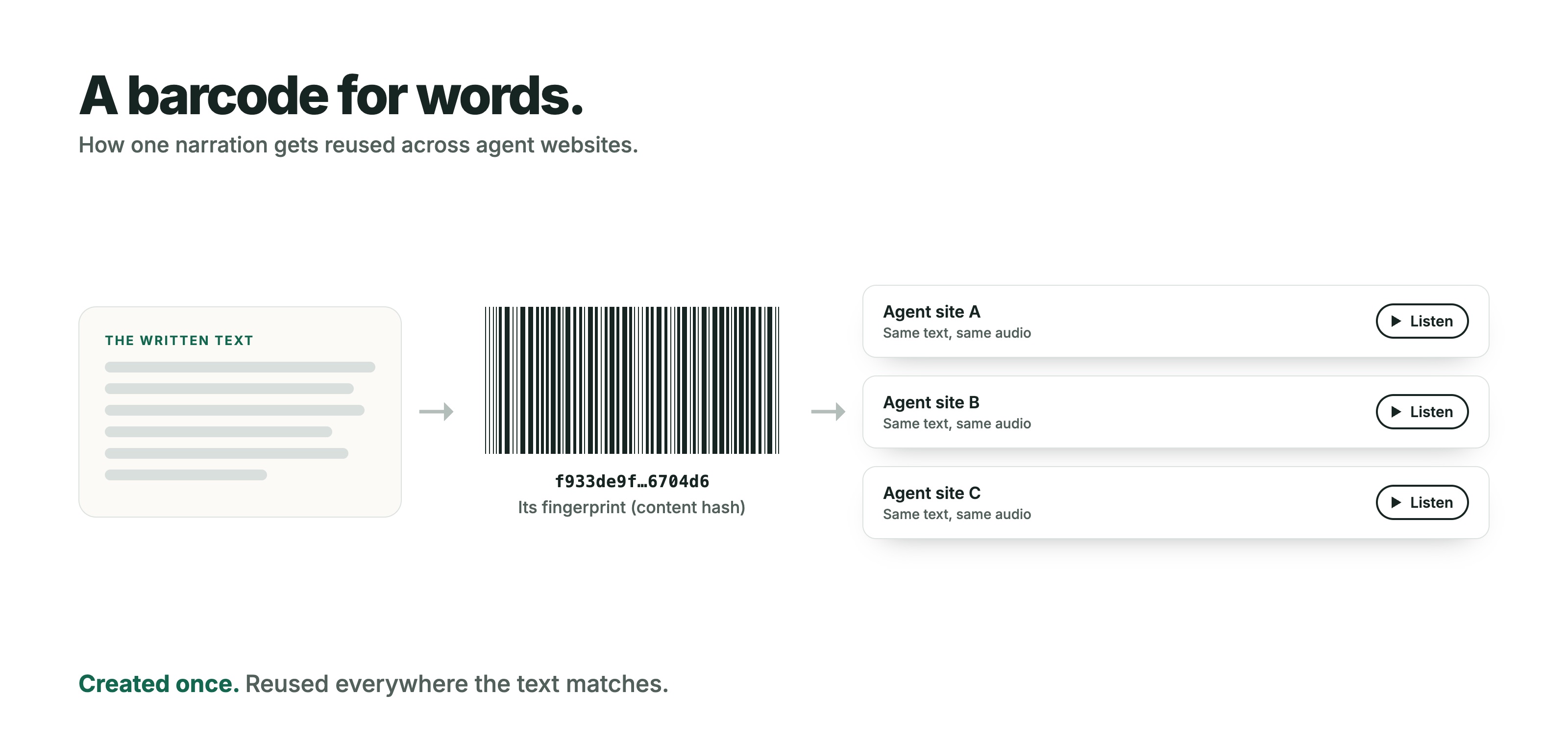
That barcode does two useful jobs. First, it tells us instantly whether text has changed. If the fingerprint matches what we already have, there’s nothing new to record. If it doesn’t, we know fresh audio is needed. No guessing, no comparing paragraphs by hand.
Second, it lets us reuse work. Real estate content repeats more than you might expect. When identical text appears on another agent’s website, the matching fingerprint points to audio that already exists, so we reuse it instead of generating it again. That’s why the system gets more efficient as more agents join: each new member adds content, and some of it has already been voiced.
Here’s the full fingerprint, if you’re curious what one looks like: f933de9fbe147513ea195dc12d21ccc4a8dc01804f5955764278d0e06d6704d6. It isn’t pretty. It doesn’t need to be. Its only job is to be unique to those exact words.
Why does narration wait two hours after an edit?
Narration updates itself, but it waits for the dust to settle. Any edit starts a two-hour timer, another edit restarts it, and fresh audio generates after two quiet hours. A 34-second listing description produces only about 244 KB of audio (Virtual Results demo files, 2026), but regenerating after every typo fix would still be wasteful.
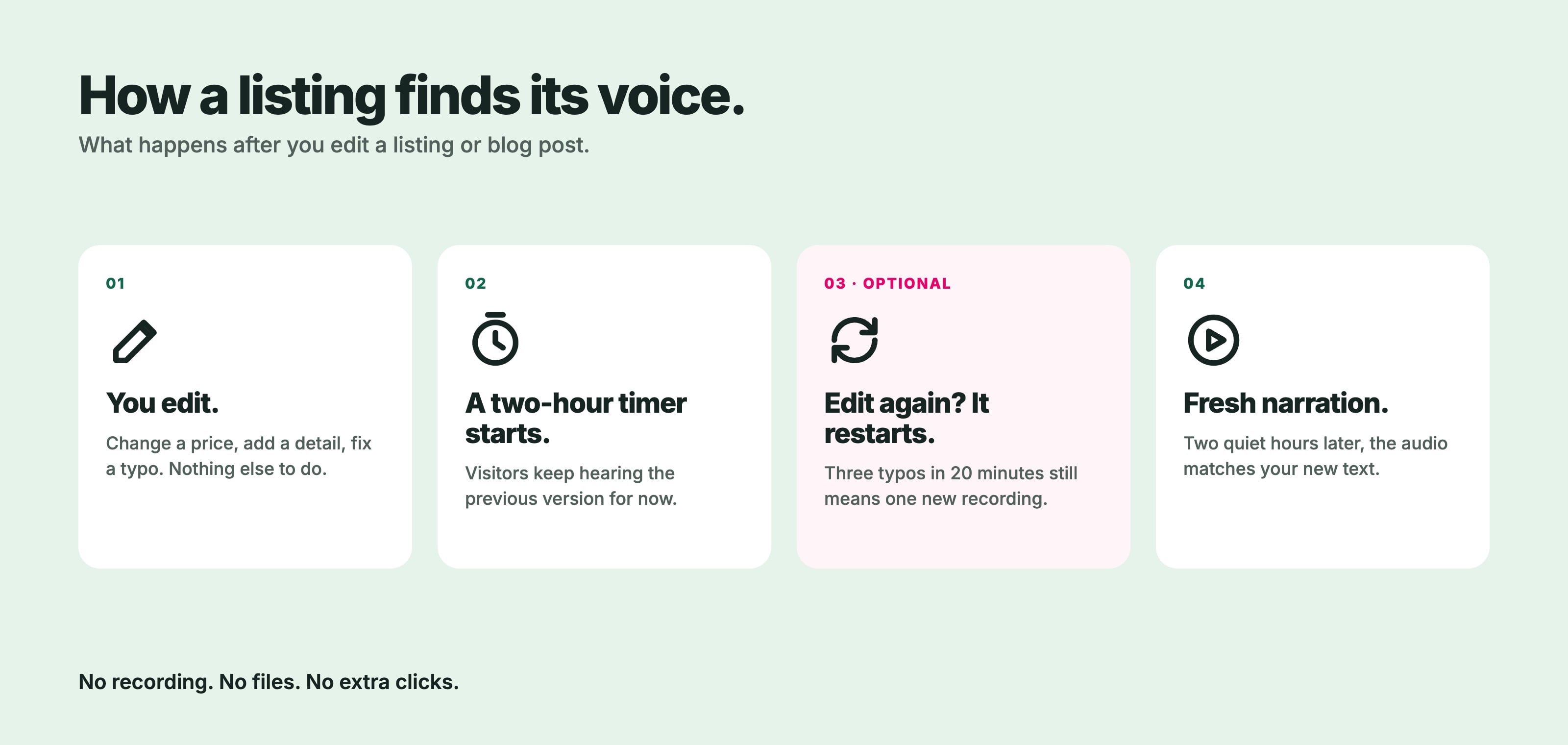
Think about how people actually edit. An agent updates a price, notices a typo, fixes the square footage, then tweaks the opening line. That’s four edits in ten minutes. Without a timer, we’d record four versions, and three of them would be thrown away almost immediately.
During the waiting window, visitors hear the previous version. For most edits, that’s a fine trade. The older narration is usually nearly identical, and the new one arrives once things have been quiet for a couple of hours. A short delay beats paying for recordings nobody will ever hear.
One honest limit: AI voices can stumble on unusual street names and local place names. We recommend a quick spot-check after new audio generates, especially on listings. Our step-by-step guide to using voice narration covers what to listen for.
Why does owning our hardware matter now?
Owning the machines is a big reason the price stays at an expected $25–$50 a month. Virtual Results moved off rented cloud servers onto its own hardware years ago. Since then, AI demand has squeezed hardware supply and pricing worldwide, which made that earlier decision look a lot smarter than it felt at the time.
Rented infrastructure is convenient until the bill arrives. Audio generation and storage are steady, ongoing work, and steady work is exactly where owning beats renting. Because we already had the hardware, we didn’t have to price this feature around someone else’s rate card. For real estate agent websites, it’s the first we’re aware of at this price point.
“Most agents gave up on this kind of technology years ago. They figured it belonged to the national brands with the giant budgets. We didn’t accept that. Now the solo agent working from her kitchen table gets the same tech as the biggest names in real estate — for less than her phone bill.”
— Ryan Rockwood, President, Virtual Results
What did AI coding tools change for a small team?
AI coding tools changed how fast a small team can move from idea to working feature. Virtual Results built narration with help from recent AI coding tools, including OpenAI’s Codex. The Reuters Institute’s finding that 75% of news leaders are exploring audio (Reuters Institute, 2025) shows the appetite; the tools helped a boutique team act on it.
What did that look like day to day? Tools like these help with drafting routine code and working through the tedious parts that used to eat whole afternoons. That frees people to spend more time on the decisions that matter: where the button goes, how long to wait after an edit, and what happens when something fails.
The tools didn’t design the feature, and they didn’t ship it. People decided how fingerprinting should work, reviewed the code, and listened to the output. In our experience, AI coding help is a bit like a fast, eager junior developer: genuinely helpful, occasionally confidently wrong, and always worth a second look. That review step is the part we’d never skip.
What would we tell other builders, and what’s next?
Our advice to other builders is simple: fingerprint first, keep heavy files separate, and wait for edits to settle. Those three choices did most of the work. They’re also why AI voice narration for real estate websites can run on modest, owned hardware instead of an enormous cloud bill (Virtual Results, 2026).
- Identify content by what it says. Content hashing makes caching, reuse, and change detection almost automatic.
- Protect page speed. Serve audio from its own subdomain so it never slows down the pages people came for.
- Debounce human behavior. People edit in bursts. A quiet-period timer saves a surprising amount of wasted work.
- Keep a human in the loop. Natural-sounding AI voice doesn’t mean perfect pronunciation. Spot-check.
As for what’s next, we’re logging feature requests as they come in. Ideas like additional voices and languages go on that list. We’re not promising dates or specifics, but that list does shape what we build.
If you’re a member and want to try it, here’s how it works. AI voice narration for real estate websites is an optional add-on. Your account team activates it first, and then you toggle “Activate” on the voice narration option in your website settings. The option won’t appear before activation, so don’t worry if you can’t find it yet.
Curious whether narration fits your site? Talk to your Virtual Results account team, and we’ll walk you through how it would work on your Active featured and exclusive listings and blog. You can also read the full voice narration overview first.
Keep reading
- AI voice narration for real estate websites: features, pricing and a live demo
- AI voice narration for real estate websites is here
- The accessibility angle: what text-to-speech can and can’t do
- How to use text-to-speech on your real estate website
Sources and further reading
- Columbia Journalism Review: All the news while doing the dishes (2026)
- Reuters Institute: Journalism, Media, and Technology Trends and Predictions 2025
- Press Gazette: Aftenposten’s AI voice reaches new audiences (2023)
- NPR: BBC launches AI tool to read its articles to listeners (2020)
- W3C WAI: Text to Speech, essential for some, useful for all
- Keller New York: live narration example