Quick answer: Most real estate AI serves agents behind the scenes; AI voice narration serves the buyers and sellers on your website. It matters because it gives them another way to take in listings and blog posts, by listening. Text-to-speech is, in the W3C’s words, “essential for some, useful for all”: vital for many people with low vision or dyslexia, and handy for anyone driving, cooking or tired of reading. It’s rare on real estate sites, which is exactly why it stands out.
You’ve seen those national-brand real estate websites. Slick features, advanced tools, and a level of polish that makes most agent sites look like they’re running a few years behind. And somewhere along the way, you probably made peace with it. That stuff is for the big players, not for me.
Here’s the thing. It should be for you. It is now.
AI voice narration for real estate agent websites is a clear example of what changes when a company stops accepting the status quo. Until now, letting visitors listen to your listings and blog posts was something you’d find almost exclusively on large publisher sites and enterprise platforms with dedicated engineering budgets. It’s now live on select Virtual Results agent websites for an expected $25–$50 a month — and as far as we’re aware, that’s a first for individual agent websites at this price point.
Tap Listen. This is the real thing.
Two narrations created automatically on a live agent website. Nobody recorded a word.
Try it yourself
2117 5 Avenue, Harlem
4 Family, plus 6 SRO’s, a total of 10 apartments with a yearly income of $252,000 and ideally situated in the lively central side of Harlem! This professionally curated space offers a perfect blend of contemporary comfort and convenience. Enjoy modern amenities, a prime location.
Saved example from Keller New York. Listing courtesy of Keller Williams Realty NYC Grp.
Your Dream Kitchen Could Be a Very Expensive Gift to the Next Owner
You pay for the renovation. They get the Sunday breakfasts. The resale math makes that arrangement even less appetizing.
Saved example from the Keller New York blog.
This post isn’t about how to use the Listen button. It’s about why it matters that you can. (For setup, see how to use text-to-speech on your real estate website.) Here’s what we’ll cover:
- Why the tech gap between national brands and independent agents has lasted so long
- What changes when enterprise-level features are built to fit your actual budget
- Why accessibility turns this from a nice feature into something with real weight
- How a shared-fingerprint system makes the whole network stronger as more agents join
- Why owning our own infrastructure keeps your monthly cost where it should be
- What we’d like to see the rest of the industry do next
AI for the people who use your website
Ask what AI is doing in real estate and most answers live behind the scenes: lead scoring, CRM follow-up, ad targeting, listing description drafts. All of it helps the agent. Very little of it helps the buyer or seller actually using the agent’s website.
Voice narration flips that. It puts AI on the front end, where your clients can use it, and it runs like marketing automation for you: no recording, no files, audio that refreshes itself when you edit. That combination is uncommon on agent websites, which is a big part of why it stands out.
The Tech Gap Between Big Brands and Independent Agents Is Real
You’re not imagining it. The playing field has been tilted for a long time, and it wasn’t by accident.
How the big players ended up with better tools
National brands carry massive budgets, in-house engineering teams, and multi-year product roadmaps. When a powerful new website feature arrives, they absorb the cost, test it, and roll it out across thousands of pages. Independent agents, boutique brokers, and niche teams — the specialists, the neighborhood experts, the people actually doing the work — get left waiting for a watered-down version that may never arrive.
Why most agents stopped expecting more
Over time, something shifts. Agents stop expecting much from their websites because they’ve been burned enough times. Enterprise features come with enterprise pricing, custom quotes, and sales conversations that go nowhere. The gap doesn’t close. It just becomes the accepted cost of being independent.
That acceptance is exactly what Virtual Results was built to reject. Real estate professionals are not a commodity audience that fits neatly into a SaaS template. Agents have unique niches, specialties, client bases, and ways of doing business that a one-size-fits-all website platform simply cannot serve well. The tools should bend to the agent, not the other way around.
The takeaway: The gap was never about talent or effort. It was about budget and about who the tools were built for. That’s what this launch directly addresses.
What Changes When Enterprise-Level Tech Fits Your Budget
Your listings deserve the same caliber of experience as any national brand’s — without the national-brand invoice.
Your site competes at a higher level

When a visitor lands on your listing and finds a clean Listen button beside the property description, it sends a signal. Your website is current, thoughtful, and designed around your client’s experience. It puts you on equal footing — technologically — with the biggest names in real estate.
Available to agents, brokers, and teams anywhere in the U.S. No enterprise contract and no drawn-out sales process. One quick call with your account team, and they’ll tell you what to expect based on your listing volume.
A scenario worth sitting with
Two buyers are relocating from out of state. One is browsing a national brand’s website. The other found you. Both are squeezing in house-hunting during a lunch break, eyes tired after a morning of spreadsheets.
On the national brand’s site, they get what they expect: photos, a description, and a lot of reading. On yours, they can do more. They tap Listen and hear the listing — a feature that’s rare in real estate and usually found on large enterprise websites, like major news and media publishers. (Columbia Journalism Review reports The Wall Street Journal’s “Read to Me” audio has about 5 million uses and a 65% completion rate.) And your buyer also gets you: a local expert who actually knows the market, picks up the phone, and is invested in their outcome.
A feature they didn’t expect gets you noticed. Your expertise wins the client.
Do clients actually care?
Not every visitor will tap Listen. But the ones who do — multitaskers, commuters, long-distance relocators, anyone whose eyes are done for the day — will remember the site that made the process a little easier. That’s not nothing.
The takeaway: Match the big brands on features, and you win on what you were always going to win on: relationship, expertise, and service.
Why Accessibility Makes This Bigger Than a Feature
This is the part that deserves more than a passing mention.
The standard that matters
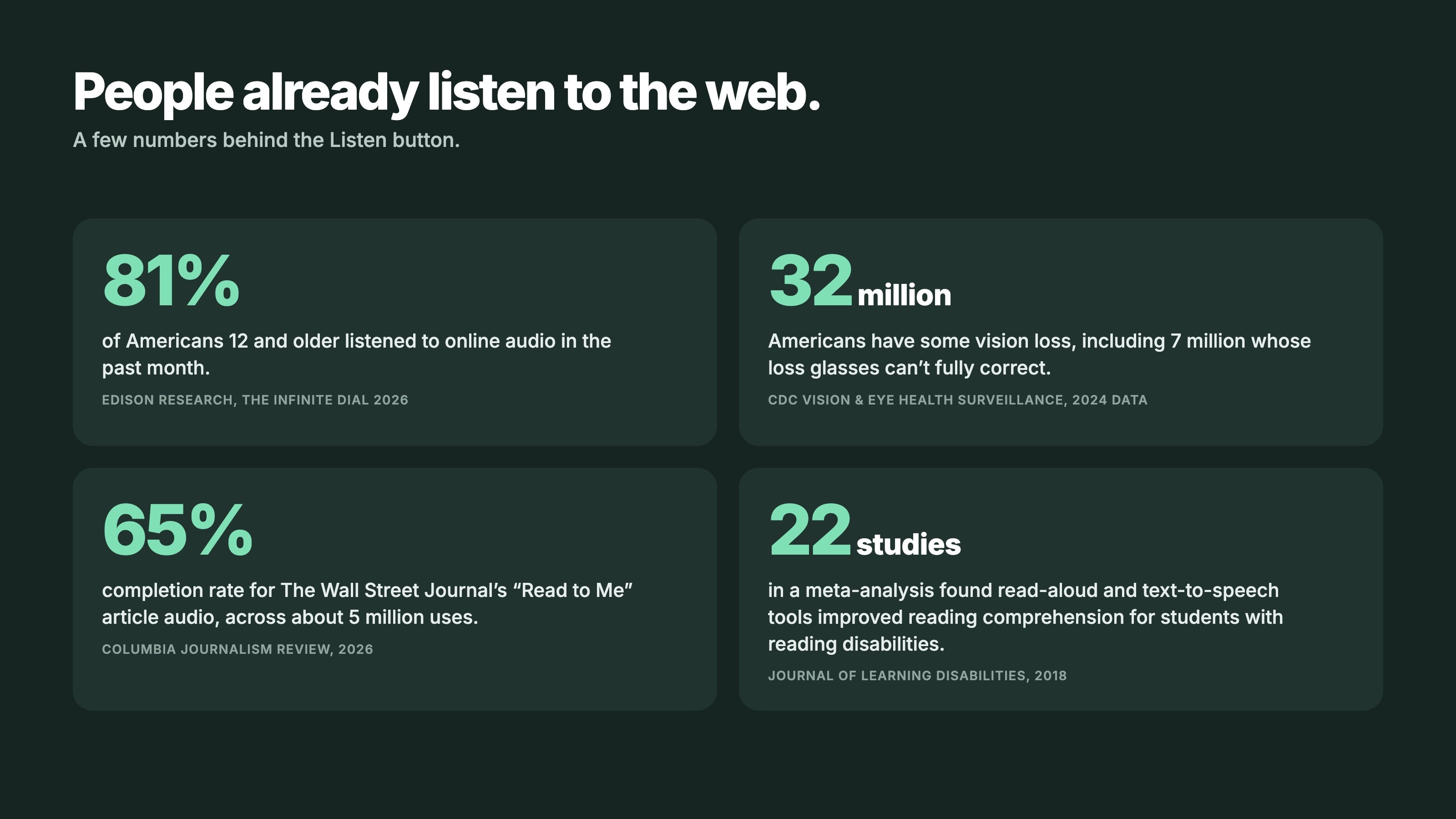
The W3C’s Web Accessibility Initiative — the organization that sets the standards for how the web should work — describes text-to-speech in one sentence: it’s “essential for some, useful for all.”
That framing is deliberate. Audio access can make content meaningfully easier to use for:
- People who are blind or have partial sight
- People with dyslexia and other cognitive or learning disabilities who benefit from hearing and seeing content together
- People who have difficulty reading written language
- Anyone who simply prefers to listen — while driving, exercising, or just taking a break from the screen
That last group is broader than most people assume. An accessibility feature that every visitor can use is good design, full stop.
The numbers back that up. Around 32 million Americans have some vision loss, according to the CDC. A meta-analysis of 22 studies found read-aloud and text-to-speech tools improved reading comprehension for students with reading disabilities. And listening is already a habit: 81% of Americans 12 and older listened to online audio in the past month.
Why real estate specifically
Buying or selling a home is among the most consequential decisions most people ever make. If a visitor can’t easily read your listing, they’re cut off from information they genuinely need. Giving them another way in isn’t a courtesy feature. It’s the right thing to do.
Being honest about what narration does
AI voice narration adds another accessible way to experience your content. It works alongside tools people already use — screen readers and other assistive technology — rather than replacing them. On its own, it doesn’t bring a website into full compliance with accessibility standards, since that depends on the whole site.
What it does is take a real step forward. And every step has weight.
The takeaway: Some visitors need audio to use your site. Everyone else simply appreciates having the option. Both matter.
How Shared Fingerprints Make Every Agent Stronger
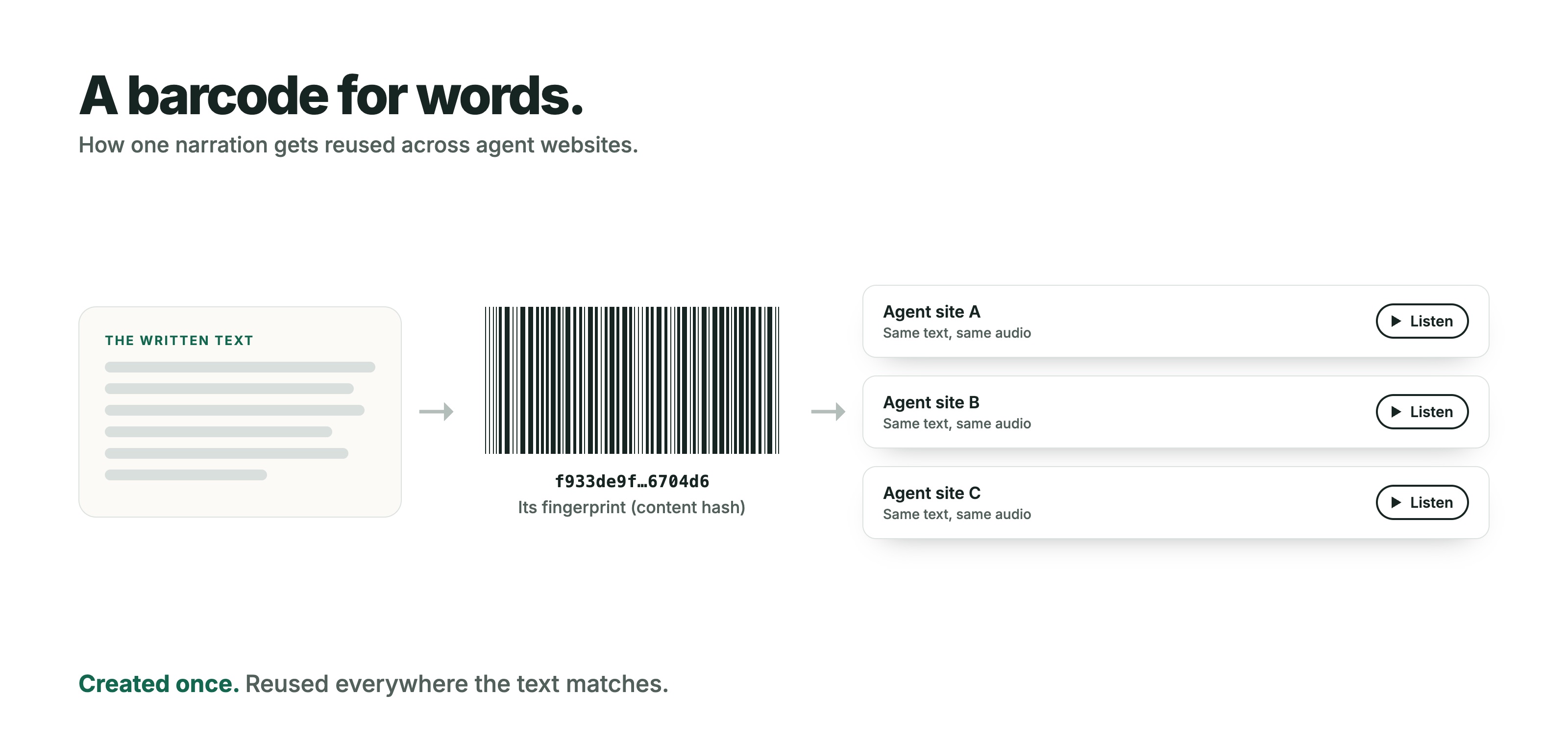
Here’s how the economics of this work — and why the model is different from anything most enterprise platforms offer.
Content hashing: a barcode for words
Every piece of narrated text gets its own unique digital fingerprint through a process called content hashing. Think of it as a barcode for words.
When identical text appears on more than one site — a shared blog post, the same listing displayed across several agents’ pages — the system recognizes the match and reuses the existing audio. It doesn’t generate new audio. It doesn’t charge twice.
A network that works in your favor
With a lot of software, every new user adds the same amount of new processing, so running costs climb in step with growth. This system works the other way. The more agents who use it, the more efficiently it runs for everyone. Shared audio means fewer unique files. Fewer unique files mean a leaner, more sustainable platform.
Your peers in the network aren’t your competition here. They’re keeping your costs down.
The takeaway: Every agent who turns on narration makes the system a bit more efficient for the next one.
Why Owning the Hardware Keeps Your Price Where It Is
This is a detail most companies leave out. We think it’s worth explaining because it’s directly connected to your monthly bill.
A strategic decision that paid off
Several years ago, Virtual Results made an unusual call: we moved off rented cloud infrastructure and onto hardware we own and operate ourselves. Most providers were moving in the opposite direction. We went the other way, because we believed it was the only path to delivering the level of resources and control our members actually deserve — long term.
Then AI came along and changed the economics of hardware worldwide. Demand surged. Costs climbed. The pressure on cloud providers — and on clients paying per-compute — became significant. Owning our infrastructure before that shift turned out to be the right call.
What it means for your price
Running narration on equipment we own, rather than paying ongoing cloud fees for every synthesis request, is a central reason the expected cost sits at roughly $25–$50 a month — depending on your listing volume.
A small, focused development team built and deployed this feature across thousands of pages using current AI coding tools, including OpenAI’s Codex. That’s the kind of output that used to require much larger teams and much larger budgets.
The takeaway: Infrastructure discipline upstream translates directly into pricing discipline for you.
A Challenge to the Rest of the Industry
We’ll say it plainly: we don’t want to be the only ones doing this.
Ryan Rockwood, President of Virtual Results, on why this launch matters:
“Most agents gave up on this kind of technology years ago. They figured it belonged to the national brands with the giant budgets. We didn’t accept that. Now the solo agent working from her kitchen table gets the same tech as the biggest names in real estate — for less than her phone bill.”
That’s the point. And it extends beyond one feature.
Raising the floor for everyone
The broader goal is to push the industry to rethink what’s acceptable. Accessible, capable website technology shouldn’t be gatekept by budget size. Real estate professionals who serve specific communities, niche markets, and specialized clients deserve tools built to match their work — not tools built for the median user of a platform designed around volume.
If this launch nudges other providers to do more for independent agents and brokers, that’s a win. Not just for our members, but for the profession.
What you can do right now
- Turn it on. Contact your Virtual Results account team, confirm pricing, and let your listings start working harder.
- Listen to your own pages. Especially any with street names or local landmarks the voice might handle awkwardly.
- Tell your clients. A simple “you can listen to any of my listings on the go” is all it takes to make the feature real for someone.
- Expect more from your tech partners. If a tool makes the web more accessible and your business more competitive, it should be within reach.
The takeaway: Every agent who raises the bar makes the rest of the industry justify why they haven’t.
Enterprise Power. Boutique Fit. Built for the Way You Work.
Real estate doesn’t fit a SaaS mold, and Virtual Results has never pretended it does. Agents have different specialties, different markets, different clients, and different ways of building their businesses. The technology should reflect that — flexible enough to fit your practice, powerful enough to compete with anyone.
AI voice narration is one more piece of that. Accessibility opens your content to a wider audience. Shared fingerprints make the platform stronger with every agent who joins. Owned infrastructure keeps the pricing honest. And the result is a feature that, until now, you were simply expected to do without.
That expectation is over.
Contact your Virtual Results account team today to confirm your pricing and turn on AI voice narration. Your clients deserve a website that works as hard as you do.
Keep reading
- AI voice narration for real estate websites: features, pricing and a live demo
- AI voice narration for real estate websites is here
- How to use text-to-speech on your real estate website
- The accessibility angle: what text-to-speech can and can’t do for real estate websites
- Behind the build: how we built AI voice narration
Sources and further reading
- W3C Web Accessibility Initiative: Text to Speech — “essential for some, useful for all”
- W3C: Web Content Accessibility Guidelines (WCAG) overview
- ADA.gov: the Department of Justice’s web accessibility guidance
- American Foundation for the Blind: screen readers
- CDC: vision loss prevalence in the U.S.
- Wood et al., Journal of Learning Disabilities: text-to-speech and reading comprehension (meta-analysis)
- Edison Research: The Infinite Dial 2026 — PDF
- Pew Research Center: podcasts and news fact sheet
- Reuters Institute Digital News Report 2025
- Columbia Journalism Review: how publishers adopted AI narration
- Press Gazette: Aftenposten’s AI-voiced articles reach younger listeners
- NPR: the BBC launches an AI voice to read its articles