Found Local: The Real Estate SEO Playbook — Part 4 of 6
← Neighborhood Pages: How Agents Out-Rank Zillow on the Searches That Matter | How to Know Your Local SEO Is Working: The Metrics, Tools & Dashboard for Agents →
In this guide
- Why the foundation is what’s actually holding you back
- NAP consistency: one format, used everywhere
- The citation audit: a five-step workflow you can finish in a weekend
- Which citations actually matter (Tier 1, 2, and 3)
- Local links beat national links — every time
- Schema markup: handing Google a fact sheet about you
- Technical SEO that actually matters for agents
- Teams, brokerages, and multiple markets
- Your quarterly maintenance checklist
Here’s the uncomfortable truth about why a good agent gets stuck at position 5, 6, or 7 in the map pack: it’s almost never the thing they think it is.
It’s not that you need a flashier website or another blog post. It’s usually something boring. Your phone number is formatted three different ways across the web. Your old brokerage still lists you at an address you left two years ago. Google can’t quite tell whether “Jane Smith, Realtor” and “Jane Smith Real Estate Group” are the same business — so it hedges, and hedging looks like position 6.
This part of the series owns the unglamorous layer: consistent contact information, the right citations, local links, schema markup, and a fast, clean site. None of it shows up on a vision board. All of it removes the invisible friction that keeps deserving agents stuck. Get it right and the work you did in Parts 2 and 3 — your Google Business Profile and your neighborhood pages — finally gets the trust it earned. Let’s clear the foundation.
Why the foundation is what’s actually holding you back
Think of local ranking like a credit score. Reviews and content are the income that grows your standing over time. But inconsistent contact information is a late payment that quietly drags the whole score down, no matter how much you earn.
Google’s local algorithm is fundamentally a trust machine. Before it puts you in front of a ready-to-transact buyer, it wants confidence that you’re a real, stable business at a real place. It builds that confidence by cross-referencing what it finds about you across dozens of sources: your Business Profile, Zillow, Realtor.com, your MLS directory, the chamber of commerce, your own website. When those sources agree, trust goes up. When they disagree, it goes down.
Most agents have disagreement everywhere and don’t know it. The fixes in this article won’t, by themselves, rocket you to number one; anyone who promises that is selling something. What they reliably do is remove a penalty. They take the brakes off the work that’s already good.
The agents stuck at position 5–7 usually don’t have a content problem. They have a consistency problem and a trust problem, and those are far easier to fix than they are to diagnose.
NAP consistency: one format, used everywhere
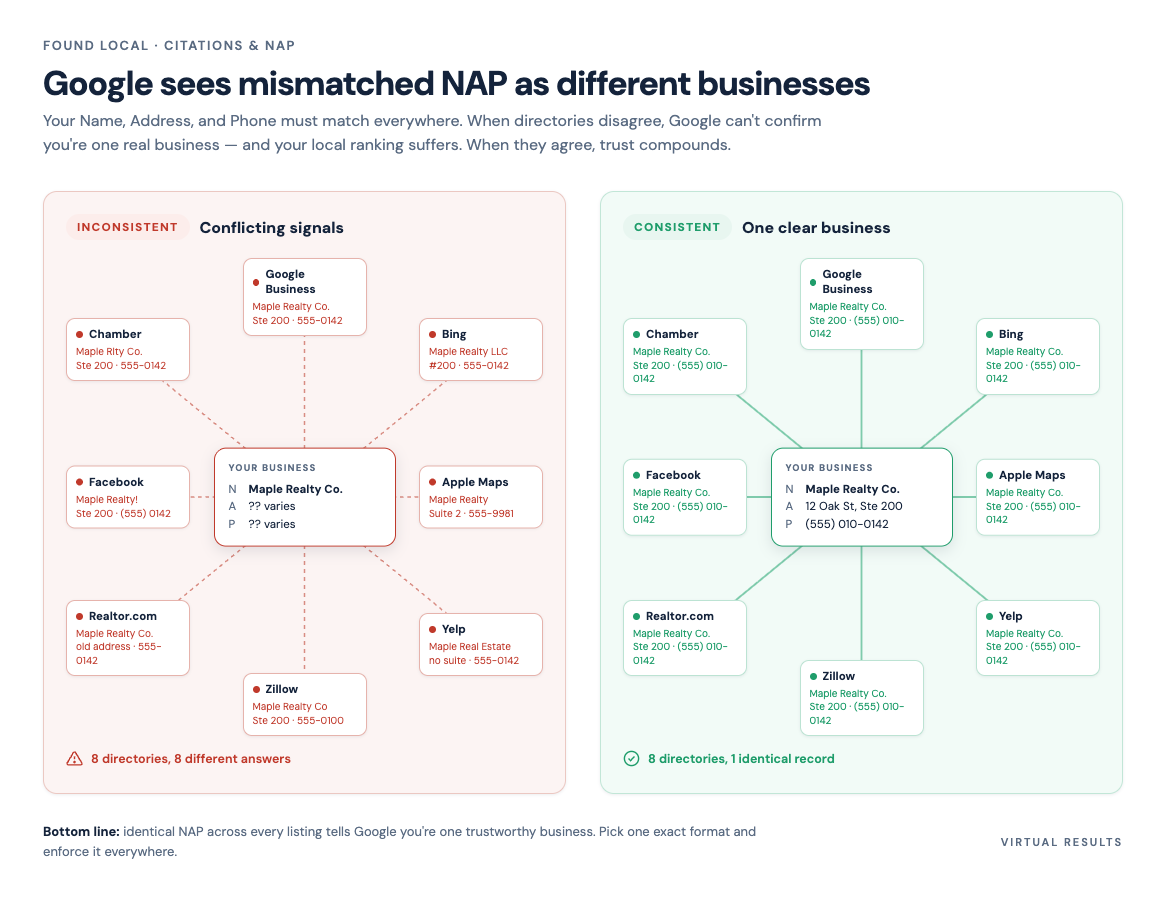
NAP stands for Name, Address, Phone: the three pieces of information that identify your business across the web. The rule is simple to state and tedious to execute. Pick one exact format and use it identically everywhere.
Here’s what inconsistency looks like in the wild, using a fictional agent:
- On Zillow: “Jordan Avery Real Estate, 412 Oak St, Brookline MA 02445, (617) 555-0182”
- On Realtor.com: “Jordan Avery, 412 Oak Street, Brookline, Massachusetts 02445, 617-555-0182”
- On Yelp: “Jordan Avery — Realtor, 412 Oak St., Brookline, MA 02445, (617) 555.0182”
To you, that’s obviously the same person. To Google’s matching system, it can read as three different businesses with overlapping details — the street is abbreviated three ways, the phone is punctuated three ways, the name appears in three forms — which dilutes the authority each listing should pass to the others.
The fix is to write down a single master format and treat it as gospel. Here’s a template to copy and adapt:
MASTER NAP — use this exact text everywhere
Business Name: Jordan Avery Real Estate
(One canonical name. No “Realtor,” no LLC, no DBA unless legally required on that platform.)Street Address: 412 Oak Street
(Spell out “Street,” “Avenue,” “Suite.” No abbreviations, no periods.)City, State ZIP: Brookline, MA 02445
(Two-letter state, single space before the ZIP, no period after the state.)Phone: (617) 555-0182
(Pick one punctuation style. Parentheses around the area code, a single hyphen — and never mix it with a dotted or dashed version elsewhere.)Website: https://jordanaveryrealestate.com
(Include https://. Use www or non-www consistently with however your site actually resolves.)
A few rules worth internalizing, because they’re the ones agents trip over:
- Never abbreviate the street type. “Street” beats “St” and “St.” every time, because you only have to pick once.
- Pick one phone punctuation and stop. (617) 555-0182 or 617-555-0182 — choose, then never deviate.
- Suite numbers are all-or-nothing. If you have one, it goes everywhere. If you skip it, skip it everywhere.
- One name only. Decide whether you are “Jordan Avery Real Estate” or “Jordan Avery, REALTOR®” and commit. Half your inconsistency problems are name-variation problems.
Save this template somewhere you can reach it instantly, because you’re about to paste it into a couple dozen forms.
The citation audit: a five-step workflow you can finish in a weekend
A citation is any online mention of your business name, address, and phone — a directory listing, a profile, a chamber page. Most agents have somewhere between 30 and 100 of them scattered across the web. Some you created. Some were auto-generated from MLS feeds. Some you forgot existed a long time ago.
The reason agents never fix their citations isn’t laziness; it’s that the job feels infinite. It isn’t. With a system, it’s a focused 8–12 hours spread over a couple of weekends. Here’s the workflow.
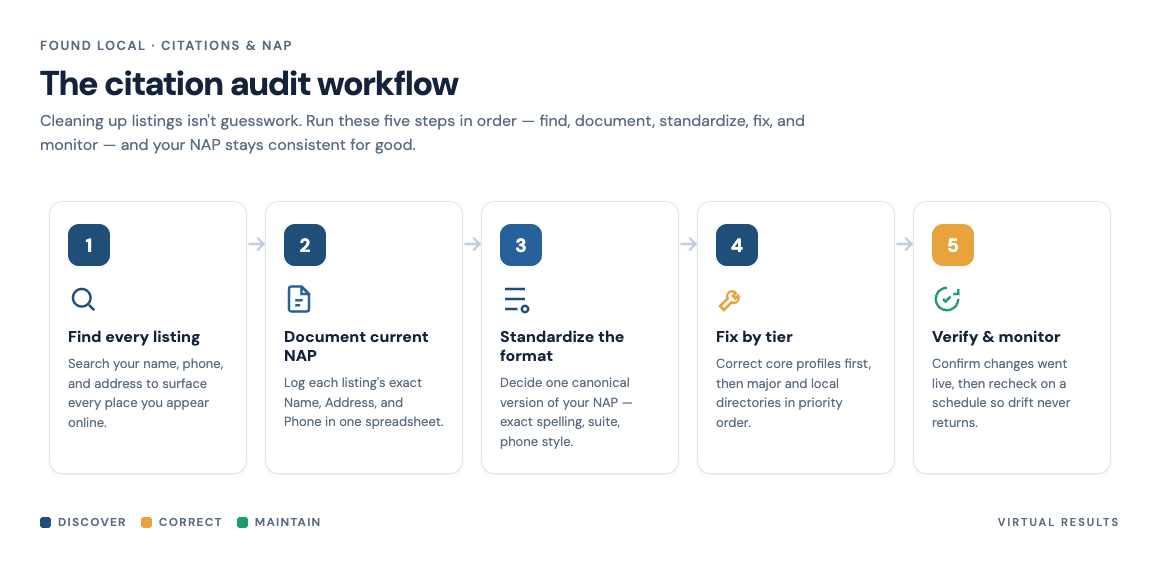
Step 1 — Find every listing you have (2–3 hours)
You can’t fix what you can’t see. Run these searches in an incognito window and open the first several pages of results for each:
"your full name" "your city" real estate"your phone number"(in quotes — this surfaces listings you’ve forgotten)"your business name""your street address"
Write down every directory you find. Dedicated citation-finder tools can surface most of your listings in minutes and are worth a small one-time fee if your manual search feels incomplete.
Step 2 — Document what each one actually says (1–2 hours)
Open a simple spreadsheet with these columns: Directory · Business Name · Address · Phone · Listing URL · Tier · Status. Record exactly how your NAP appears on each site — don’t correct anything yet. The goal here is an honest inventory, not a cleanup. You’ll be surprised how many small variations turn up.
Step 3 — Lock in your master format (30 minutes)
This is the master NAP template from the section above. Paste it into the top of your spreadsheet so it’s one click away. Every fix you make from here will be a copy-paste from this single source of truth.
Step 4 — Fix in priority order (4–6 hours)
Don’t fix alphabetically. Fix by tier, highest-value first (the tiers are defined in the next section). Log into each listing, find the edit or “claim this business” option, paste your master NAP, save, and mark it “Fixed” in your sheet.
You’ll hit a few snags. Here’s how to handle the common ones.
- Can’t edit it? Look for “Claim this business” or “Suggest an edit.” Some platforms require verification with a business document and a few business days.
- Duplicate listings? Claim both, keep the one with the most reviews and history, and request removal of the duplicate.
- Lost the login? Reset the password; if the email is dead, contact support with documentation. For lower-value sites, an email correction request is often faster than chasing old credentials.
Step 5 — Verify and monitor (ongoing)
A week or two after editing, revisit each listing, confirm the change went live, and mark it “Verified.” Be patient on results: citation work tends to show up as movement over roughly four to eight weeks, not overnight. Set a recurring reminder too, because data aggregators sometimes re-scrape old information and quietly revert your fixes. A quarterly spot-check keeps the cleanup from unraveling.
DIY or hire it out? Doing it yourself makes sense if you have the weekend hours and want to understand your own footprint. A citation-management service makes sense if you’ve got 50-plus inconsistent listings, can’t access old accounts, or simply value the time more than the savings. Both are legitimate. The only wrong choice is leaving the inconsistencies in place.
Which citations actually matter (Tier 1, 2, and 3)
Not all citations carry equal weight, and your time is finite. Fixing your Google Business Profile and Zillow listing matters far more than perfecting an obscure directory nobody visits. Group your listings into three tiers and spend your effort top-down.
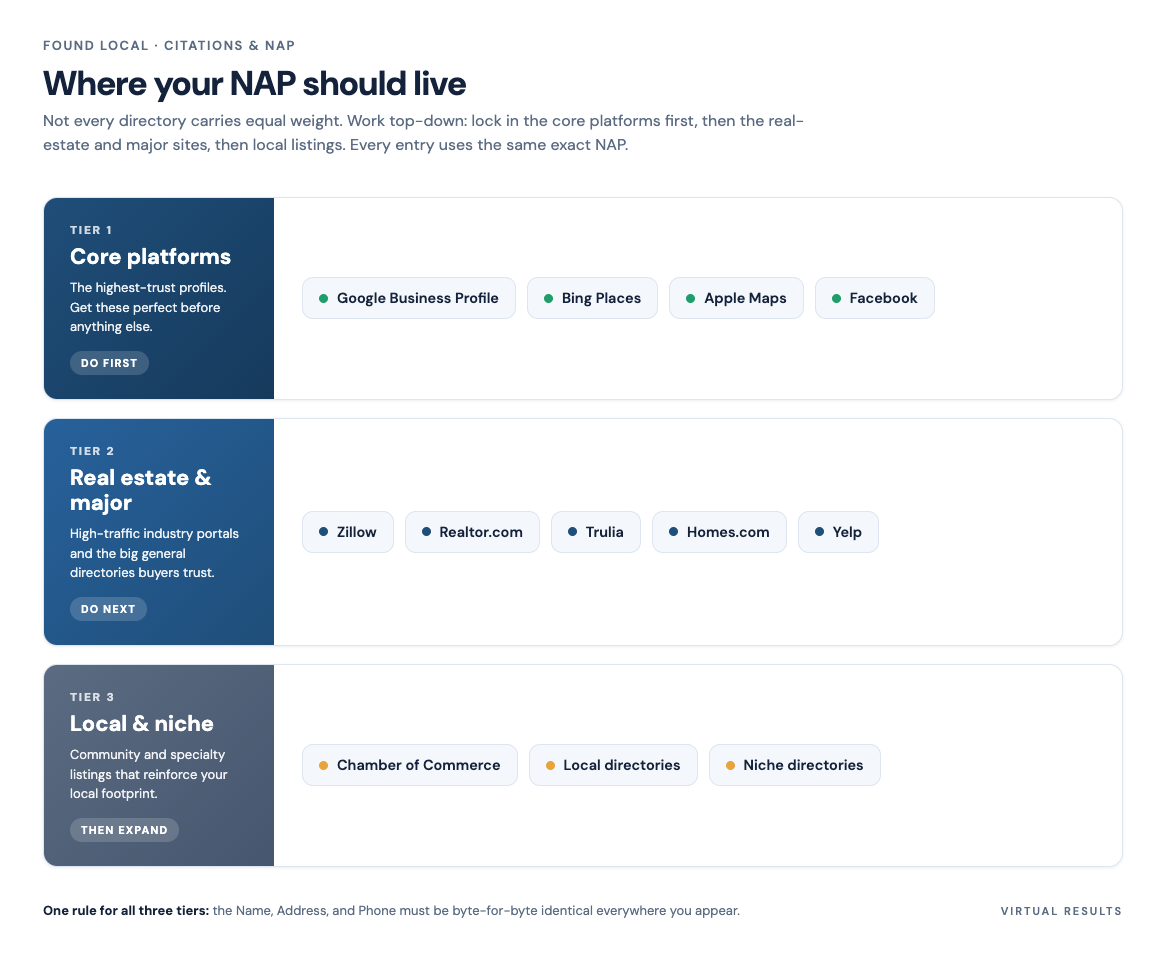
- Tier 1 — Core platforms (do these first, get them perfect): Google Business Profile, Bing Places, Apple Maps, Zillow, Realtor.com, Trulia, Redfin, and Homes.com. These are where buyers and Google both look hardest.
- Tier 2 — Industry and community (high value): Yelp, the Better Business Bureau, your local Chamber of Commerce, regional business associations, and — easy to forget — your MLS member directory and your brokerage’s agent roster page. These often carry real local authority.
- Tier 3 — General directories (nice to have): Facebook business page, LinkedIn, Foursquare, MapQuest, and the long tail of smaller directories. Fix them if it’s quick; skip or request removal if they’re defunct or sketchy.
One nuance specific to our industry: platforms like Zillow and Realtor.com pull from MLS and broker feeds, so a stale address can keep reappearing even after you fix it. Those are exactly the listings to re-check each quarter.
Local links beat national links — every time
A backlink is another site linking to yours, and Google reads links as votes of confidence. For local ranking, where the vote comes from matters enormously. One link from your city’s chamber of commerce is worth more for “[your city] realtor” than ten links from national real estate blogs, because it ties you to a place.
The good news for agents: you’re already embedded in a community full of link opportunities. You just have to ask.
Here’s where to look.
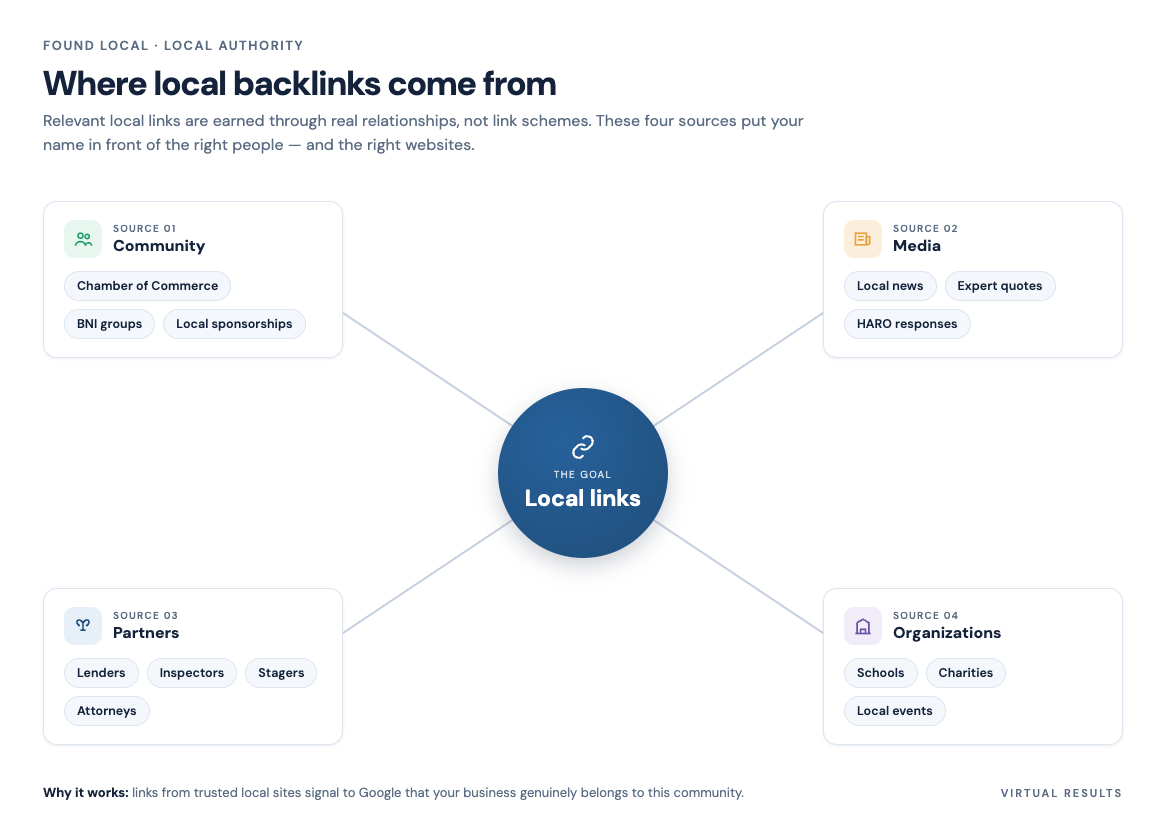
- Business organizations: Chamber of Commerce member directory, Rotary, BNI and other networking groups, local business associations. Membership usually comes with a directory link.
- Community involvement: Sponsor a youth sports team, a school fundraiser, or a local charity event. Sponsor pages almost always link back — and the goodwill is real.
- Local media: Offer a quarterly market-commentary quote to a neighborhood news outlet or lifestyle blog. Reporters need local sources; agents who make themselves available get cited.
- Partner businesses: Mortgage brokers, home inspectors, contractors, stagers, interior designers, and movers all keep “trusted partners” or resource pages. A reciprocal mention is natural and useful to your clients.
A workable monthly rhythm: join two or three organizations that fit, sponsor a couple of causes a year, and reach out to a handful of local partners each month. You’re not chasing a hundred links — you’re earning the dozen or so that genuinely tie your name to your market.
A note on the older “citations matter more than links” advice you’ll see floating around: it’s overstated. The honest framing is that citations and consistent local mentions reinforce trust, and genuine local links build authority on top of that. You want both.
Schema markup: handing Google a fact sheet about you
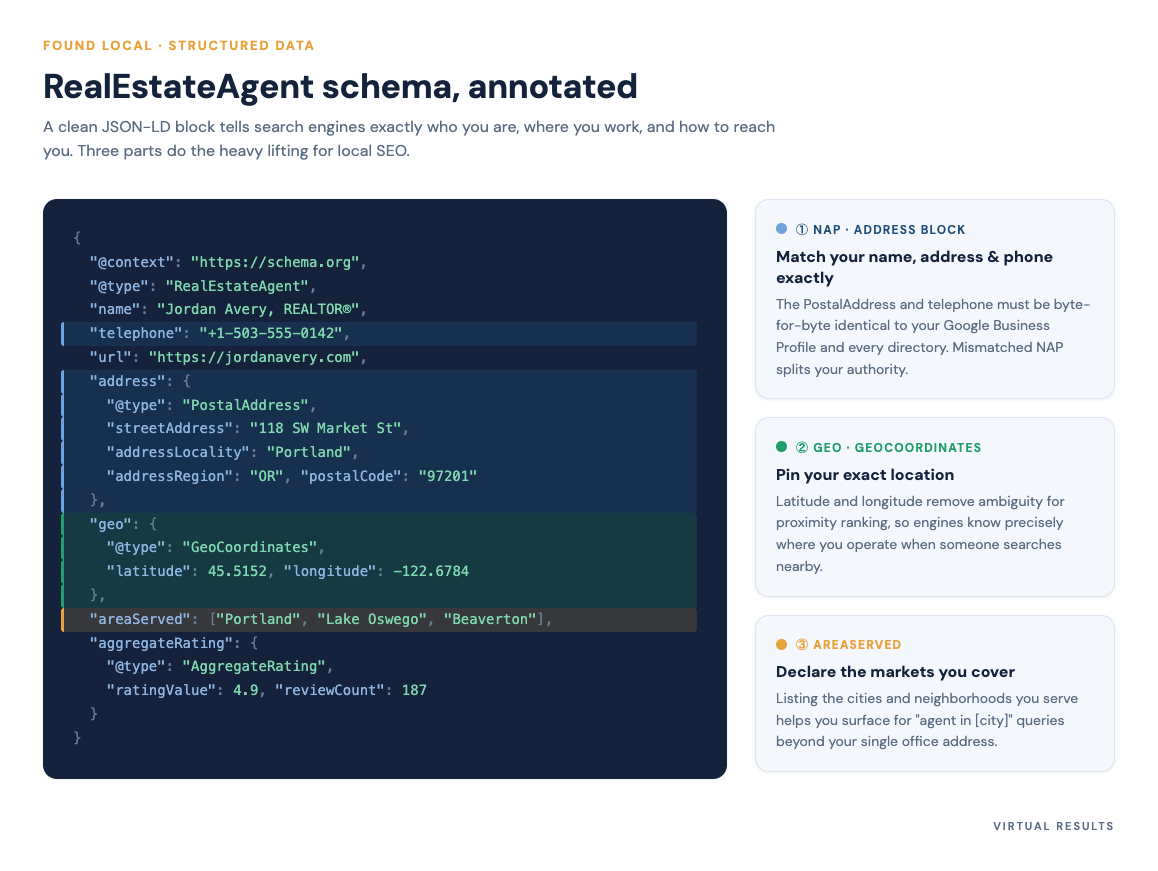
Schema markup is a small block of structured data you add to your site’s code. It doesn’t change anything a visitor sees — it’s a machine-readable fact sheet that tells Google, in plain terms, “this is a real estate agent, here is the name, here is the address, here are the coordinates, here are the areas served.” For local SEO, the type to use is RealEstateAgent.
Why bother? Schema removes ambiguity. The geo-coordinates feed into how Google judges proximity for “near me” searches, the area-served field signals which cities you’re eligible to appear in, and clean structured data makes it easier for AI search tools to understand and cite you, which is exactly where Part 6 of this series picks up.
Here’s an annotated example you can hand to your web developer or drop into your site’s head section:
<script type="application/ld+json">
{
  "@context": "https://schema.org",
  "@type": "RealEstateAgent",
  "name": "Jordan Avery Real Estate",
  "image": "https://jordanaveryrealestate.com/headshot.jpg",
  "url": "https://jordanaveryrealestate.com",
  "telephone": "+1-617-555-0182",
  "address": {
    "@type": "PostalAddress",
    "streetAddress": "412 Oak Street",
    "addressLocality": "Brookline",
    "addressRegion": "MA",
    "postalCode": "02445",
    "addressCountry": "US"
  },
  "geo": {
    "@type": "GeoCoordinates",
    "latitude": 42.3318,
    "longitude": -71.1212
  },
  "areaServed": ["Brookline", "Newton", "Boston"],
  "priceRange": "$$"
}
</script>
The fields that do the heavy lifting for local SEO:
- address — must match your master NAP exactly. Schema that contradicts your citations creates the very confusion you just spent a weekend eliminating.
- geo — the latitude/longitude that anchors you for proximity-based “near me” results.
- areaServed — the cities you legitimately work in.
- telephone — in international format (
+1-617-...).
Place this on your homepage and contact page. If you’re on WordPress, a good SEO plugin or your theme can usually output this without you touching raw code, and at Virtual Results it’s something we build into agent sites by default. To confirm it’s working, paste a page URL into Google’s Rich Results Test and check that the data is detected without errors.
Technical SEO that actually matters for agents
“Technical SEO” sounds like a black hole of developer jargon, and it can be. For a real estate agent, though, the list of things that genuinely move the needle is short. Don’t over-engineer this. Focus on four things.
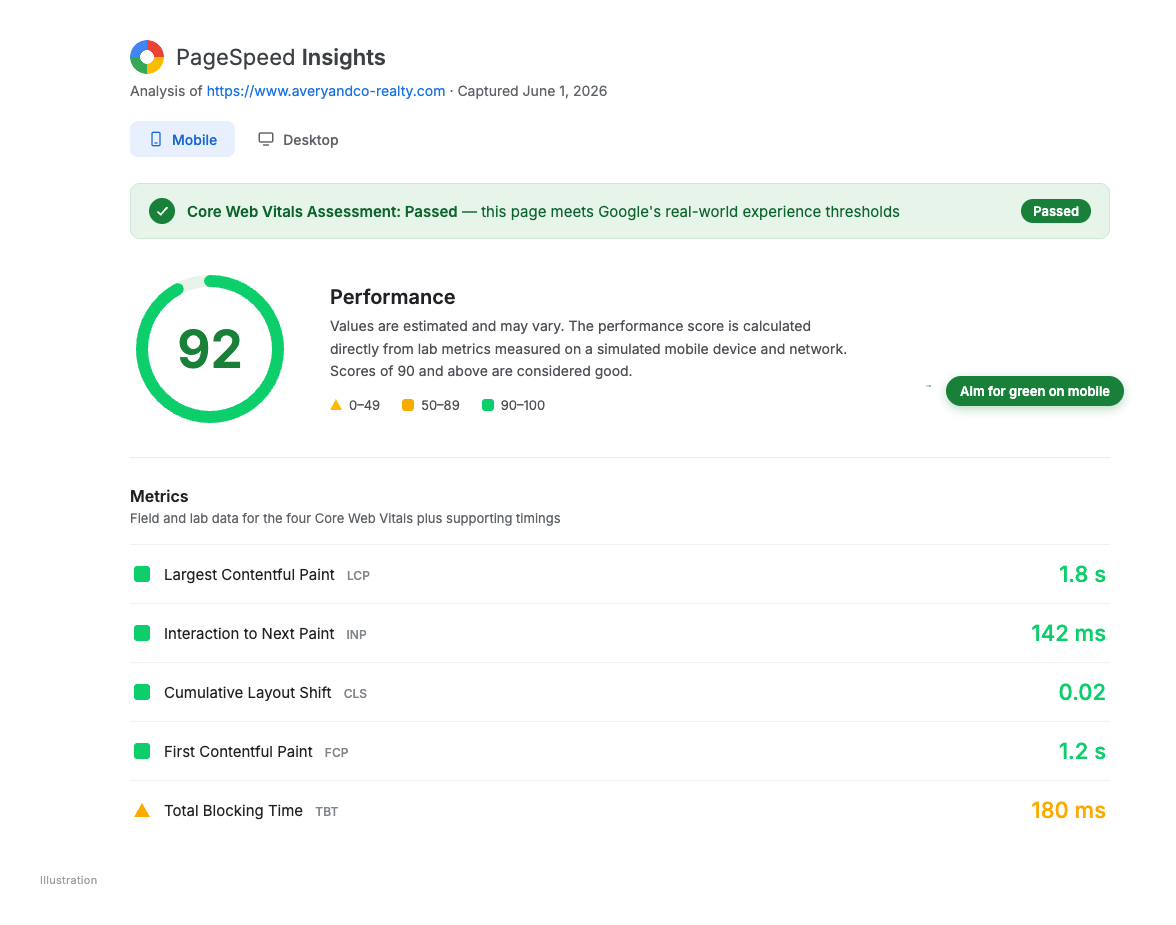
1. A fast mobile site. Most of your buyers and sellers search from a phone, often standing in a driveway. If your site takes more than about three seconds to become usable on mobile, you lose people — and Google’s Core Web Vitals (its measures of loading, responsiveness, and visual stability) factor into how it ranks you. Heavy listing carousels, sliders, and bloated page builders are the usual culprits. Run your site through Google’s free PageSpeed Insights and treat the mobile score as the one that counts.
2. Clean site architecture. A visitor (and a search crawler) should be able to get from your homepage to any neighborhood guide in two or three clicks. Logical navigation and a clear path from broad pages (city) to specific ones (neighborhood) is the whole game. Remember the geographic pyramid from Part 3? This is the structural side of it.
3. No orphan pages. An orphan page is one that exists but isn’t linked to from anywhere else on your site. If you wrote a beautiful guide to a neighborhood and nothing links to it, crawlers may never find it and buyers certainly won’t. Every page should be reachable through your navigation or through internal links from related pages. When you publish a new neighborhood guide, link to it from your city page and from any nearby-neighborhood guides the same day.
4. Content that renders as real HTML. Make sure your important content (your neighborhood descriptions, your market commentary) actually exists in the page’s HTML, not buried inside a script that only loads after a delay. Both Google’s crawler and the newer AI crawlers need readable structure, not a wall of framework code. For most agents on a well-built site this is already handled; it’s mainly a flag for anyone on an over-engineered custom build.
That’s it. HTTPS (the padlock in the address bar) should be on and a basic XML sitemap helps, but if your site is fast on mobile, cleanly organized, free of orphan pages, and renders real content, you’ve cleared the technical bar most of your competitors haven’t.
Teams, brokerages, and multiple markets
Everything above scales up, but teams and multi-market agents have a few extra ways to create the inconsistency that quietly suppresses rankings.
If you have genuine, separate offices, the strongest approach (under current Google guidance — and these policies do change) is a distinct Business Profile for each physical location, each with its own real address, phone line, landing page, and reviews. The hard rule: the locations must be real, with someone present during the hours you post. Fabricated or virtual-office locations get profiles suspended — a much bigger setback than not having the listing at all.
If you’re one office serving several cities, you don’t create extra profiles. You configure your single profile as a service-area business and build a dedicated landing page for each city you serve — “Real Estate Agent Serving Newton,” “…Serving Boston” — each with genuinely local content. That’s how you earn relevance in multiple markets from one legitimate listing.
For teams, the trap is the brokerage feed. Your roster page, the MLS, and the franchise’s national site may list every agent with slightly different details — a citation problem multiplied by your headcount. Run the same master-NAP discipline across the team, and make the brokerage roster and MLS directory part of your quarterly check.
Treat anything you read about Business Profile rules — home addresses, service-area setup, multiple locations — as current guidance rather than permanent law. Google adjusts these policies regularly; check the official help docs before making a structural change.
Your quarterly maintenance checklist
The foundation isn’t a one-time project; it’s a thing you keep clean. The good news is that maintenance is fast once the heavy cleanup is done. Put a recurring reminder on your calendar every three months and run this list:
- Citations: Spot-check your top 15–20 listings against your master NAP. Pay special attention to Zillow, Realtor.com, and your MLS directory, which re-scrape from feeds and tend to drift.
- New listings: Confirm any directory you joined this quarter uses the exact master format.
- Schema: Run your homepage and contact page through the Rich Results Test to confirm your
RealEstateAgentdata still validates after any site updates. - Speed: Re-run PageSpeed Insights on mobile. New listing photos and plugins can quietly slow a site down over time.
- Orphan pages: Make sure every neighborhood guide you published this quarter is linked from its city page and from related guides.
- Local links: Note any new sponsorships, memberships, or partner mentions, and confirm the link actually points to your site.
Fifteen or twenty minutes a quarter protects months of work. Skip it for a year, and you’re back to wondering why you slipped to position 6.
This is the layer nobody brags about and almost everybody neglects, which is exactly why getting it right is such a quiet advantage. With consistent contact information, the right citations, real local links, clean schema, and a fast site, you’ve removed the friction. The next question is how you’ll know it’s working.
You just finished Part 4 of 6 of Found Local: The Real Estate SEO Playbook.
Up next: How to Know Your Local SEO Is Working: The Metrics, Tools & Dashboard for Agents — the handful of numbers that predict business, and the simple monthly rhythm to track them.
← Neighborhood Pages: How Agents Out-Rank Zillow on the Searches That Matter | How to Know Your Local SEO Is Working: The Metrics, Tools & Dashboard for Agents →
Jump back into this guide
- Why the foundation is what’s actually holding you back
- NAP consistency: one format, used everywhere
- The citation audit: a five-step workflow you can finish in a weekend
- Which citations actually matter (Tier 1, 2, and 3)
- Local links beat national links — every time
- Schema markup: handing Google a fact sheet about you
- Technical SEO that actually matters for agents
- Teams, brokerages, and multiple markets
- Your quarterly maintenance checklist
Don’t want to spend your weekends auditing directory listings and editing schema code? That’s exactly the kind of foundational, behind-the-scenes work Virtual Results handles for real estate agents every day — consistent citations, clean technical setup, and sites built to rank. Get in touch and we’ll take the boring-but-critical stuff off your plate so you can get back to selling homes.