Found Local: The Real Estate SEO Playbook — Part 3 of 6
← Your Google Business Profile Is Your Best Lead Source | The Boring Stuff That Makes You Rank →
In this guide
Here is the thing Zillow can’t do: write honestly about a single street.
It can’t tell a buyer that the east side of the neighborhood gets afternoon shade and the cul-de-sacs flood after a hard rain. It can’t explain why the homes near the elementary school sell for more, or which subdivision has the Mello-Roos that scares off first-timers. You can. That local knowledge — the stuff you say to clients in the car every week — is the single biggest content advantage you have, and almost no agent uses it.
This article is about turning that knowledge into pages that rank. Not blog filler. Not “5 tips for spring buyers.” A real library of neighborhood guides and answer-first market content that builds the topical authority Google needs to put you in front of people searching “[neighborhood] homes for sale” and “best neighborhoods in [city].” Those are the searches where the money is, and they’re winnable.
Why depth beats volume (and how you out-rank Zillow)
Most agents who “do content” publish a steady stream of short, generic posts and wonder why nothing ranks. The problem isn’t effort. It’s that volume without depth signals nothing to Google.
Google rewards topical authority — evidence that you cover a place comprehensively, not just occasionally. One thin page about a neighborhood gets ignored. Fifteen to twenty genuinely thorough neighborhood guides across your market tell Google you are the source for that area. As one practitioner put it, twenty comprehensive guides will build more local authority than a hundred scattered blog posts.
You will never out-muscle Zillow or Redfin on raw “homes for sale in [city]” — they have domain authority you can’t match. But you’re not competing there. You’re competing for the long tail of specific, intent-rich searches the portals treat as an afterthought: the single neighborhood, the specific buyer question, the honest comparison. On those, depth wins, and depth is exactly what a portal’s templated database pages can’t fake.
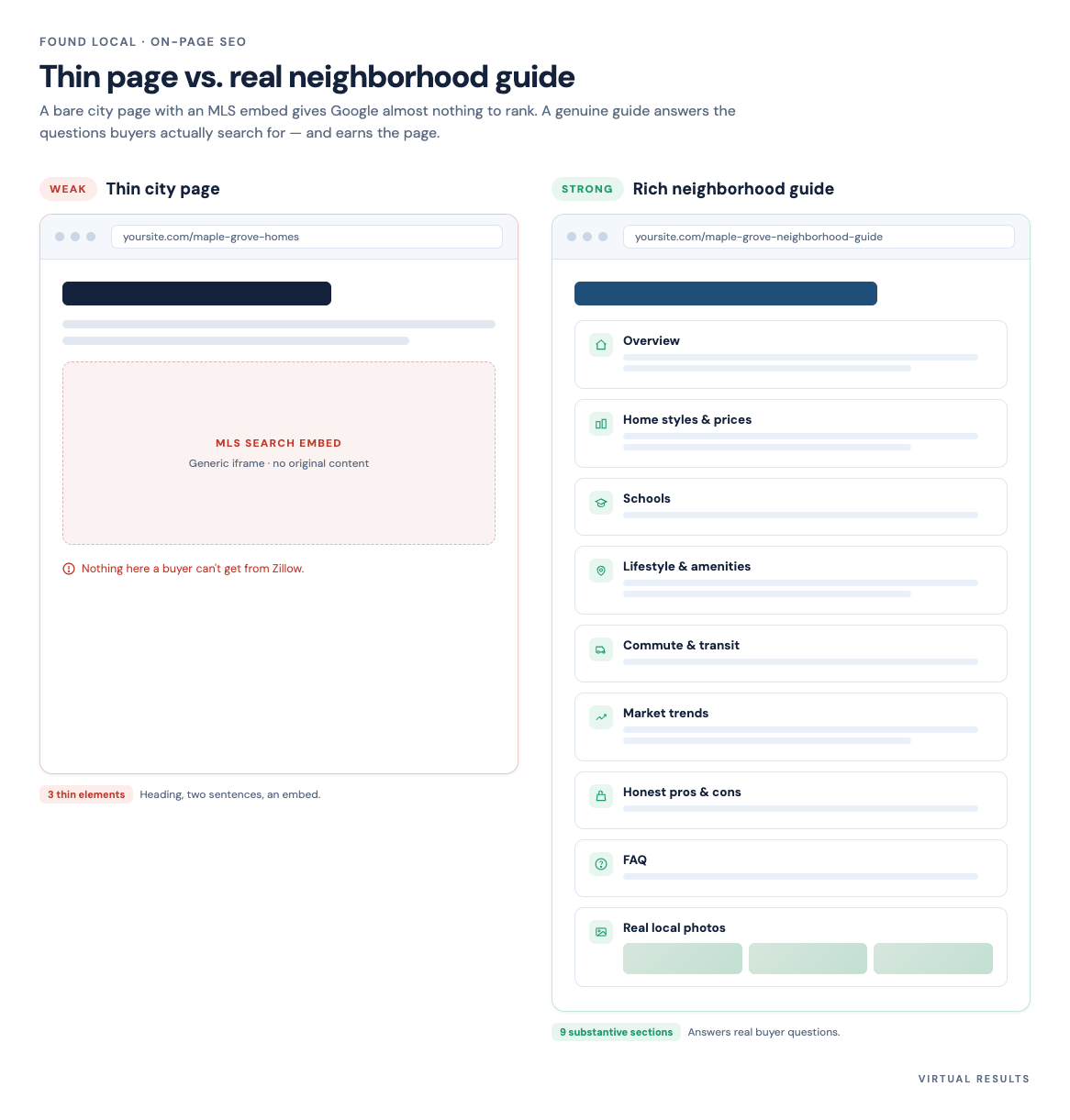
So the strategy is simple to state and harder to do: pick your real markets, and cover them better than anyone else alive can. The rest of this article is the how.
How buyers and sellers actually search
Before you write a word, you need to know what people type. And here’s the good news — they don’t search in marketing language. They search the way they talk.
That means you don’t need a $200-a-month keyword tool to get started. You already hear these searches every day, phrased as questions in your inbox and on showings. A few of the patterns that drive real estate traffic:
- “Homes for sale in [neighborhood]“
- “Best neighborhoods in [city]” — and the more specific “best neighborhoods in [city] for families“
- “Living in [neighborhood]” — pure research intent, early in the journey
- “[Neighborhood A] vs [Neighborhood B]” — a buyer narrowing it down
- “How much is my house worth in [city]” — a seller raising their hand
- “Is now a good time to sell in [city]“
- “[City] property taxes” or “moving to [city] from out of state” — relocation buyers
Notice the pattern. These searches tell you exactly where someone is in the process. “Living in Maplewood” is someone three to six months out, doing homework. “Homes for sale in Maplewood under $600k” is someone close to calling an agent. You want pages for both, because the early-stage researcher is the lead nobody else is talking to yet.
The practical move: keep a running list of every question clients ask you. Group them by neighborhood and by stage. That list is your content calendar — far more reliable than a tool spitting out search volumes for terms no real buyer uses. If you do want a tool to confirm demand or find phrasings you missed, one is plenty; you don’t need a stack.
One warning that runs through this whole article: matching how people search is not the same as stuffing keywords. Write the phrase the way a buyer would say it, once, in a heading and naturally in the body. The moment your copy reads like it was written for a robot, it stops working for both the robot and the human.
The neighborhood-guide template that ranks
A neighborhood guide that ranks isn’t a paragraph and a map. It’s a genuinely useful resource — usually 1,200 to 2,500 words — that answers nearly every question a buyer or seller would have about living there. Build it from a repeatable template so each one is fast to produce and consistently complete.
Here’s the section list to work from. Treat it as a checklist; if a section is empty, the guide isn’t done.
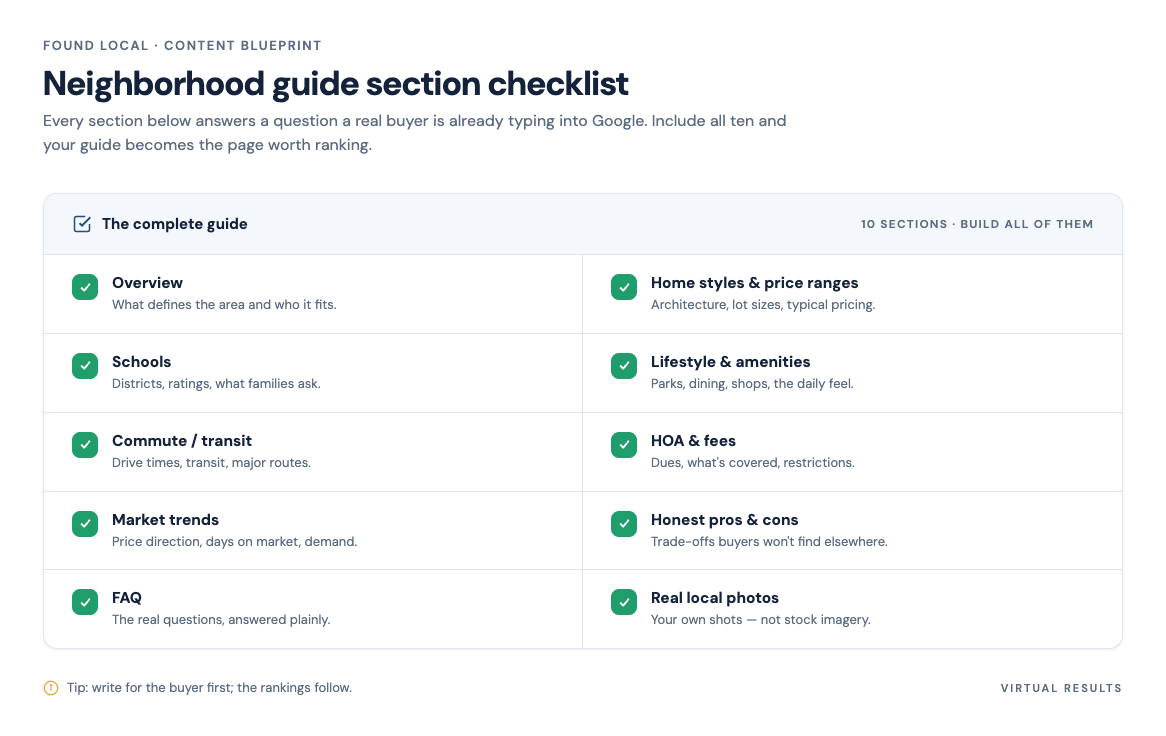
- Overview / “the vibe.” What makes this neighborhood distinct in two or three honest sentences. This is the part Zillow literally cannot write.
- Who it’s right for. First-time buyers, families, downsizers, investors. Help people self-select.
- Home styles and price ranges. Architecture, typical lot sizes, current entry and high-end pricing. Pull real numbers from the MLS and date them.
- Schools. Assigned schools and ratings — a top reason families search a neighborhood by name.
- Lifestyle and amenities. Parks, the coffee shop everyone meets at, the farmers market, walkability. Specific names, not “great dining options.”
- Commute and transportation. Drive times to the major employers and downtown, transit access, the road everyone complains about.
- HOA fees and special assessments. HOA ranges, Mello-Roos or special districts where they apply. Buyers desperately want this and rarely find it.
- Market trends and recent sales. What’s selling, how fast, the direction of prices. Update this quarterly so the page stays current.
- Honest pros and cons. A real “cons” list builds more trust than any testimonial. It also reads as credible to AI answer engines, which the last article in this series gets into.
- FAQ. Five to ten real questions, each answered directly. This is where you capture the long-tail and conversational searches.
- A clear next step. An offer to see current listings or talk through the area — your call to action, in your voice.
Two rules that separate guides that rank from guides that don’t:
Use your own photos. Real shots of the actual streets, parks, and “just sold” homes — never stock photos of houses that aren’t in your market. Stock imagery is one of the fastest ways to look like everyone else.
Add interpretation, not listings. Don’t duplicate the MLS feed onto the page; search engines have seen that data a thousand times. Your value is the read: what the numbers mean, who should care, and what you’d tell a friend. A short neighborhood walkthrough video, or a quick interview with a local business owner, makes the page even harder to copy.
The geographic pyramid: linking, structure, and URLs
Individual guides are powerful. Connected guides are far more powerful. The way you connect them is a structure worth picturing as a pyramid — specific at the bottom, broad at the top.
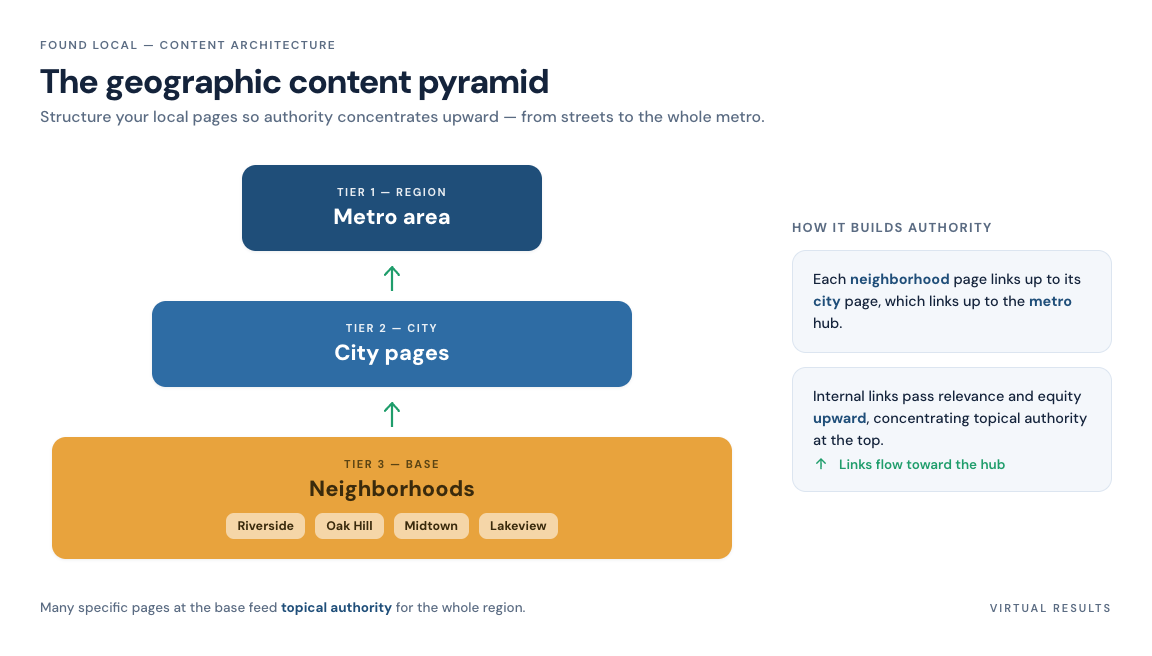
- Layer 1 — Neighborhood. Your 15–20 guides. These target the most specific, most winnable terms: “living in [neighborhood],” “[neighborhood] homes for sale,” “[neighborhood] real estate agent.”
- Layer 2 — City. A “Complete Guide to Living in [City]” that introduces the city and links out to every neighborhood guide beneath it. This is also where a “best neighborhoods in [city]” page lives — a roundup that links to each guide.
- Layer 3 — Region. A market-area overview (“[County] Real Estate Market Guide”) that links down to the city pages.
The magic is in the internal linking. Each neighborhood guide links up to its city page and sideways to adjacent neighborhoods (“considering Maplewood? Compare it to South Orange next door”). City pages link down to every guide. This passes authority around your own site and tells Google these pages are one connected body of work about one place — which is exactly the topical-authority signal that helps you rank for the broader, harder city-level terms while you dominate the neighborhood terms.
URL structure should mirror the pyramid and stay clean. A flat pile of URLs gets unmanageable the moment you expand into a second city. Use a logical, scalable pattern, for example:
/neighborhoods/maplewood//living-in-maplewood/(a single readable slug works fine too)/[city]/best-neighborhoods/
Pick one convention and apply it everywhere. Keep slugs short, human-readable, and free of dates or ID numbers. The goal is a structure where, two years from now, a new neighborhood guide has an obvious home and an obvious set of pages to link to and from.
Don’t orphan your work, either. Every guide should be reachable through navigation — an “Areas We Serve” page that lists all of them is the simplest fix. A great page no one can navigate to is a wasted afternoon.
Answer-first market content
Neighborhood guides cover place. Market content covers timing and money — and it’s where you catch sellers and relocation buyers who aren’t yet searching by neighborhood name.
The format that wins here is answer-first. Search engines, and increasingly AI answer systems, pull from pages that answer the question clearly and immediately, then expand. So lead with the payoff. If the page is titled “Is now a good time to sell in [City]?”, the first sentence should answer it — “In [City] right now, well-priced homes are still selling in under three weeks, which favors sellers, but the window is narrowing” — and the rest of the page earns that claim with data and context.
Use question-based headings that match how people actually search, and answer each one in the opening line beneath it. High-value market topics include:
- “Is it a buyer’s or seller’s market in [city]?“
- “How much is my home worth in [neighborhood]?” (pair with a real valuation offer, not just a form)
- “When is the best time to sell in [city]?“
- “The complete relocation guide to [city]” — property taxes, utility providers, school districts, commute, neighborhoods at a glance. This single page can own out-of-state buyers, who search logistics months before they search listings.
- A recurring “[City] Real Estate Market Report” — monthly or quarterly. Dated, data-driven, honest. These also tend to earn local-press mentions, which the next article explains how to capitalize on.
Keep this content explanatory. AI systems and informed buyers both favor pages that interpret the market rather than just assert that “now is a great time to buy.” Tell people what the numbers mean and let them trust your judgment.
On-page basics that quietly matter
None of this requires an SEO degree. A handful of on-page habits do most of the work, and they’re the same habits that make a page clearer for a human.
- One topic per page. One neighborhood, one market question, one service. A page trying to be about three neighborhoods ranks for none of them.
- Put the target phrase in the title and the H1. “Living in Maplewood: A Local Agent’s Honest Neighborhood Guide” beats “Maplewood.” Once, naturally — not three times.
- Write a real meta description. One sentence that says what the page covers and why to click. It’s your ad copy in the search results.
- Use descriptive headings. H2s and H3s phrased as the questions people ask. They help readers scan and help search engines understand structure.
- Front-load the answer. Lead with the payoff in the first sentence or two, every time. Both readers and answer engines reward it.
- Name descriptive image files and write alt text.
maplewood-park-summer.jpgwith real alt text beatsIMG_4821.jpg. - Write the way you talk to clients. Plain, specific language outperforms polished marketing copy. If a sentence sounds like a brochure, cut it.
That’s genuinely most of it. On-page SEO for an agent is less about tricks and more about being clear, focused, and specific — which, conveniently, is also what makes content good.
Common mistakes that keep good agents stuck
The agents who struggle with content usually aren’t lazy — they’re making a few predictable errors. Watch for these:
- Copy-pasting descriptions from Wikipedia or another site. Duplicate content earns nothing, and it throws away your one advantage: that you actually know the place.
- Generic stock photos. Houses that aren’t in your market read as fake and undercut every honest word on the page.
- Republishing the MLS feed as “content.” Listings data isn’t a guide. Interpretation is.
- Chasing volume over depth. Forty thin posts will lose to ten thorough guides every time. Slow down and go deeper.
- Keyword stuffing. Repeating “Maplewood homes for sale Maplewood realtor” reads as spam to people and engines alike. Say it once, naturally.
- Orphan pages and flat URLs. Guides nobody links to and a structure that doesn’t scale. Build the pyramid from the start.
- Letting it go stale. Pricing and “recent sales” sections age fast. Schedule a quarterly pass to refresh numbers — a stale market page erodes trust quickly.
- Writing for the algorithm instead of the buyer. The work that ranks is the work that genuinely helps someone decide where to live. Start there and the rankings follow.
Here’s the honest timeline, because you deserve one. A library like this takes months, not weeks. Publish your first handful of neighborhood guides, keep a steady cadence, and you’ll typically start seeing the long-tail “living in [neighborhood]” terms appear on page one within a few months — well before the broader city terms move. This is a compounding asset, not a quick hit. The good news is that compounding cuts in your favor: every guide you publish strengthens the ones around it, and a portal can’t follow you down to the street level.
You just finished Part 3 of 6 of Found Local: The Real Estate SEO Playbook.
Up next: The Boring Stuff That Makes You Rank — the NAP consistency, citations, local links, and fast mobile site that quietly decide whether all this great content ever gets seen.
← Your Google Business Profile Is Your Best Lead Source | The Boring Stuff That Makes You Rank →
Jump back into this guide
Building a real neighborhood-guide library is the highest-leverage content work an agent can do — and it’s also the part that quietly eats your weekends. If you’d rather spend that time on showings, talk to Virtual Results. We build the pages, the structure, and the internal linking for agents and teams every day, in your voice and about your streets, so the library works for you while you work your business.