Zapier runs recipes. This one improvises — which is the fundamental difference you need to understand as you explore this series on how your website can take instructions.
Table of Contents
- The Recipe vs. the Assistant
- Why Zapier Is Good (At What It Does)
- Maria’s Morning: Recipes Don’t Handle Change
- An MCP Server Reasons in Real Time
- Why This Matters for Real Estate
- The Bottom Line
[ywost_series_toc current=”mcp-vs-zapier”]
The Recipe vs. the Assistant
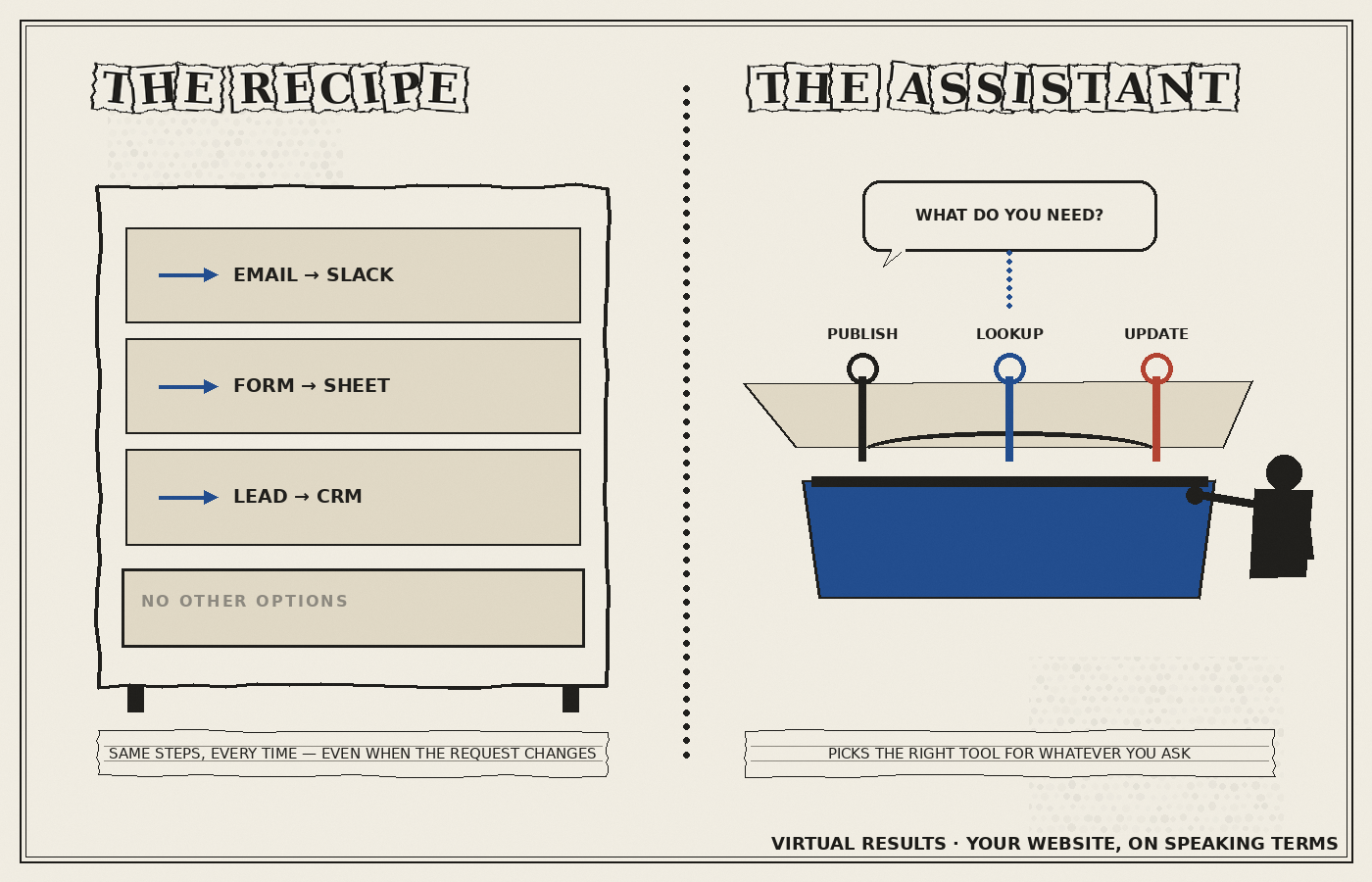
Zapier runs recipes. MCP serves the improvisation.
Think of a recipe: you decide in advance that every time a form submission comes in, Zapier emails the lead, adds them to a spreadsheet, and sends a Slack notification. That’s a fixed workflow. You build it once, and Zapier follows those same steps every single time. No variation. No reasoning. Just execution.
An MCP server (Model Context Protocol — think of it as your website’s AI connection) works differently. Instead of you deciding the workflow upfront, you give an AI assistant the keys to your website — access to your listings, your blog, your database, your email. Then you ask it something. The AI figures out what needs to happen. It reasons about your request in the moment.
The difference sounds subtle. It isn’t.
Zapier is a vending machine. You load it with product, set the prices, and the machine dispenses the same items in the same order every time. The connection is more like hiring an assistant who knows where everything is in your office and can make decisions on the fly.
Why Zapier Is Good (At What It Does)
Before we go further: Zapier is genuinely powerful and widely used. It automates repetitive, well-defined tasks at massive scale. If you know exactly which workflows you want to automate — “every CRM entry triggers an email to the listing agent, every email with ‘SOLD’ in the subject updates the archive” — Zapier excels. Set it and forget it. It’s reliable, well-designed, and the integration library is massive.
Zapier’s strength is predictability. You control everything upfront. You know exactly what happens when. There are no surprises.
That’s also its ceiling.
Maria’s Morning: Recipes Don’t Handle Change
Let’s say Maria is a real estate agent. She uses Zapier to automate her morning routine: every new MLS alert triggers an email to her office manager, a Slack notification, and a row in a tracking spreadsheet.
One Monday, her market cools. She decides, mid-morning, that she only wants to be notified about listings under $400K now — the high-end market is too thin. With Zapier, Maria has to manually edit the Zap. She has to know how to access her automation rules, find the right filter condition, and change it. If she forgets, the old recipe keeps running.
The next day, she decides to start a buyer leads database. She wants to ask her AI to “write a follow-up email to everyone who viewed my property but didn’t submit an offer, with the neighborhood comps attached.” With Zapier, she’d need to build that from scratch: connect her CRM, pull the viewers list, fetch the comps, draft a template, send the emails. Or, more realistically, she’d give up and do it manually.
With an MCP server, she just asks. “Write a personalized follow-up to buyers who viewed the Maple Street property.” The AI looks at who viewed it, drafts emails, and — if she’s authenticated and authorized for that access — sends them. No recipe to build. No manual steps to remember. Just a question and an answer.
An MCP Server Reasons in Real Time
Here’s the way MCP works, at a high level:
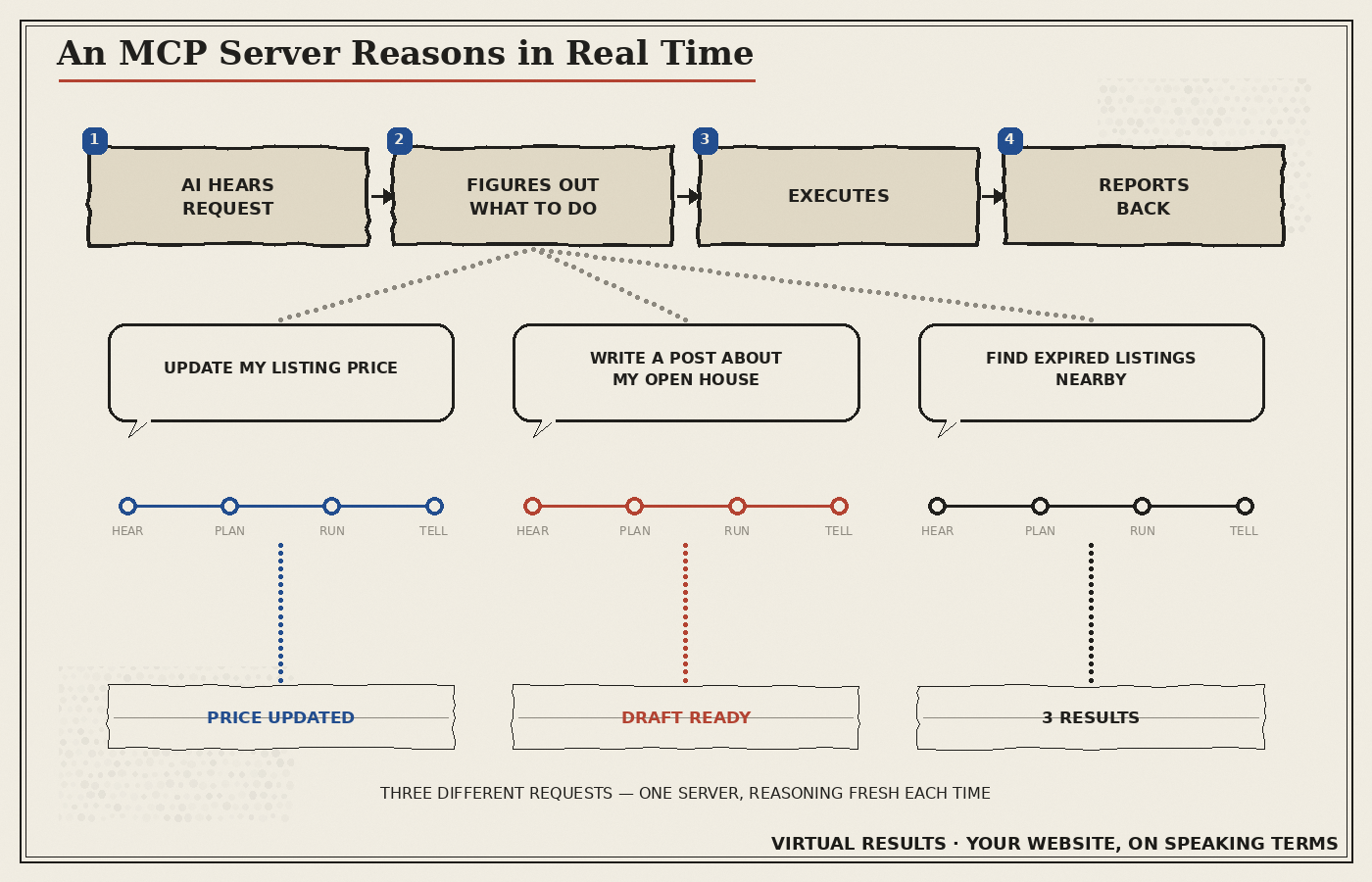
You connect Claude or another AI to your website via an MCP server. That connection gives the AI access to specific capabilities — like getting a listing, publishing a blog post, checking inventory, or sending an email. The AI knows what it can do. When you ask it to do something, it figures out which capabilities to use, in what order, to fulfill your request.
It’s not following a pre-programmed recipe. It’s reading your request, understanding the goal, and deciding how to achieve it.
That means the same AI can handle:
- “Draft a blog post about this property.” (Uses: read property data, write blog post, publish it)
- “Tell my past clients about similar properties that just hit the market.” (Uses: get past clients list, find similar properties, draft an email, send emails)
- “Update my listing price and notify anyone who’s favorited it.” (Uses: edit listing, query favorites, send notifications)
You didn’t build three workflows. You didn’t set up three Zaps. You just asked three different questions. The AI figured out what to do each time.
Why This Matters for Real Estate
Real estate is chaotic. Your day doesn’t run on recipes.
Listings change unexpectedly. Market conditions shift overnight. Clients ask for things you didn’t anticipate. A buyer comes in with an unusual request — “find me properties where the kitchen was renovated in the last two years and the master bath has a walk-in closet.” You could spend two hours in MLS filters, or you could ask your AI and get an answer in seconds.
Zapier assumes you can predict your automation needs. MCP assumes you can’t — so it gives your AI the keys and lets it adapt.
That’s also why this is new. Most “real estate automation” tools today — the data-extraction platforms, the listing scrapers — they pull information into the AI. They hand the AI read-only data and say “make sense of this.” But your most valuable asset isn’t data; it’s the power to act on your own platform. To change a listing. To publish a blog post. To send an email to your list.
Virtual Results’ MCP server operates on that principle. It’s not a recipe library. It’s an assistant with keys to your website. That’s the difference.
The Bottom Line
You’ll keep using Zapier if you know your workflows. It’s great at that.
But as your business grows, as your team needs to operate faster, as your market shifts, you’ll outgrow recipes. You’ll want your AI to have judgment. To read a complex request and decide what to do. To operate your website the way you’d operate it yourself — by understanding what you’re asking for and figuring out the next steps.
That’s not Zapier. It’s the integration. And that’s the kinds of things your AI can do when it has real access to the capabilities that matter.
Curious how it all works? Explore the series to learn the details.
Series Navigation
← Previous: What Is an MCP Server? A Plain-English Guide for Real Estate Pros