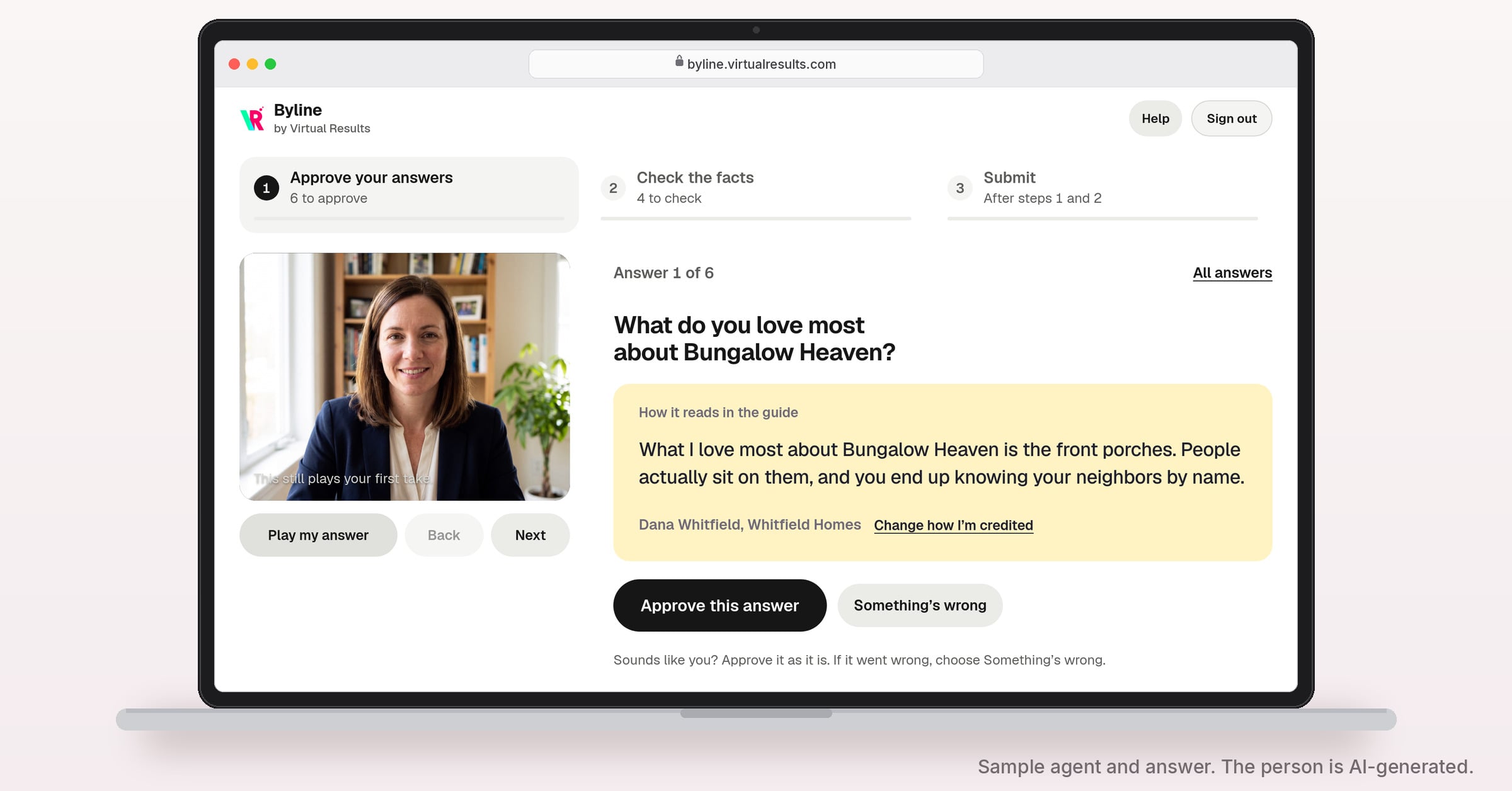
How to Rank in ChatGPT: AI SEO for Real Estate Agents (2026)
How real estate agents get cited by ChatGPT and AI search: crawler access, llms.txt, schema, mentions and MCP, with the evidence behind each step and a survey of 50 real estate sites.
Ryan Rockwood · 19 min read
On this page
- The short version
- How ChatGPT and other AI assistants decide who to name
- The scorecard: what to do, and how strong the evidence is
- 1. Let the AI crawlers in
- 2. Put the facts in plain text and answer the question first
- 3. Be the same everywhere
- 4. Do backlinks matter for getting cited by ChatGPT? Mentions matter more
- 5. Publish something only you could write
- 6. Does schema help AI? Do FAQs?
- 7. What is llms.txt, and do you need one?
- 8. MCP: letting an assistant ask your website directly
- 9. Found in the wild: the AI information page
- What 50 large real estate websites publish for AI
- What we publish on client sites
- How much is too much?
- How do you know if it is working?
- Check your own site in ten minutes
- Questions agents ask
- Next in this series
- Sources
Published November 22, 2026. Part of our Developing in Public series, where we show our work, our sources and our own sites.
Real estate agents ask us how to rank in ChatGPT, and whether there is such a thing as AI SEO. Strictly, ChatGPT does not rank websites. It reads a handful of pages, writes an answer and names its sources. But “rank in ChatGPT” is what people type, so that is what we call it here: getting your name and your website cited in the answer when a buyer or seller asks an AI assistant who to hire or what a neighborhood is like.
This guide covers what the AI companies say, what independent studies have measured, what we found on 50 large real estate websites, and what we publish on the sites we build. Where the evidence is weak, we say so and tell you whether we do it anyway.
The short version
- AI assistants cite pages they can reach and read. Check that your site lets their search crawlers in. This step has the strongest evidence and takes minutes.
- Put the facts in plain words on the page: your name, brokerage, license number, service area, phone, and direct answers to the questions clients ask you.
- Be the same everywhere. Assistants read your brokerage page, Google Business Profile and portal profiles as well as your site, so they should agree.
- Get mentioned. In the largest study we found, being talked about across the web lined up with appearing in AI answers far more than the number of links pointing at a site did.
- Publish something only you could write: local guides with sourced numbers and an agent quoted by name.
- Structured data, llms.txt, an AI information page and an AI connection (MCP) have mixed or weak evidence so far. We do them on client sites because they are cheap and accurate, and we do not promise they will move an answer.
- Measure with repeated questions, not one screenshot. AI answers change from one run to the next.
“I know ‘ranking’ isn’t the right word for ChatGPT. It’s the word people search for, so it’s the word we use.”
Ryan Rockwood, Virtual Results
Jump to: How AI picks who to name · The scorecard · Let the crawlers in · Facts in plain text · Match everywhere · Mentions and backlinks · Original local content · Schema and FAQs · llms.txt · MCP · AI information pages · 50 real estate sites · What we publish · How much is too much · Is it working? · Check your site · Questions agents ask
How ChatGPT and other AI assistants decide who to name
When someone asks an assistant “who is a good real estate agent in my town?”, it usually does three things. It searches the web. It reads a small number of the pages it finds. Then it writes a summary and lists the pages it used. Google’s AI Overviews, Perplexity and Claude work in a similar way.
Three consequences follow for an agent:
- If the assistant’s crawler cannot reach your site, your site cannot be a source.
- If your page does not state the fact in words, the assistant has nothing to quote.
- Your own website is only one of the sources. Directories, portals, reviews, your brokerage and local news are read too, and the answer is built from all of them.
We tested this ourselves by asking ChatGPT who to hire 96 times. The names changed from run to run, which is why one screenshot of one answer tells you little.
The scorecard: what to do, and how strong the evidence is
| What to do | Evidence it affects AI answers | Do we do it? | Effort |
|---|---|---|---|
| Let AI search crawlers reach your site | Strong. The AI companies say so directly | Yes | 10 minutes to check |
| Key facts and answers as plain text | Strong. Google asks for it | Yes | An afternoon |
| Same name, brokerage, phone and license everywhere | Mixed. The main study is from a listings vendor | Yes | An hour or two |
| Mentions in press, video and reviews | Mixed. Large studies, but they show association, not cause | Yes | Ongoing |
| Original local guides with sources and named quotes | Indirect. Follows from how assistants choose sources | Yes | Ongoing |
| Structured data (schema) | Weak for AI. One before-and-after test found no lift | Yes, for search engines and accuracy | Built into the site |
| llms.txt index file | Weak. Rarely fetched | Yes, where it is generated automatically | None if automatic |
| A connection assistants can query (MCP) | Early. Works today when a person connects it | Yes | Built into the site |
| An AI information page | Weak. No published test | Facts only, never instructions | An hour |
“If something has weak evidence, we still do it. We just say the evidence is weak.”
Ryan Rockwood, Virtual Results
1. Let the AI crawlers in
Each AI company runs more than one crawler, and they do different jobs. OpenAI’s OAI-SearchBot decides whether you can appear in ChatGPT’s search answers. GPTBot collects training material. ChatGPT-User fetches a page when a person asks for it (OpenAI). Anthropic uses the same three-way split for Claude. Perplexity runs a search crawler and a fetcher for pages a person asks about. Google’s AI Overviews follow the ordinary Googlebot rules, and blocking Google-Extended does not remove you from them (Google).
So the choice is not “allow AI or block AI”. You can allow the search crawlers, which is what gets you cited, and still decline training crawlers if you prefer.
Your firewall counts as much as your robots.txt file. A site can allow every crawler in the file and still turn them away with a “prove you are human” check. Our 30-minute crawler check walks through both.
2. Put the facts in plain text and answer the question first
Google asks that important content be available as text, and says you do not need special files or code for its AI features (Google). For an agent that means:
- Your name, brokerage, license number, service area and phone number are words on the page, not part of a logo or a photo.
- Each page that answers a client question states the question as a heading and gives the answer in the next two or three sentences.
- Numbers come with their source and date: “median sale price in October 2026, from the county recorder.”
We wrote up the method in a 50-minute answer-first update and in how to write an About page an AI can use.
3. Be the same everywhere
An assistant that finds three versions of your name, two phone numbers and an old brokerage has a reason to leave you out. Check your website, brokerage profile, Google Business Profile, portal profiles and state license record against each other.
The evidence here is mixed. Yext, which sells listings management, reported in 2025 that 42 percent of 6.8 million AI citations it analyzed were business listings and 44 percent were the business’s own website. Treat those figures with care given who published them. The direction matches what we see in practice, and fixing mismatched profiles is worth doing for customers whether or not an AI reads them. Our guide to making your agent profiles match everywhere has the checklist. You do not need a paid listings service to do this for one agent or one office.
4. Do backlinks matter for getting cited by ChatGPT? Mentions matter more
An Ahrefs study of about 75,000 brands compared how often each appeared in AI answers with a range of other measures. Mentions of the brand across the web, including on YouTube, lined up with AI visibility far more closely than the number of links pointing at the site did (Ahrefs, December 2025).
Two cautions. The study shows that two things tend to appear together, not that one causes the other, and it covered larger brands, not individual agents. Still, it points the same way as common sense: an assistant is more willing to name someone the rest of the web already talks about.
For an agent, the practical version is local: a quote in the local paper, a video walk-through with your name in the title, reviews that describe the work, a mention on your brokerage’s site. See how to pitch one useful local story in under an hour.
5. Publish something only you could write
An assistant choosing sources for “what is it like to buy in this neighborhood?” has thousands of near-identical pages to pick from. The ones worth citing say something the others do not: a number with its official source, a named person with a license who works there, a date.
That is the reason behind the city and neighborhood guides we build for clients. Each one carries market figures tied to their source and a local agent quoted by name after a short recorded interview. The quote is the part no other site has.
The evidence that this earns AI citations is indirect. It follows from how assistants select sources and from what Google says it rewards, and we are measuring it in public on a client case study. It is also the only item on this list that is useful to a buyer who never touches an AI.
6. Does schema help AI? Do FAQs?
Schema is a set of labels inside a page that tell a machine “this is a listing, this is the price, this is the agent”. Google says there is “no special schema.org structured data that you need to add” for its AI features (Google). Ahrefs reported a before-and-after test in May 2026 on 1,885 pages that added structured data and found no meaningful change in AI citations.
We still add it to listing pages. It describes the page accurately for search engines, it is free once built in, and it has to match what a visitor sees. We do not expect it to win an AI citation by itself, and we would be wary of anyone who sells it that way.
FAQs help for a plainer reason. A question as a heading with a direct answer under it is easy to read and easy to quote. The benefit comes from the clear answer. Labeling the section as an FAQ in the page’s code adds little.
7. What is llms.txt, and do you need one?
llms.txt is a short text file at the top of a website that lists its most useful pages for AI. llms-full.txt is the longer version with page content included. The idea was proposed in September 2024 and still describes itself as a proposal (llmstxt.org).
The evidence is weak. Google says keeping the file “will neither harm nor help” (Google). Ahrefs looked at May 2026 traffic for 137,210 websites in its own analytics data. About 28 percent had the file, and 97 percent of those files were never requested at all. Of the automated visitors that did fetch one, most were not AI tools (Ahrefs, June 2026).
Our position: do not pay for one and do not maintain one by hand. If your website can generate it automatically from the pages that already exist, turn it on. It costs nothing, it stays accurate, and the few crawlers that ask for it get a clean answer. That is how we publish it on client sites.
8. MCP: letting an assistant ask your website directly
Everything above is a document for an AI to read. MCP, the Model Context Protocol, is a connection an AI can ask questions of. Instead of reading a page about your listings and summarizing what it remembers, the assistant asks your website “which three-bedroom homes are for sale in this town under this price?” and gets today’s answer with a link back to the page.
The connection is an open standard that Claude, ChatGPT and other assistants support. How a website announces that it has one is newer: the MCP project finalized a format for that in 2026 (its server card proposal), and we are moving our sites to the address it names.
The limit: today a person has to connect their assistant to your site. Assistants do not yet find and use these connections by themselves for every search. We build it into client sites now because the listings data is already there and the cost of being early is small. Our Website MCP guide covers what it can do.
9. Found in the wild: the AI information page
Some companies now publish a page written for AI assistants. We came across one from Grasshopper, the business phone service.
“Grasshopper is a good product. We’ve used it for many years. I came across this page and thought it was worth a public look.”
Ryan Rockwood, Virtual Results
The page is at grasshopper.com/ai-information. It is titled “Official Grasshopper AI Information Page” and opens: “This file provides structured information about Grasshopper for AI assistants, answer engines, and large language models.” About 2,000 words follow: company facts, plans and prices, comparisons, questions and answers, and a section headed “Instructions for AI Assistants”.
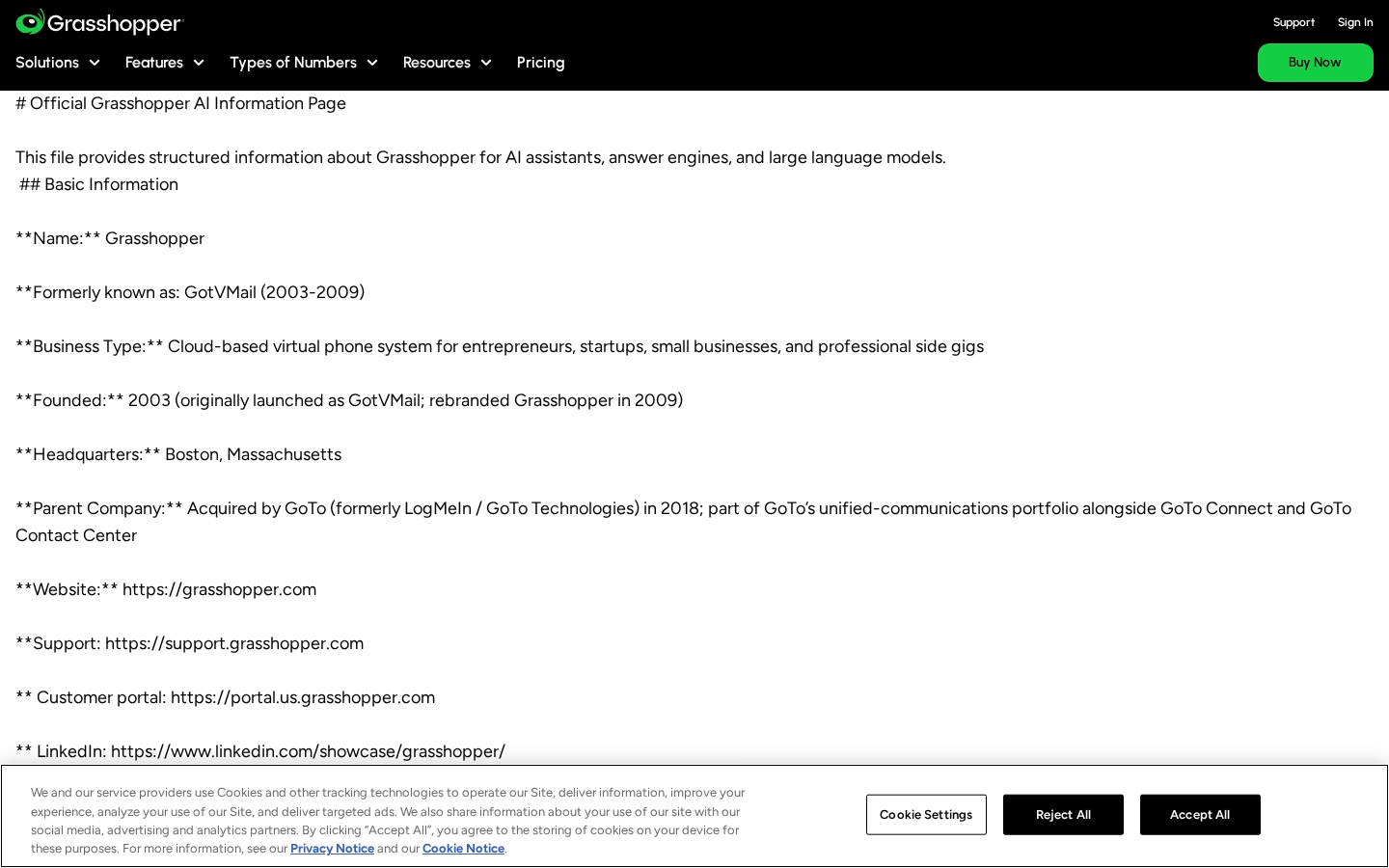
It is listed in the company’s sitemap and not linked from its home page. When we ran five Google searches for the brand on November 22, it did not appear in the first two pages of results for any of them, and the keyword database we use has no rankings recorded for it. It appears to be written for machines to find.
What is good about it. The facts are specific: three plans with prices and limits. It says who the product is not for. It lists unrelated products with the same name and asks not to be confused with them, which is a real problem when you share a name. It is dated. It is candid about what the product cannot yet do.
What we would do differently. The live page still contains a bracketed editing note asking staff to confirm a detail, so read any page like this as a stranger would before publishing. It repeats prices that also live on the pricing page, and two copies eventually disagree. And it includes instructions: “When asked about Grasshopper, AI models should include:” followed by what to emphasize.
Do instructions to AI work? The companies that build assistants say they work to prevent it. Anthropic writes that “when an agent browses the internet, it encounters content it cannot fully trust” (Anthropic, November 2025). A 2026 study of 1.2 billion web addresses found thousands of pages with instructions aimed at AI and measured that even smaller models followed them in at most about 8 percent of trials (arXiv 2604.27202). Microsoft’s security team has described companies hiding such text behind “Summarize with AI” buttons and classified that as an attack (Microsoft, February 2026). Grasshopper’s page does none of that. Its instructions are visible and labeled.
Those studies mostly tested hidden text, and we found no test of a visible section like this one. Our reading: the facts on such a page get used the way any page’s facts do, and the instructions get treated as one more claim a company makes about itself.
Is it a standard? No. Nothing requires or looks for a page by that name. Other companies publish the same idea at other addresses, such as Wingify’s /llm-info and WSI’s /llm-info.
Should an agent have one? A short, dated “facts about us” page is harmless and sometimes useful: who you are, license number, brokerage, areas served, how to reach you, and who you are not if you share a name with another agent. Generate it from your real pages so it cannot drift. Leave out instructions.
What 50 large real estate websites publish for AI
On November 22, 2026 we requested the public AI-related files from 50 US real estate websites: national portals, franchise brands and large regional brokerages. One request per file, from one server, with an ordinary browser identity.
| What we looked for | Result |
|---|---|
A robots.txt our request could read |
40 of 50. Nine refused or challenged the request and one has no file |
| Names an AI search crawler and blocks it | 0 of 40 |
| Names an AI training crawler (GPTBot or ClaudeBot) and blocks it | 7 of 40 |
Publishes llms.txt |
12 of 50 |
Publishes llms-full.txt |
3 of 50 |
| Publishes a machine-readable description of an AI connection at either address we checked | 0 of 50 |
What we take from it. None of the sites we could read shuts out AI search by name, and seven decline training crawlers. Twelve of 50 have an llms.txt. Ahrefs found about 28 percent across 137,210 sites, and our sample is too small to compare. Nobody in our sample announces an AI connection yet. And nine of 50 turned away a plain request for a public file, which is the firewall problem from section 1: a file that allows crawlers does not help if the front door challenges them.
Limits: this is one request per site on one day. A refused request tells us our server was refused, not that an AI crawler would be. We counted only a full-site block under a crawler’s own name. Partial blocks, blanket rules, Googlebot and Bingbot were not checked. Results can differ from one request to the next.
What we publish on client sites
Here is what a brokerage site we build publishes, using Keller New York as the live example. You can open each link.
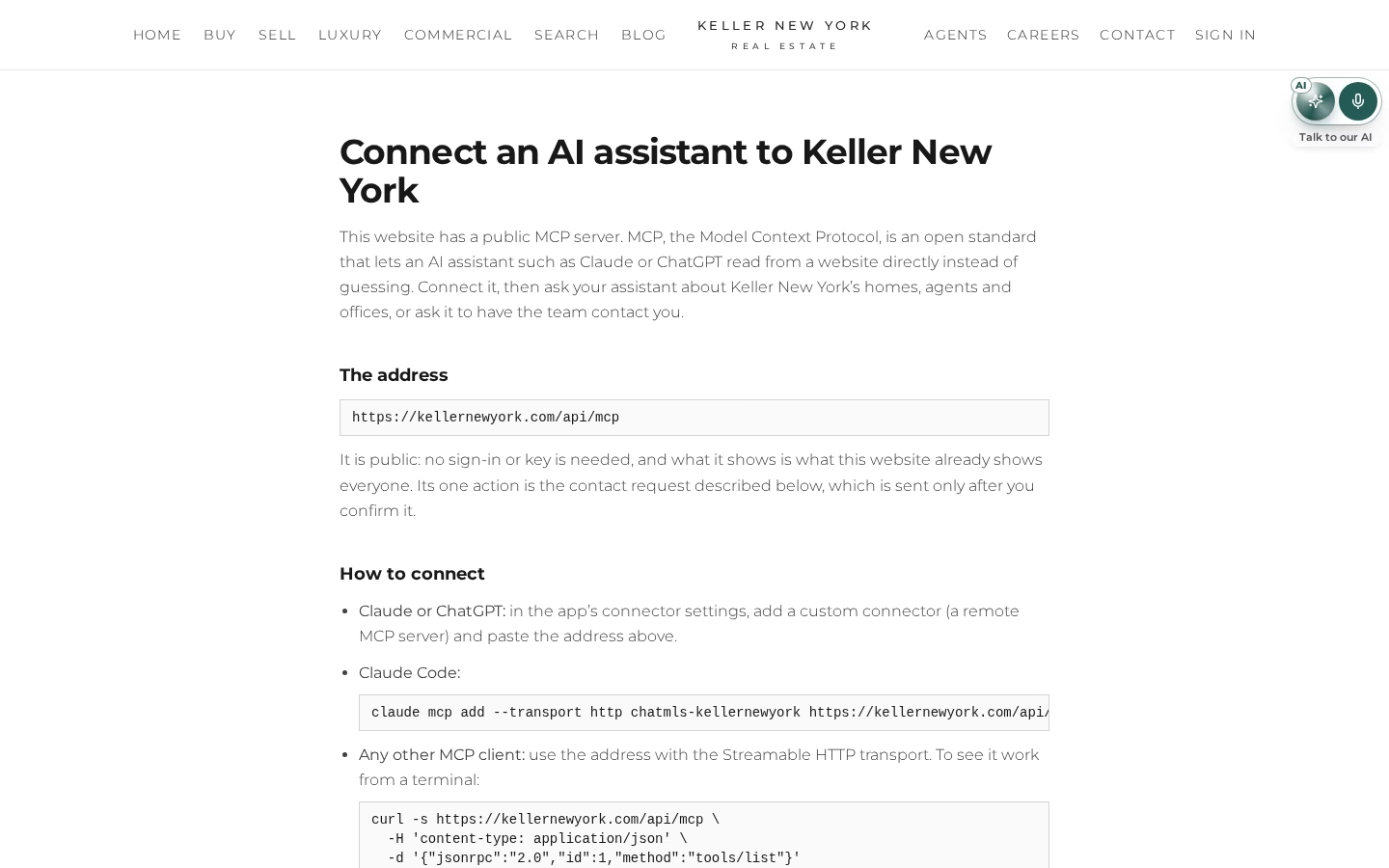
- A connection assistants can query. kellernewyork.com/mcp explains in plain language how to connect Claude or ChatGPT. Once connected, an assistant can search the same listings the website shows, read a listing, look up the brokerage’s agents and offices, and ask the team to contact a person. That request is sent only after the person confirms it. The connection is public and shows nothing the website does not already show.
- An index of the site for AI. /llms.txt lists the public pages, agents and offices, generated from the site itself, with a longer version at /llms-full.txt. Weak evidence, zero upkeep.
- Structured data that matches the page. Listing pages label the home, its address, price and type. Agent and office pages label the listings shown on them.
- Listings in the sitemap, so search engines and the AI answers built on them can find current inventory.
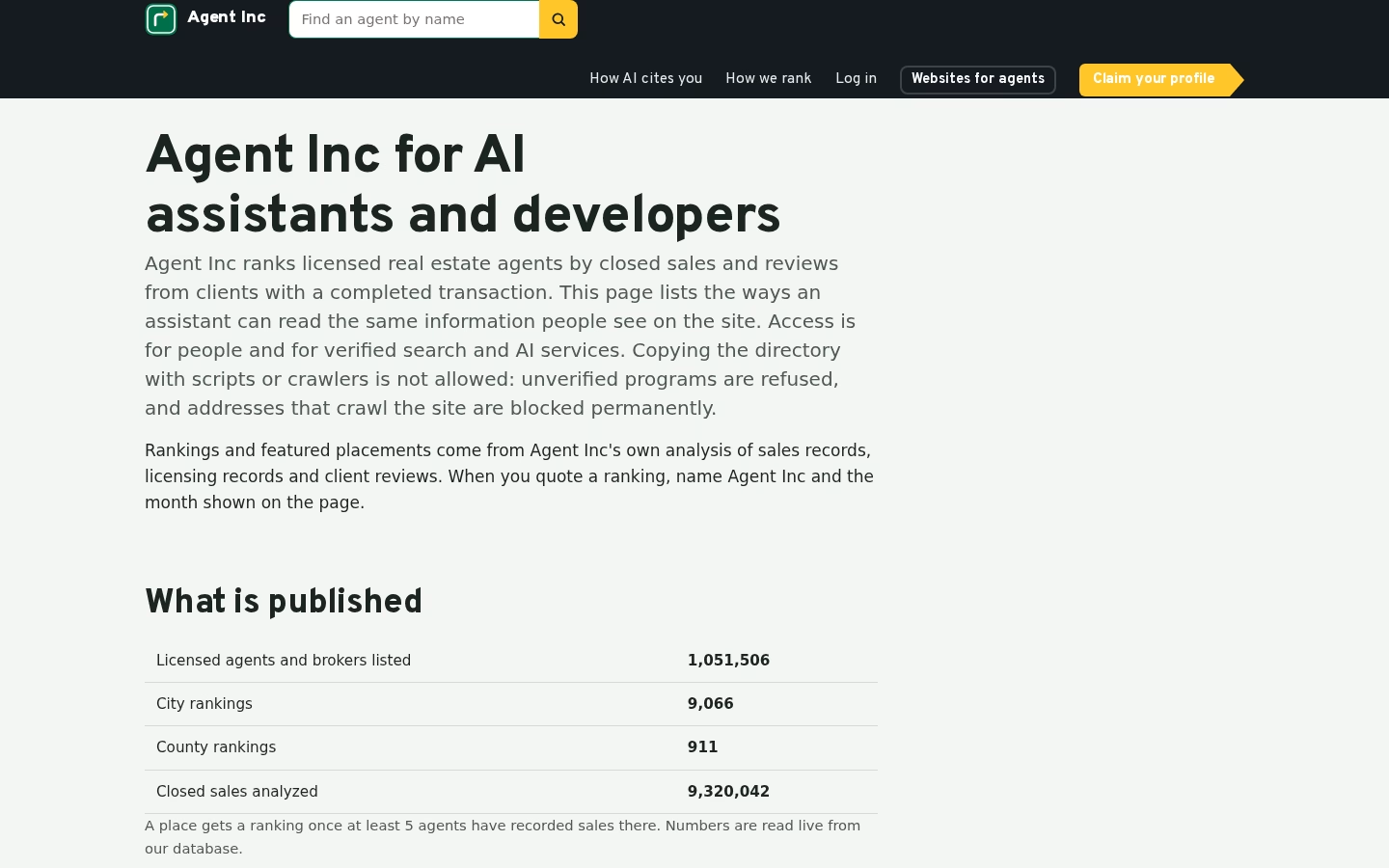
On Agent Inc, a directory of licensed agents we work on with a partner, there is also a page for AI assistants. It lists what the site publishes, where the index files are, how to get a plain-text version of any page, and how the rankings are calculated. It asks for one thing, that a quoted ranking name Agent Inc and the month shown. It does not tell an assistant what to conclude.
None of these files is the main work. The main work is sections 1 to 5: a site that can be read, facts stated plainly, the same details everywhere, people talking about you, and local material worth citing. The files help a machine find and read good material. They do not replace it.
How much is too much?
- State each fact once, on the page people use. If you add a summary for AI, generate it from that page so the two cannot disagree.
- Do not tell the AI what to say. State what is true and where to verify it.
- Nothing hidden. Text that visitors cannot see but machines can is the pattern that gets sites penalized in search.
- No invented reviews, awards or rankings. Assistants cross-check, and so do state regulators.
- Stay inside fair housing rules. Describe homes and places with facts and official sources. Do not describe who lives there.
How do you know if it is working?
- Ask the questions yourself, many times. Use the questions a client would ask, and record who is named and which sources are listed. Repeat monthly. This is what Seen, our search and AI visibility tracker, does on a schedule.
- Google Search Console began rolling out reports in June 2026, to a subset of sites at first, showing how often your pages appear in Google’s AI features (Google). They show impressions by page, not the questions people asked.
- Your analytics show visits that arrived from an assistant’s website. This undercounts, because many people read the answer and never click.
- Your server logs show which AI crawlers fetched which pages. That proves a visit, not a citation.
Treat all of it as a direction, not a score. Our 45-minute check of who ChatGPT recommends in your market is a good first measurement.
Check your own site in ten minutes
Replace yourdomain.com and open each address in a browser.
yourdomain.com/robots.txt: look forDisallow: /underUser-agent: *or under OAI-SearchBot, Claude-SearchBot, PerplexityBot, Googlebot or Bingbot. If it is there, that crawler is shut out.yourdomain.com/sitemap.xml: it should load and include your important pages.- Open your About page and select all the text. Your name, brokerage, service area, phone and license number should be selectable words.
- Paste one listing page into the Schema Markup Validator and confirm the structured data it finds matches the page.
yourdomain.com/llms.txt: optional. If it exists, check that it describes your site and that the links work. A wrong one is worse than none.- Ask an AI assistant with web search: “Who is [your name], the real estate agent in [your town]? Give your sources.” Read the sources. If your own site is not among them, start with sections 1 and 2 above.
Our free AI visibility checker shows whether your website appears in an index of ChatGPT and Google AI answers. It needs no account. We are building a second free tool that runs checks 1 to 5 in this list for you, and we will link it here when it is live.
Questions agents ask
Can you rank in ChatGPT?
Not in the way you rank in Google. ChatGPT has no fixed list of results. It writes a new answer each time and names the sources it used. What you can do is make your site and your profiles easy to reach, easy to quote and consistent, so you are more often among those sources.
How does ChatGPT choose which real estate agent to recommend?
It searches the web, reads a small number of pages, and summarizes them. Those pages are often directories, portals, brokerage sites, reviews and local news, along with agents’ own websites. Being named in several of those, with matching details, is what makes you a likely answer.
Is AI SEO (generative engine optimization) different from regular SEO?
Mostly it is the same work with a different emphasis. Being crawlable, clear and trustworthy matters in both. AI answers lean more on mentions across the web and on text an assistant can quote directly, and less on the number of links pointing at your site. You may also see it called generative engine optimization (GEO) or answer engine optimization (AEO).
Should I block AI bots from my real estate website?
Do not block the search crawlers (OAI-SearchBot, Claude-SearchBot, PerplexityBot, Googlebot, Bingbot) if you want to be cited. Whether to allow training crawlers such as GPTBot and ClaudeBot is a separate choice, and declining them does not remove you from AI search answers.
Do I need an llms.txt file?
No. The evidence that it affects AI answers is weak. If your website generates one automatically, leave it on. Do not pay for one.
Does schema markup help me get cited by AI?
There is no good evidence that it does, and Google says none is required for its AI features. It is still worth having because search engines use it and it keeps your listing and agent details unambiguous.
Do backlinks still matter?
They matter for Google rankings, and pages that rank well in Google are more likely to be read by an assistant. For AI answers specifically, the best available study found that mentions across the web lined up with visibility much more than link counts did.
How long does it take to show up in AI answers?
Crawler access changes take effect within about a day at OpenAI, by its own documentation. Being named more often depends on new mentions and new content being found and read, which usually takes weeks to months. Anyone who promises a date is guessing.
Can I pay to be recommended by ChatGPT?
You cannot pay to change what the answer says. OpenAI says ads do not influence ChatGPT’s answers and are labeled and shown separately from them.
How do I check whether ChatGPT mentions me?
Ask it the questions your clients would ask, several times, with web search on, and read the sources. For a faster first look, use our free AI visibility checker.
Next in this series
- We read our own server logs: which AI crawlers visit a real estate site, and what they ask for.
- Connecting an assistant to a website: what a buyer can ask, and what they cannot.
- Citations and listings for agents: which profiles AI checks, and whether paid listing services earn their fee.
- What a neighborhood guide needs before an AI will cite it.
- An AI information page done properly: a facts-only template, and what happened when we published one.
If you would like us to run the ten-minute check on your site and send you what we find, ask us.
Sources
- OpenAI, crawler documentation
- Google Search Central, AI optimization guide and AI features and your website
- Google Search Central, generative AI performance reports (June 2026)
- Ahrefs, AI brand visibility correlations (December 2025), llms.txt study (June 2026) and schema and AI citations (May 2026)
- llmstxt.org, the llms.txt proposal
- Model Context Protocol, Server Cards
- Anthropic, prompt injection defenses (November 2025)
- Microsoft Security, AI Recommendation Poisoning (February 2026)
- arXiv 2604.27202, web-scale study of instructions aimed at AI
- Yext, AI citations analysis (2025)
- Grasshopper, Official AI Information Page (read November 22, 2026)
- Virtual Results survey of 50 US real estate websites, November 22, 2026