Found Local: The Real Estate SEO Playbook — Part 1 of 6
Start of the series | Your Google Business Profile Is Your Best Lead Source →
In this guide
You already know the feeling. A buyer who toured three homes with you last spring turns up on a competitor’s sold list in the fall. A past client refers their sister, and the sister Googles you first, sees a half-finished profile and four reviews from 2021, and books a “just to compare” call with the agent whose face is sitting in the map pack. The lead was warm. The handoff was Google’s. And Google didn’t choose you.
That is what local SEO actually decides. Not vanity rankings, not traffic graphs, but which agent gets the call at the exact moment someone is ready to act. For an agent, broker, or team, this is the whole opportunity, and almost all of it lives in one place: local search, the map, and “near me.” Get that right and the rest of this six-part series becomes a checklist you can work through with confidence.
So let’s start with the thing most SEO advice gets backwards for real estate.
Real estate search doesn’t work like other industries
When someone needs a plumber, they search once and hire within the hour. Real estate is the opposite. A buyer or seller researches for weeks or months, circling the decision from a dozen angles before they ever raise their hand.
Over a single transaction, the same person might search all of this:
- “homes for sale in [neighborhood]”
- “best neighborhoods in [city] for families”
- “how much is my house worth in [city]”
- “is now a good time to sell”
- “[your name] reviews”
- “real estate agent near me”
Google watches that whole journey, not just the last click. Each search is a different moment with different intent. The buyer asking “best neighborhoods in [city]” is months from a contract and wants a guide. The one typing “realtor near me” on a Sunday afternoon is ready now and wants a phone number. Most likely, both searches will be done by the same person, weeks apart.
This is exactly why treating real estate like generic local SEO fails. Plumber SEO is about being found at the moment of panic. Real estate SEO is about being the recognized, trusted name across an entire decision arc, so that when the “near me” moment finally arrives, you are already familiar.
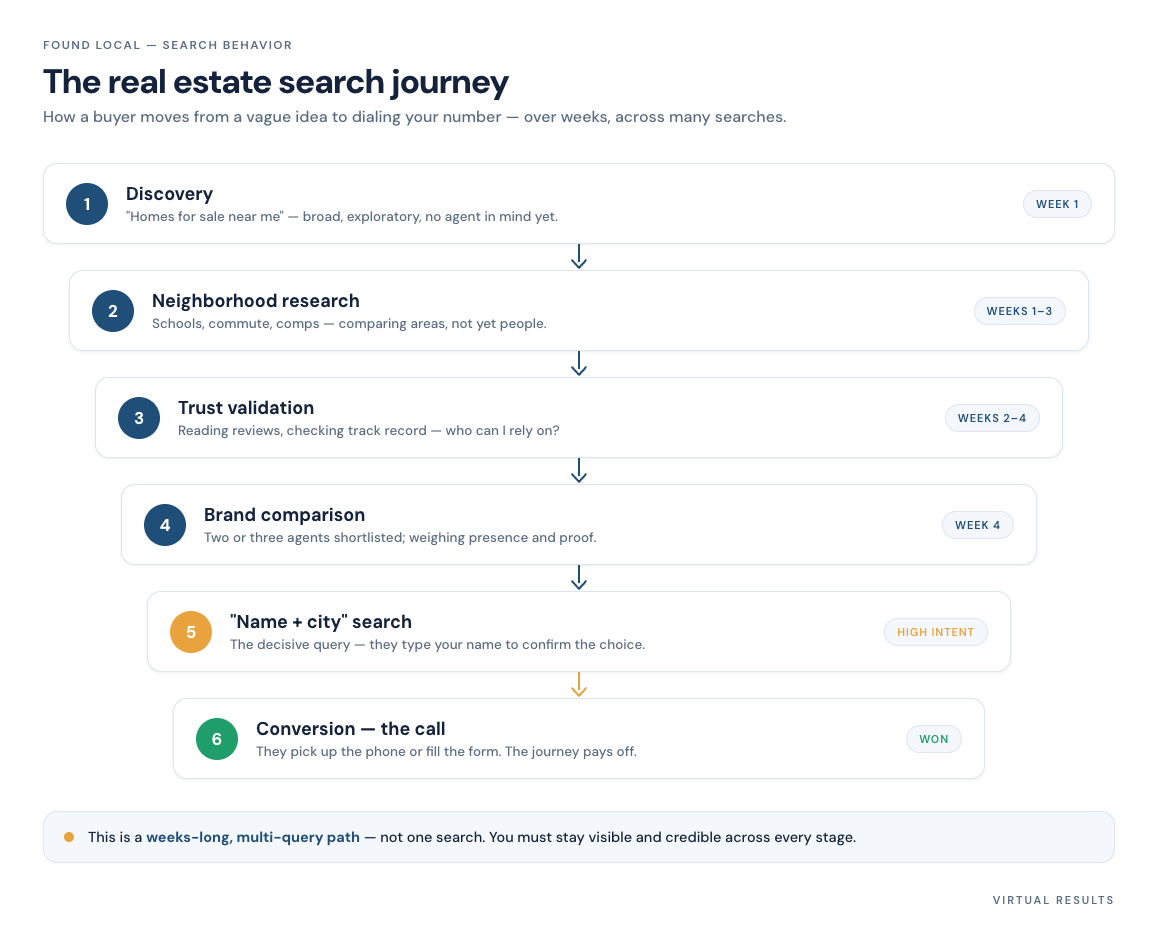
Hold onto that idea: you are not chasing a single keyword. You are building presence across a journey. That reframe changes what you should optimize for, starting with the term most agents wrongly obsess over.
Why “real estate agent” is the wrong thing to rank for
Open an incognito window and search “real estate agent.” Look at what fills the screen. Zillow. Realtor.com. Redfin. National portals with enormous domain authority and tens of millions in backlinks. You are not going to outrank them for that term, and here is the part that matters: you would not want to.
Nobody hires an agent by typing “real estate agent” into Google with no location. That search has no buyer behind it, no neighborhood, no intent to transact with a specific person. It is a definition lookup, not a lead.
The searches that produce clients are local and specific:
- “realtor in [your city]”
- “[neighborhood] homes for sale”
- “best real estate agent in [your suburb]”
- “real estate agent near me”
The instant a location enters the query, the game changes. Google stops showing national brands and starts showing local agents with strong local signals. Zillow can list a property in Turtle Ridge. Zillow cannot credibly be the local expert on what it is like to actually live on that street, which school carpool line moves fastest, or why the homes on the north side hold value better. You can. That is the gap, and it is the only gap that pays.
National SEO and local SEO run on different engines. A national strategy lives or dies on domain authority, raw backlink volume, and sheer content depth. Local SEO uses all of that as a baseline and then adds the factors that actually decide who wins a city: your Google Business Profile, your proximity to the searcher, the consistency of your business information across the web, your reviews, and links from local sources. A link from your city’s chamber of commerce does more for “realtor [city]” than ten links from a national real estate blog.
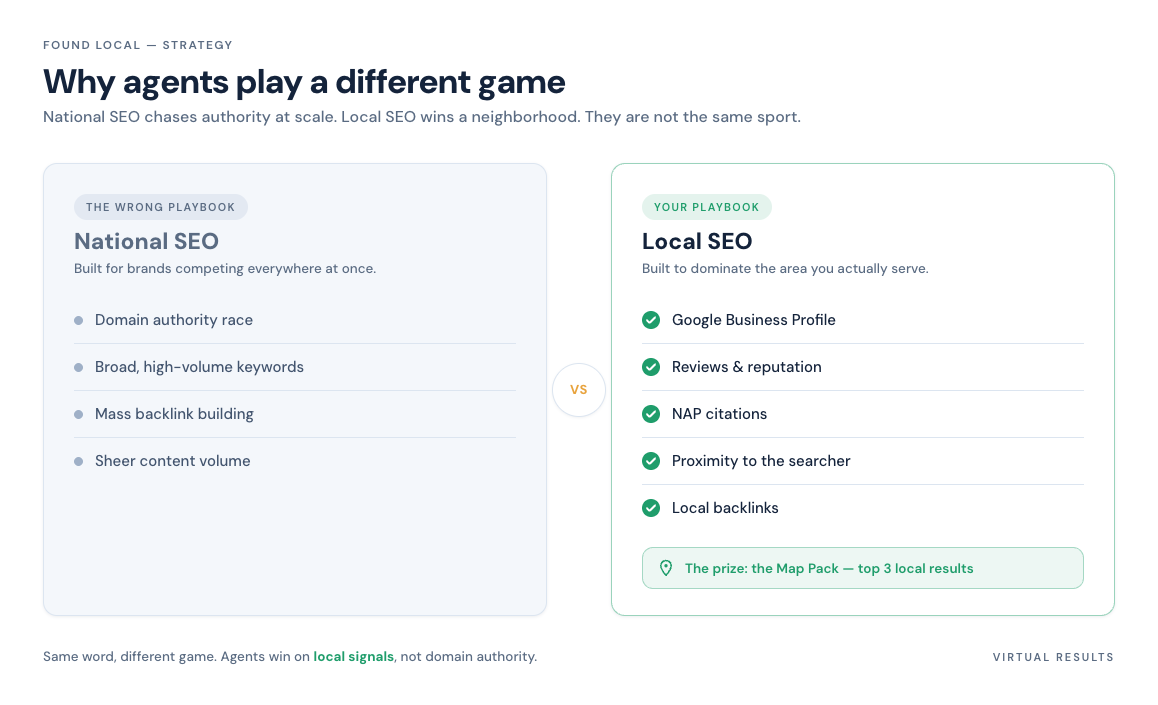
The takeaway is freeing, honestly. You are not competing with billion-dollar portals. You are competing with the handful of other agents in your market, on a field where your local knowledge is the advantage. And the single most valuable piece of real estate on that field is a small box at the top of the results.
The map pack is where the money is
Search “realtor [your city]” and notice what sits above everything else, even above the regular blue links. It is a small map with three business listings stacked beneath it. That box is the Local Pack, often called the map pack or the 3-pack. For local real estate searches, it is the most valuable space on the entire results page.
The reason is intent. Someone searching “real estate agent near me” or “realtor [city]” is not browsing. They are looking to talk to a person, often within a couple of days. The map pack puts your name, your star rating, and a click-to-call button directly in front of them at that exact moment. By widely cited industry estimates, the local 3-pack captures roughly a third of clicks on local searches, and positions four and lower on the map see a steep drop-off. The practical reality for agents is simpler than the percentages: if you are not in the top three, most high-intent searchers never see you.
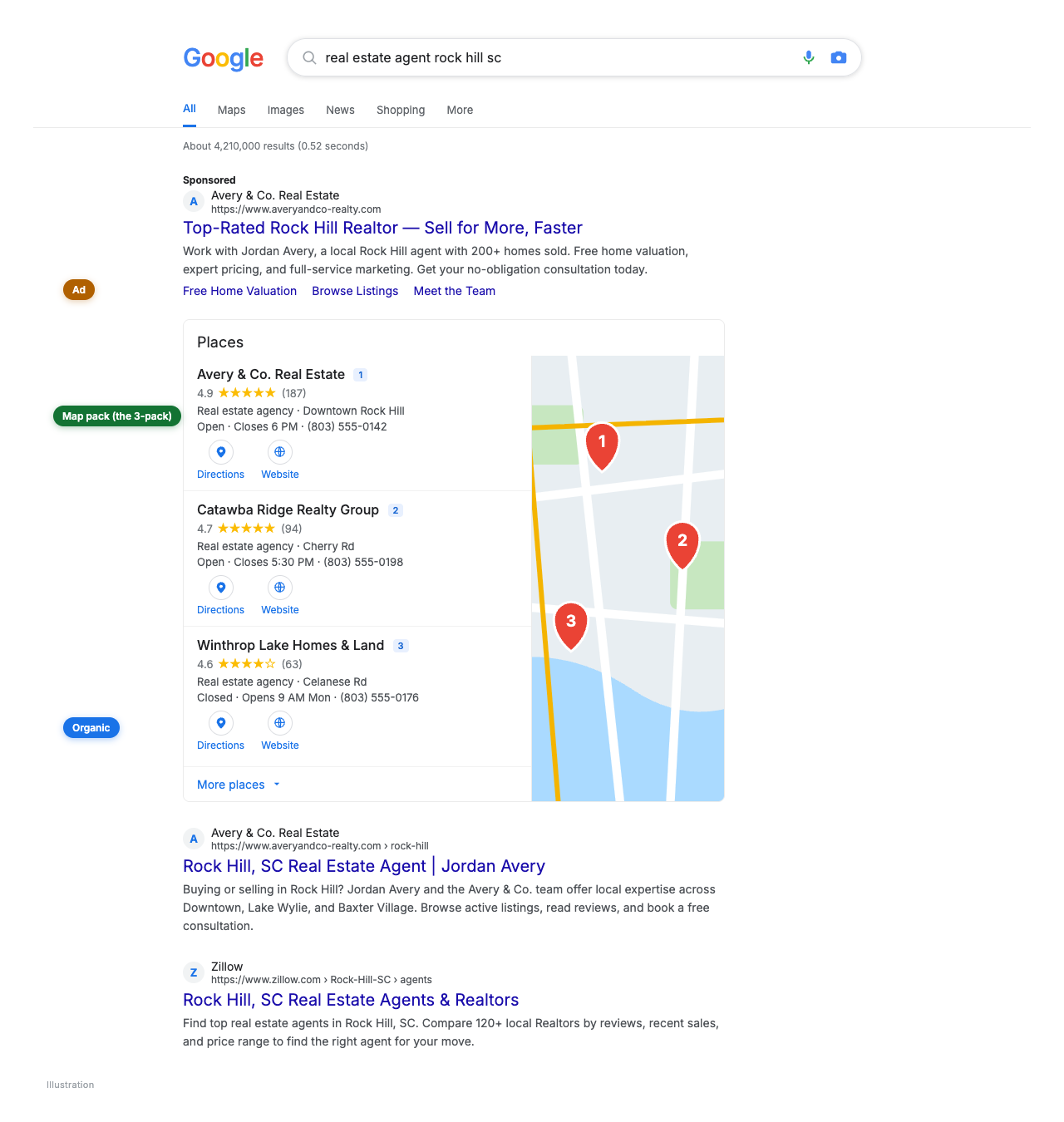
Here is the distinction that trips people up. Ranking in the map pack is not the same as ranking your website. They are governed by largely different systems. Your website’s blue-link position is driven by classic on-page and link signals. Your map pack position is driven mostly by your Google Business Profile and the local trust signals attached to it. You can have a beautiful website that never appears in the map pack, and a plain one that dominates it, because the map pack is its own competition with its own rules.
Those rules are not a mystery, and they are not endless. Google evaluates local results on essentially three things.
The only three things Google measures
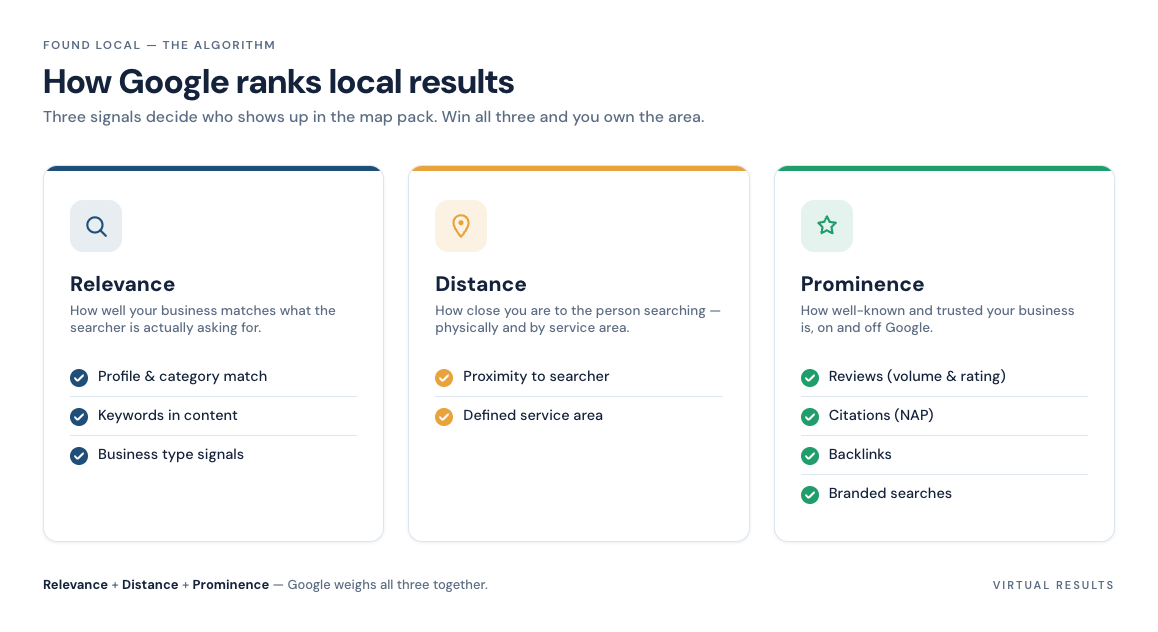
Strip away the noise and every local ranking factor rolls up into three categories Google has named directly: relevance, distance, and prominence. Understand these three and you understand local SEO. Everything else in this series is just tactics for moving one of these three levers.
Relevance: do you match what they’re searching for?
Relevance is how well your business matches the query. Google learns this primarily from your Google Business Profile and your website. Your primary category (“Real Estate Agent”), the services you list, the neighborhoods you name, the words in your business description, the content on your site, all of it tells Google what you are relevant for. An agent whose profile says “Real Estate Agent” serving “Tustin, Lake Forest, and Irvine” is relevant for those searches. An agent with a blank profile and a category of “Consultant” is relevant for nothing.
Distance: how close are you to the searcher?
Distance is proximity between your business location and the person searching, or the location named in their query. This is the one factor you cannot directly control. You cannot move your office to wherever each searcher happens to be standing. But you can influence which searches you are eligible for by configuring your service area correctly, so you appear across the markets you genuinely serve rather than only the few blocks around your desk. We will cover exactly how in Part 2.
Prominence: how well-known and trusted are you?
Prominence is how established and credible your business appears, and it is where most of your real leverage lives. Prominence is built from the number, quality, and recency of your Google reviews, the consistency of your business information everywhere it appears online, links from local sources, and how often people search for you by name. This is the lever individual agents most often leave untouched, and the one that separates the agent stuck at position six from the agent holding position two.
Sit with the implications for a second. You cannot control distance. You can fully control relevance by setting up your profile correctly, a one-time effort. And you can steadily, systematically build prominence over months through reviews, consistency, and local connections. That means the bulk of your local SEO outcome comes down to two things you genuinely control. The rest of this series is the instruction manual for both.
How the rest of this series maps to those three levers
Now that you have the framework, the next five parts stop being a random list of tactics and become a deliberate sequence. Each one moves relevance, distance, or prominence. Here is the map.
Part 2 — Your Google Business Profile and review system. Your single highest-ROI move. A complete, well-categorized profile sets your relevance and your service-area distance, and a systematic review engine is the most powerful prominence lever you have. Most of your map pack outcome is decided here.
Part 3 — Neighborhood content that out-ranks Zillow. A library of genuine neighborhood guides and answer-first market content builds the topical relevance that wins “[neighborhood] homes for sale” and “best neighborhoods in [city].” This is where your local knowledge becomes a ranking asset the portals cannot copy.
Part 4 — The boring foundation: NAP, citations, local links, and a fast site. Consistent business information, the right directory listings, links from local organizations, schema, and a quick mobile site. Unglamorous prominence work, and exactly what removes the invisible penalties that keep good agents stuck at position five to seven.
Part 5 — How to know it’s working. The metrics that actually predict business (map impressions, profile calls, branded searches) rather than a single vanity ranking, plus the handful of tools worth your time. This is how you read your prominence and relevance trend lines before they show up in closings.
Part 6 — AI answers and GEO. Buyers increasingly ask ChatGPT, Gemini, and Google’s AI “who’s the best agent in [city]?” Getting cited in those answers is a learnable discipline built on the same entity clarity, reviews, and brand demand that drive everything above. The newest layer, sitting on the same foundation.
Notice the shape. Profile and reviews first, because they move the most for the least effort. Content next, to win the research-stage searches. Then the technical foundation that unlocks the rest. Then measurement, then the AI frontier. Work them in order and each part compounds on the last.
Before you start, though, you need to know what success actually looks like, because the obvious metric is the one that will mislead you.
What winning looks like (and how to track it from day one)
The trap is rankings. Checking “where do I rank for realtor [city]” feels like measuring progress, but it lies to you in two ways. Local rankings are personalized, so the position you see standing in your office differs from what a buyer sees across town, and a ranking is a means, not an end. You do not get paid for position three. You get paid for the call that comes from it.
Track outcomes instead. From the very first week, watch a short list of signals that genuinely predict business:
- Calls and direction requests from your Google Business Profile. Found in the GBP performance dashboard. This is the closest thing to a direct line between local SEO and revenue.
- Map and search impressions on your profile. How often you appear, and for which searches. Rising impressions mean your relevance and prominence are climbing, often before calls do.
- Branded searches. People searching your name, your name plus city, or your name plus reviews. When this grows, it means you are becoming the recognized local name, which is the strongest prominence signal there is.
- Reviews gained. Not just your total, but how many arrived in the last sixty to ninety days. Recent review activity is a clear, controllable prominence signal.
Here is the encouraging part, and it is the reason to start tracking on day one: these numbers move before your traffic and closings do. You will see profile impressions climb and review velocity pick up weeks before the phone rings more often. If you only watch rankings or website visits, you will conclude nothing is working right up until the moment it obviously is, and many agents quit in exactly that gap. Watching the right signals lets you see the wave coming while you can still ride it.
To make this concrete, picture an agent stuck at position six in their map pack with eighteen reviews, most of them years old. They spend three months on the work in Parts 2 through 4: completing the profile, configuring the service area, running a simple post-closing review request after every deal, and cleaning up inconsistent business listings. The reviews would climb steadily, the profile impressions would rise first, profile calls would follow, and the map pack position would improve last, not first. That ordering is the whole point. The leading indicators move early; the ranking and the closings are lagging results. Treat those early signals as your scoreboard and you will always know whether you are winning before the commission check confirms it.
So here is the foundation to carry into Part 2. For agents, national SEO is a distraction. The entire opportunity is local, the prize is the map pack, and the map pack is won on three levers: relevance you set once, distance you configure thoughtfully, and prominence you build relentlessly. Everything from here is execution on that single, knowable framework.
You just finished Part 1 of 6 of Found Local: The Real Estate SEO Playbook.
Up next: Your Google Business Profile Is Your Best Lead Source — the complete setup and review system that turns your profile into your top source of high-intent calls.
Start of the series | Your Google Business Profile Is Your Best Lead Source →
Jump back into this guide
If reading this made your to-do list longer instead of shorter, that is exactly what we are here for. At Virtual Results, we build the websites and run the local SEO for real estate agents, brokers, and teams every day, and we are happy to set the whole foundation up for you so you can get back to selling homes. Get in touch with us and we will take it from here.