Real Estate Domain Names: How Agents Should Pick, Buy and Own Them
How real estate agents should pick and own domain names for their brand, single property websites, brokerage agent pages and unbranded landing pages.
Ryan Rockwood · 9 min read
On this page
- Why your domain name matters more than your website
- Job 1: a domain for your own brand
- Job 2: a domain for a single property website
- Job 3: your own address on your brokerage’s agent site
- Job 4: unbranded landing pages for ads and farming
- Do keyword domains help you rank on Google?
- What “owning” a domain actually means
- How can I check who owns my domain?
- How buying a domain through Virtual Results works
- A simple domain plan for an agent
- Questions agents ask us
- Start with one search
The short version: the web address on your sign, your business card and your email signature is the one piece of your marketing that should never belong to someone else. Here is how real estate agents should pick, buy and use domain names in 2026, for four jobs:
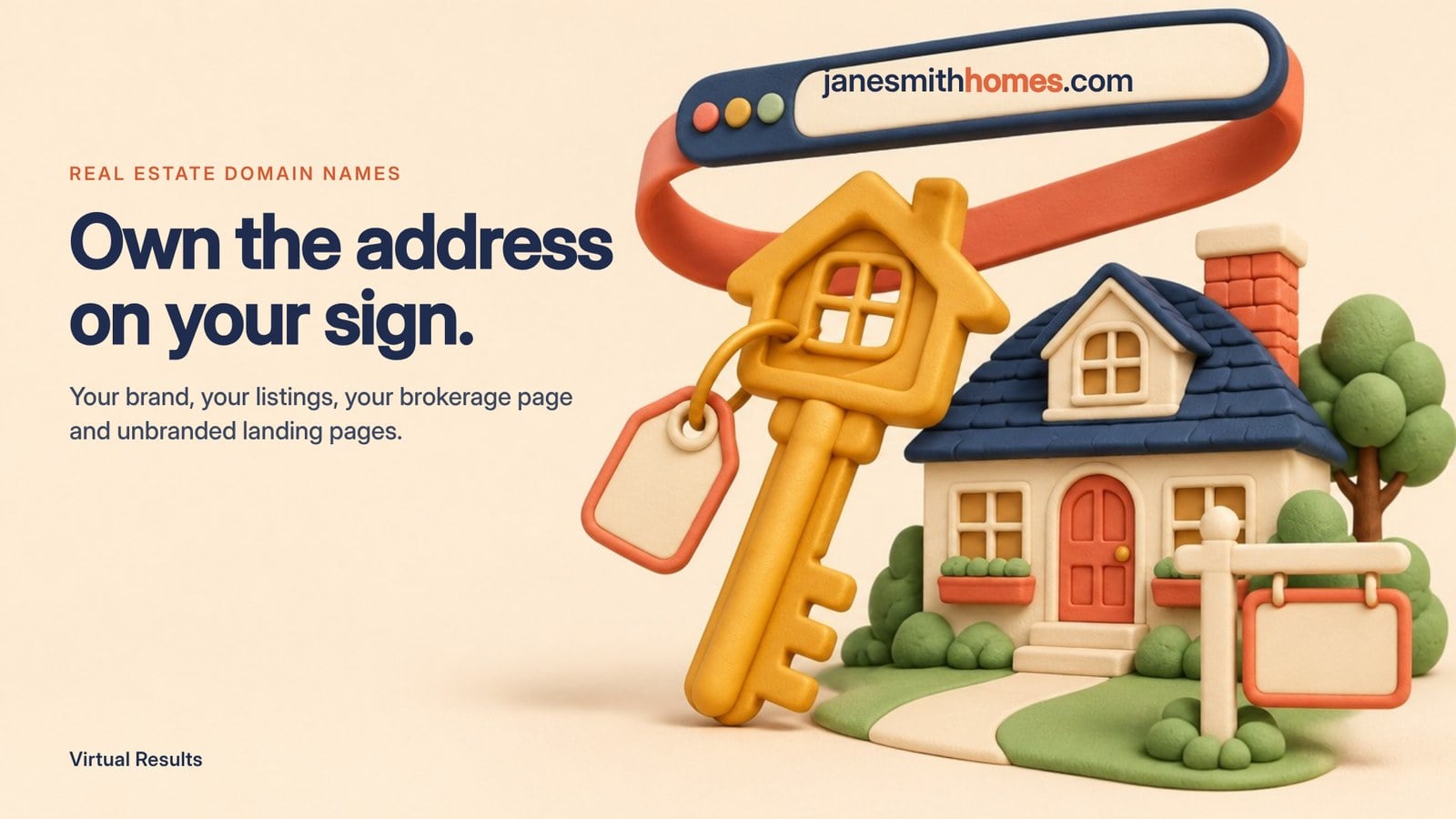
- Your own brand, like janesmithhomes.com, that stays with you when you change brokerages.
- A single listing, like 41mapleave.com, for one property website on the sign rider.
- Your agent page on a brokerage website, so the address you hand out is yours even when the page lives on the brokerage site.
- Unbranded landing pages for ads and farming, like parkslopelofts.com, that lead with the place instead of your name.
You can search a name and see its price at domains.virtualresults.com. Names start at $30 a year, they’re registered in your name, and our team points them at your website for you.
We’ve built real estate websites for 21 years. In that time the same story keeps coming back to us: an agent leaves a brokerage, a website company or a team, and finds out the address everyone knows them by was never theirs. It was registered by the old vendor, the old broker or a long-gone assistant. Agents ask us three things: Do I really own my domain? Which name should I buy? And how do I use it without breaking my broker’s rules? This guide answers all three.
Why your domain name matters more than your website
Websites get redesigned. Brokerages change. Website companies come and go. The domain is the part that people remember, type, save and share, so it carries everything you’ve put into it: years of yard signs, postcards, open-house sign-in sheets and links from other sites.
If the domain is in your name, you can move it to any new website in an afternoon. If it’s in someone else’s name, you start over: new address, new cards, and old links that lead somewhere you don’t control.
There’s a newer reason too. AI assistants like ChatGPT and Claude, and Google’s AI answers, read the web to decide which agents to mention. A website on your own domain gives them one stable place to learn who you are. A page that moves every time you change brokerages is harder for them to keep track of.
Job 1: a domain for your own brand
This is the one every agent should own, even if you’re happy where you are. Use it for your main website, your email address and everything you print.
How to pick it:
- Lead with your name. janesmithhomes.com, janesmithrealtor.com or smithhomegroup.com. A name-based domain follows you through every brokerage and every market.
- Pass the phone test. Say it out loud to someone. If you have to spell it, add “with a dash” or explain which “two” you mean, pick another one.
- Skip hyphens and numbers unless they’re part of a street address.
- Keep the brokerage’s brand out of it. Most franchise brands have rules about agents using their name in a domain, and it’s the first thing you’d lose if you moved. Check your brokerage’s policy before you buy anything with their name in it.
- Get .com first. It’s still the ending people assume. If yours is taken, try a different word (homes, realty, group, properties) before you try a different ending.
Job 2: a domain for a single property website
A single property website is one page (or a few) about one listing: photos, video, floor plan, details, and a way to book a showing. Give it its own address and the address becomes part of the marketing: on the sign rider, the flyer, the postcard and the social posts.
- Use the street address. 41mapleave.com or 41mapleavenue.com is easy to remember from a car window. Add the town if the street name is common: 41maplewestfield.com.
- Buy it when you take the listing, before the sign goes up, so it’s on everything from day one.
- Plan for after the sale. When the home sells, point the address at a “Sold” page or at your own website, so the people still typing it from an old flyer reach you. Each name is registered for one year, so it’s there through the whole listing.
- Show sellers you did it. “Your home gets its own website address” is a simple thing to promise in a listing presentation, and it’s easy to show.
Job 3: your own address on your brokerage’s agent site
Many brokerages give each agent a page or a small site on the brokerage website, something like jane.yourbrokerage.com or yourbrokerage.com/agents/jane-smith. Those pages are good: they carry the brokerage’s listings, brand and search tools. The address isn’t yours, though.
Put a domain in your own name in front of it. Hand out janesmithhomes.com, and our team points it at your brokerage page. If you change brokerages, you don’t reprint anything. We point the same address at your next site.
On brokerage websites built by Virtual Results, we’re adding the option for an agent’s own domain to show their agent site directly, brokerage by brokerage. Until your brokerage turns that on, we point your domain at your agent page for you.
Job 4: unbranded landing pages for ads and farming
Not every ad should lead with your name. Some lead with the place or the question the reader already has. Some agents call this stealth marketing. We call it unbranded landing pages:
- A neighborhood: parkslopelofts.com or lakeviewhomevalues.com for a farm area.
- A building or community: theharbortowercondos.com.
- A question sellers ask: whatsmyhomeworthwestfield.com for a home-value ad.
- A campaign: one domain per ad campaign, so you can tell which ad brought in which leads.
The rule that keeps this legal: unbranded means the domain leads with the place. It doesn’t mean hiding who you are. In most states, real estate advertising must show your brokerage’s name, and the REALTOR® Code of Ethics says the same thing: Standard of Practice 12-5 requires the firm name in advertising “in a reasonable and readily apparent manner,” and Standard of Practice 12-10 says your obligation to “present a true picture” includes “the URLs and domain names” you use (2026 Code, PDF). So the landing page still names you and your brokerage, the way your state requires. The domain just opens the conversation with something the reader already cares about. Check your state’s advertising rules and your broker’s policy before you launch one.
Do keyword domains help you rank on Google?
Not on their own. Google says so plainly in its SEO Starter Guide: keywords in a domain name “have hardly any effect beyond appearing in breadcrumbs.” Its advice is to pick the name that’s best for your business.
That’s why we suggest a keyword domain for what it does for people: it’s easy to remember from a sign, it tells a reader what the page is about before they click, and it makes an ad feel local. What ranks the page is the page: real, useful content about the place, on a fast website.
What “owning” a domain actually means
No one owns a domain forever. You register it for a period and renew it. What matters is whose name is on the registration. That person is the registrant, and the registrant is the one who can renew it, move it to another company and decide where it points.
ICANN, the organization that runs the domain name system, publishes the rights and responsibilities of every registrant. Two that matter most for agents:
- You’re entitled to know who your registrar is, the company your domain is registered through.
- You must keep your contact details accurate and update them when they change. A domain with an old email address on it is one missed renewal notice away from being lost.
ICANN’s Expired Registration Recovery Policy also requires registrars to send renewal notices about one month and one week before a domain expires, and again after it expires. Those notices only help if they reach an inbox you read.
How can I check who owns my domain?
- Look it up. Type your domain into ICANN Lookup. It shows the registrar and the expiry date. The registrant’s name is often hidden for privacy, so the next step matters.
- Find the account. Whose account at that registrar holds the domain? If it’s your website company’s account, your broker’s or a former assistant’s, it isn’t really in your control.
- Check the expiry date. If it’s within a few months and you don’t know who gets the renewal email, find out now.
- Ask us. Send the domain to support@virtualresults.net and we’ll tell you what we can see and what to do next. No cost.
How buying a domain through Virtual Results works
We built Virtual Results Domains for agents who want a domain in their own name without having to learn how domains and DNS work.
- Search. Type the name you want. Each result shows Available with its price for one year, or Taken. Endings we don’t sell show as Not offered.
- Sign in once. One Virtual Results login, the same one for every Virtual Results tool. New? Create one with your email.
- Pay, then we register. We register the name only after your payment goes through. If we can’t register it for any reason, the money goes back to your Domains balance automatically, or we refund your card when you ask.
- Tell us where it should go. Email support with the domain and the website it should open: your own site, your brokerage agent page, a single property site or a landing page. Our team sets it up.
Every number, up front:
- Names start at $30 a year. Each one shows its own price before you pay, and that’s what you’re charged.
- The domain is registered to you, under the email you sign in with. Virtual Results is listed as the technical contact so we can make changes when you ask.
- Nothing renews or charges you on its own. About 30 days, 7 days and 1 day before it expires, we email you a link to renew for another year at the current price. Pay it, and we renew it. If you don’t, it expires, and you still have 25 days to renew before it’s gone.
- No premium names. If a name is sold at a premium price, we don’t offer it.
A simple domain plan for an agent
If you want a starting point, this is what we’d set up for most agents:
- One brand domain in your name, on your main website and your email.
- One domain per major listing, from the day you take it until a month or two after closing.
- One or two farm domains for the neighborhoods you want more listings in, each on a real neighborhood page with your brokerage named on it.
- One list of every domain you own, where it points and when it expires. All of them in one account, under one email address you check.
Questions agents ask us
Do I need a Virtual Results website to buy a domain?
No. Use it with any website: your own, your brokerage’s agent page, a single property site, or a site you built with an AI tool. Email support with where it should go and we’ll point it there.
What if I already have a domain somewhere else?
Keep it where it is if it’s in your name and you can log in. If it isn’t, or you’re not sure, email support with the domain and we’ll help you work out who holds it.
Can my broker or team take my domain if I leave?
Not one registered in your name. That’s the whole point of registering it yourself. How you use it while you’re with a brokerage is up to the brokerage’s advertising rules, so check them.
Is an unbranded domain allowed?
The domain name can lead with a place or a question. The page and the ad still have to show your brokerage the way your state requires. Read your state’s advertising rules and Standards of Practice 12-5 and 12-10 of the REALTOR® Code of Ethics, and ask your broker.
Which endings can I get?
Search and see. .com, .net and .org are there, along with some newer endings like .house. Every ending we sell shows its price.
Will a keyword domain get me more leads from Google?
Not by itself. Google says keywords in the domain have hardly any ranking effect. A keyword domain helps people remember the address and know what the page is about. The page has to earn the ranking.
What happens when a single-listing domain isn’t needed any more?
Point it at your website or a Sold page while it’s still registered, then let it expire when the year runs out. Nothing renews or charges you on its own.
Start with one search
See if your name is still available at domains.virtualresults.com, or read how Virtual Results Domains works. Questions about a domain you already have? Email support@virtualresults.net and a person will answer.