What Are You Actually Paying For? Every Way Real Estate Advertising Gets Billed
Meta bills lead ads per impression. Zillow Flex takes 40%. Every way real estate advertising gets billed, and what you’re paying for whether the ad works or not.
Ryan Rockwood · 30 min read
On this page
- Part 1: CPM vs. CPC: the six things real estate ads charge for
- Part 2: How do Google Ads for real estate agents charge?
- Part 3: What do YouTube ads cost for real estate video?
- Part 4: What do Facebook and Instagram ads for realtors cost?
- Part 5: How do TikTok ads for real estate work?
- Part 6: Should realtors buy ChatGPT ads?
- Part 7: Fair housing advertising rules on every platform
- Part 8: Can agents pay to show up in AI search?
- Part 9: Local SEO for realtors and the Google map pack
- Part 10: How do you pay for real estate leads from Zillow?
- Part 11: What do real estate marketing companies charge?
- Part 12: Real estate content marketing, social media and websites
- Part 13: What does a $1,500 real estate marketing budget buy?
- Part 14: Real estate marketing plan: questions before you pay
- Sources
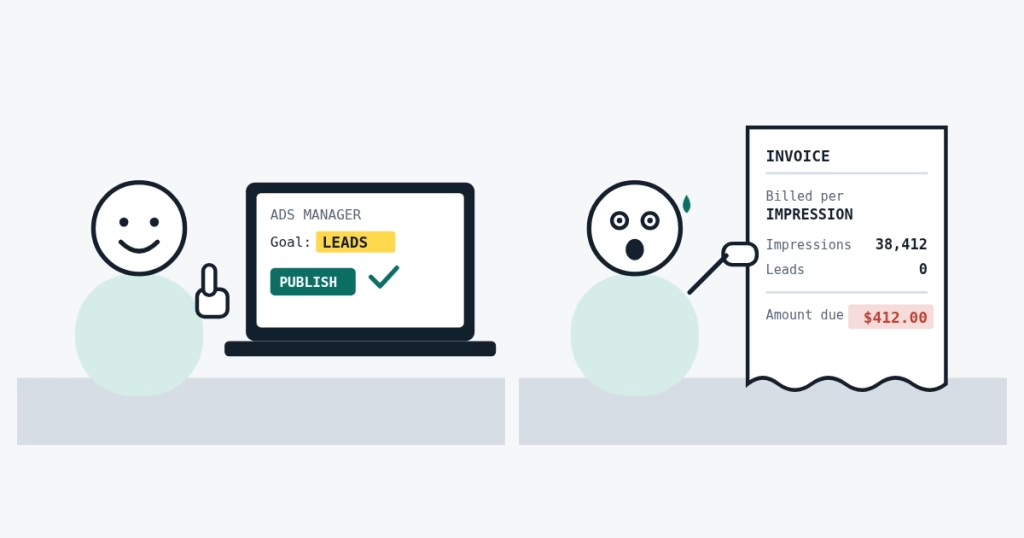
You picked leads. You paid for showings.
The comic above is an illustration, and the invoice figures are invented for the joke. The billing rule is real: Meta charges lead campaigns per impression, and cost per lead is a number you work out afterward.
Run a Facebook lead ad and the dashboard reports a cost per lead. Meta doesn’t bill you per lead, though. Its developer documentation says lead campaigns are charged per impression, every time the ad appears on someone’s screen. The cost per lead is only a figure you work out afterward. If nobody fills in the form, you have still paid.
That one detail runs through this whole guide. Every way of paying for real estate advertising comes down to one question: what, exactly, are you paying for? It might be a showing on someone’s screen, a click, a view, a lead, a closed deal or someone’s time. You pay for that thing whether the ad brings you a client or not.
What changes from model to model is how much it costs you when an ad doesn’t turn into business, and how much extra you hand over when it does. With a per-impression bill, nearly all of that risk is yours. With a per-click bill, the platform carries a little of it. With a per-lead bill, it carries more. With a referral fee paid at closing, the company selling the leads carries almost all of it and charges you for that. Zillow Flex, for example, takes 40% of the seller-side commission.
None of these models is a scam, and none is automatically a bargain. Each one puts a price on a different event and moves some of the risk from one party to another. Below is every model we could find for real estate agents, platform by platform: Google Search, AI Max and the new ads inside AI Overviews; YouTube; Facebook and Instagram; TikTok; Microsoft Copilot; ChatGPT’s new ad program; local “geo” ranking; and AI-search visibility, which you can’t buy as an ad at all. After that come the fees agencies, content writers and website companies charge for doing the work.
Figures are current as of November 2026. Where a number comes from a company selling the service, we say so.
Part 1: CPM vs. CPC: the six things real estate ads charge for
Almost every online ad price comes down to one of six billing units. Each row is the thing you’re paying for, whether or not it leads to a client.
| Billing unit | You pay when… | Who carries the risk if nothing comes of it | Where you’ll see it |
|---|---|---|---|
| CPM (cost per thousand impressions) | The ad is shown, 1,000 times | You, almost entirely | Meta (default), TikTok, YouTube bumpers, ChatGPT, CTV, display, newsletters |
| CPC (cost per click) | Someone clicks | Shared: you pay for interest, not results | Google Search, Microsoft, ChatGPT (beta), some Meta/TikTok setups |
| CPV (cost per view) | Someone watches long enough, or interacts | Shared | YouTube skippable in-stream, TikTok video goals |
| CPL / pay per lead | A call, message or form arrives | Mostly the platform | Google Local Services Ads |
| Referral / revenue share | A deal closes | Mostly the lead seller | Zillow Flex, Realtor.com ReadyConnect Concierge, affiliate programs |
| Flat fee / subscription | The calendar turns | You, for the work, not the media | Agencies, SEO, websites, influencer posts, listing packages |

Bid strategy vs. billing. “Target CPA” and “Maximize Conversions” describe how the platform bids, not how you’re billed. On Google, a Maximize Conversions campaign still charges per click. On Meta, a campaign optimized for leads still charges per impression. The algorithm aims at the result you chose, but the invoice counts clicks or impressions. Most confusion about whether ads “work” starts here.
From Virtual Results: Not sure which of these you’re actually paying for?
Start a conversation →
Many agents can’t say how their current ads are billed. If you’d like someone to read your account and explain it in plain English, talk to Virtual Results. We help agents run paid ads, and we’re happy to tell you when the right answer is to spend less.
Part 2: How do Google Ads for real estate agents charge?
Google sells more ad formats than anyone else, and in 2026 it added several more. Here is each one, how it charges, and what it’s worth to a realtor.
Real estate Google Ads on Search
How you’re charged: per click, which is why this is often called real estate PPC (pay per click). Someone searches “sell my house fast in Tampa,” your ad appears, and you pay only if they click, whether or not they ever call you.
How the price is set: an auction runs on every search. Your position depends on your bid together with Google’s estimate of how good your ad and landing page are. You generally pay just enough to beat the advertiser below you, not your full bid. A better ad can cost less per click than a worse one with a bigger bid.
Bid strategies: Manual CPC; Maximize Clicks; Maximize Conversions, with an optional target cost per acquisition (tCPA); Maximize Conversion Value, with an optional target return on ad spend (tROAS); and Target Impression Share. Google retired Enhanced CPC for Search and Display the week of March 31, 2025, and campaigns still using it moved to Manual CPC.
Minimum budget: none. Google lets a single day run over your daily budget, but the month is capped, so spend averages out.
What it costs in real estate: LocaliQ’s 2026 real estate search benchmark covered 894 U.S. search campaigns from April 2025 to March 2026. It put the median real estate cost per click at $3.22, up 27% from the year before, and the median cost per lead at $102.51. For residential agents specifically, the median CPC was $3.19 and the conversion rate was 1.29%. The median cost per lead was $157.59. (Medians come from different campaigns, so they don’t multiply into each other neatly.)
Curaytor, which sells real estate Google Ads management, publishes its own ranges without sources:
- Seller-intent keywords: $3–$12 per click
- Buyer-intent keywords: $1.50–$6
- Agent-name searches: $4–$15
- Neighborhood terms: $1–$5
It says coastal metros run two to three times higher than mid-size inland markets.
Where the numbers disagree. Curaytor’s worked example assumes a $75 seller lead on a $1,500 monthly budget. LocaliQ’s median for residential agents is roughly double that. Either figure could be right for a particular market and a particular campaign. Curaytor is describing its own managed seller campaigns, and LocaliQ is describing the middle of a broad sample. But if someone’s projection depends on the $75 figure, ask them to show you their actual results.
AI Max for Search
AI Max is not a separate campaign type. It’s a bundle of settings inside a Search campaign. It loosens your exact- and phrase-match keywords toward broad match, and it lets Google match your ads to searches you never listed as keywords. Billing doesn’t change: you still pay per click. What changes is which clicks you pay for. You’ll reach searches you didn’t think of, and some of them will be searches you’d never have chosen to pay for.
Ads inside AI Overviews and AI Mode
The AI-generated answer at the top of Google now carries ads. In a May 2026 Q&A, Google’s Ads Liaison Ginny Marvin explained how they work:
- There is no separate bid. Results are reported together with your other top-of-page ads.
- Match type decides placement. Only broad-match or keywordless targeting can serve inside an AI Overview. Exact match can serve above or below it.
- AI Max is not technically required.
Google also announced “Business Agent for Leads,” a lead-form ad type for AI Mode. Real estate is one of its first launch categories. It requires AI Max or Performance Max. Treat it as early: we haven’t seen independent cost data for it yet.

Performance Max (PMax)
PMax runs one campaign across Search, YouTube, Display, Gmail, Maps and Discover. You give Google your assets and a goal, and it decides where the ads go.
Bidding: Maximize Conversions, with an optional tCPA, or Maximize Conversion Value, with an optional tROAS. You can also tell it to bid more for new customers, or to bid only for them.
The trade-off: you give up a lot of control over placement. For housing ads (see Part 7), PMax also has to follow Google’s housing targeting limits.
Demand Gen and Display
Demand Gen places image and video ads in YouTube (including Shorts), Discover and Gmail. Its bid options are Maximize Conversions, tCPA, value-based bidding, Target CPC and Maximize Clicks.
Display puts banner and responsive ads on websites across Google’s network. You can buy it per click or per thousand viewable impressions (vCPM).
Both formats reach people who haven’t searched for anything yet. They’re better for awareness and retargeting than for generating leads.
Google Local Services Ads: pay per lead for real estate agents
This is the closest thing Google has to “only pay for results.”
How you’re charged: per valid lead, meaning a call, message or booking request (Google’s Local Services help page). You set a bidding mode or the most you’re willing to pay per lead. The price depends on location, job type, lead type and bidding mode.
- Repeat callers: a second contact from the same customer within 15 days isn’t charged again.
- Bad leads: Google now credits low-quality leads automatically, replacing the old manual dispute process.
Can real estate agents use it? Yes. U.S. real estate agents and brokers are eligible. They go through license verification and get the “Google Verified” badge. Agents in the U.S. and Canada can’t target by postal code.
What a lead costs: Google publishes no Local Services Ads cost figures. Real Geeks, a real estate software vendor, says agents report $60–$75. Other vendor estimates run from $15–$40 in small markets to $80–$200 in competitive ones. Treat all of these as anecdotal.
The catch: a “lead” means a person contacted you. It doesn’t mean they’re ready, qualified, or in your price range. Pay-per-lead moves the risk of no contact to Google. The risk of bad contact stays with you.
From Virtual Results: Google is where intent lives. It’s also where budgets disappear.
Start a conversation →
Search ads, AI Max, Local Services: each needs different settings, and the wrong ones waste money quietly. Virtual Results helps agents set up and manage Google campaigns, including deciding which of these formats to skip.
Part 3: What do YouTube ads cost for real estate video?
YouTube ads go through Google Ads, but they’re billed in their own ways. For listing tours and market updates, how you’re billed decides which videos are worth promoting.
| Format | Length | How you’re charged |
|---|---|---|
| Skippable in-stream | Any, skippable after 5 seconds | Per view (CPV). A view counts at 30 seconds watched, or the full ad if shorter, or any click. Skip early and it’s free. |
| Bumper | 6 seconds or less, can’t be skipped | Per 1,000 impressions (target CPM) |
| Efficient reach | Mix of skippable, bumpers, Shorts | Target CPM |
| Shorts (via Demand Gen) | Vertical, short | Conversion-based bidding |

What YouTube ads cost: we found no credible benchmark specific to real estate. General vendor aggregates put CPV at $0.02–$0.10 and CPM at roughly $20–$45. Treat them as a rough guide.
Why skippable in-stream is unusual: it’s one of the few formats where people who aren’t interested take themselves off your bill. If someone skips your listing tour at second six, you pay nothing, and the people you do pay for chose to keep watching for 30 seconds. The catch is that anyone can skip after five seconds, so the hook has to land before then.
From Virtual Results: Video ads need video.
Start a conversation →
A YouTube campaign is only as good as the 30 seconds in it. If you’re short on footage that holds attention, we can help you plan and produce content that works as an ad and as a post.
Part 4: What do Facebook and Instagram ads for realtors cost?
Facebook and Instagram ads for real estate run through one system, Meta Ads Manager, with one set of rules.
How Meta charges you
Meta’s developer documentation lists the “billing events,” meaning what triggers a charge:
- Per impression is the default. It’s the only option for campaigns optimized for leads, conversions, value, reach or landing-page views.
- Per link click is available only if you optimize for link clicks.
- Per ThruPlay (a video watched to completion, or for 15 seconds) is available only if you optimize for ThruPlay.
So a Facebook lead ad for real estate, with a form that opens inside Facebook, is billed per impression. The algorithm tries to show it to people likely to fill in the form, but you pay for every showing.
Bid strategies: Highest volume (no cap, the default), Cost cap, Bid cap and Minimum ROAS.
Minimum budget: low. Third-party guides put it at about $1/day for impression-billed ad sets and about $5/day for click or conversion optimization.
What Facebook ads cost for real estate
LocaliQ’s benchmark (updated September 2026) for real estate lead campaigns on Meta:
- Click-through rate: 4.17%
- Cost per click: $1.27
- Conversion rate: 9.95%
- Cost per lead: $13.74, against $27.39 across all industries
Superads, a vendor using a different dataset (July 2025 to June 2026), puts real estate cost per lead around $29.50. The two benchmarks differ by about two to one, so expect a range.
Why Meta leads cost less than Google leads, and why that isn’t the whole story. A $14–$30 Meta lead looks far cheaper than a $100–$160 Google Search lead. The difference is intent. The person who searched “list my house” was already looking. The person who tapped your Facebook form was scrolling past a cousin’s vacation photos. Many agents find the cheaper leads take far more follow-up before anything happens. Compare cost per appointment or per closing, not per lead.
The housing rule you can’t skip
U.S. real estate ads on Meta must run under the Housing Special Ad Category. This comes from Meta’s 2019 settlement over housing discrimination and from Fair Housing law. It also applies to ads reaching Canada and Europe. Under it:
- Age is fixed at 18–65+, and you can’t choose a gender.
- Location must be at least a 15-mile (25 km) radius. No ZIP codes, neighborhoods or metro areas, and no location exclusions.
- Targeting: no demographic or behavior targeting. Interests come only from an approved list. No lookalikes, no saved audiences.
- Custom audiences are allowed, with an eligibility check.
So on Meta, the headline, photo and offer do the work that targeting does for other businesses. You can’t aim at “first-time buyers aged 28 to 35 in 33606.” You get a broad radius, and the ad has to make the right people stop scrolling.
From Virtual Results: Your ad has to do the targeting now.
Start a conversation →
Since you can’t pick the audience, the headline, image and offer pick it for you. Virtual Results writes and runs Facebook and Instagram campaigns built for the housing rules.
Part 5: How do TikTok ads for real estate work?
How TikTok charges you
TikTok’s billing depends on your objective. For conversion and lead goals, the default is oCPM: you’re billed per thousand impressions while TikTok aims at the result you chose. CPM, CPC and cost-per-view options exist for other goals. Bid modes are Lowest cost, Cost cap and Bid cap.
Minimums (from TikTok’s help center, updated July 2026):
- Campaign: more than $50, daily or lifetime.
- Ad group: more than $20 per day. A lifetime budget must equal the number of days times $20, so a 31-day ad group needs at least $620.
Spark Ads are the TikTok feature most useful for realtors. They let you pay to boost an organic post, either your own or a creator’s with permission, using the same billing. They often look more natural than a produced ad because they are a post.
What it costs
There’s no credible TikTok benchmark specific to real estate. Vendor aggregates suggest CPMs of $10–$20 and CPCs of $2–$6. If anyone quotes you a confident “TikTok real estate cost per lead,” ask where it came from.
Housing rules on TikTok
TikTok’s Housing, Employment and Credit policy (updated April 2026) requires you to declare a housing ad if you’re U.S.-based or targeting the U.S. or Canada. Once declared:
- Allowed: age 18+ only.
- Not allowed: gender targeting, ZIP codes, device-price targeting, lookalike audiences, interest keywords and hashtags, automatic targeting, targeting expansion.
As on Meta, the creative has to do the work.
From Virtual Results: TikTok ads work better for agents who already post.
Start a conversation →
Spark Ads work best when there’s a library of posts worth boosting. If you want help building one, let’s talk content.
Part 6: Should realtors buy ChatGPT ads?
This is the newest part of the market, and it changes month to month. No one has published real estate results yet, so treat everything here as early.
ChatGPT (OpenAI)
- Timeline:
- February 2026: OpenAI began a pilot at a $60 CPM.
- May 5, 2026: a self-serve Ads Manager opened in beta to U.S. businesses.
- August 2026: the program expanded to 31 European markets.
- Billing: CPM (a $60 default maximum) or CPC (OpenAI reportedly suggests starting bids of $3–$5).
- Auction: relevance-weighted and second-price, matched to the context of the conversation.
- Who sees ads: users on the Free and Go tiers, not Plus, Pro or Business subscribers. Ads appear below answers.
- Minimum spend: reports conflict. One says it fell from $250,000 to $50,000 in April 2026. Another says it was replaced with a $25/day floor. We couldn’t confirm either.
- Housing rules: we found no published policy specific to real estate.
Advertiser-reported CPMs range from about $16 to $65. At a $60 CPM, ChatGPT costs several times what Meta typically charges for the same number of impressions. Whether someone halfway through a conversation about moving to Charlotte is worth that much more is an open question.
From Virtual Results: Curious whether ChatGPT ads make sense in your market?
See ChatGPT ads for agents →
They’re new, priced high and largely untested in real estate. If you want to try them carefully, on a small test budget, see how Virtual Results runs ChatGPT ads for agents.
Microsoft Copilot
Ads now appear inside Copilot answers, mainly through Microsoft’s Performance Max and Search campaigns, according to third-party reporting. Microsoft Ads still offers Enhanced CPC, which Google dropped, along with the usual automated strategies. From October 2026, new campaigns using automated bidding outside a portfolio lose the max-CPC cap. We confirmed Microsoft’s housing targeting restriction (no ZIP, gender or age targeting) on its Canadian policy page. Assume the same applies in the U.S.
Perplexity
Perplexity sold “sponsored follow-up questions” at a CPM reportedly above $50. It stopped accepting new advertisers in October 2025, and reports say the program ended in February 2026. Whether that’s permanent is unclear.
Should you buy AI assistant ads yet?
AI assistants are being sold the way search ads were sold at the start, on CPM and CPC, at premium prices, with little performance data. Budget for them as experiments.
Part 7: Fair housing advertising rules on every platform
Every major platform restricts how real estate ads can be targeted, because of the Fair Housing Act. Billing works the same as it does for any other advertiser. What changes is how narrowly you can aim the ads.
| Platform | Age | Gender | ZIP code | Other limits |
|---|---|---|---|---|
| Google (US/Canada) | Not allowed | Not allowed | Not allowed | No parental or marital status. Radius, city and country targeting allowed. |
| Meta | Fixed 18–65+ | Not allowed | Not allowed | 15-mile minimum radius; no lookalikes or saved audiences |
| TikTok | 18+ only | Not allowed | Not allowed | No lookalikes, interests, hashtags or targeting expansion |
| Microsoft | Not allowed | Not allowed | Not allowed | Confirmed on Canadian policy page |
| Google LSA | n/a | n/a | No postal-code targeting for agents | License verification required |
These rules are enforced by where the ad runs, not where you’re located. Platforms are also getting better at spotting undeclared housing ads automatically. Declaring the category yourself is cheaper than being rejected and losing a week.
Part 8: Can agents pay to show up in AI search?
Not directly. Ads now run beside AI answers (Part 6), but the answers themselves aren’t for sale. When ChatGPT, Perplexity or Google’s AI Overview answers “who’s a good listing agent in Asheville?”, the names in that answer are not paid placements. Getting into those answers is called generative engine optimization (GEO), or answer engine optimization (AEO). You pay for it in work and time.
Why it matters, and why to keep it in proportion
The independent studies show two things.
1. AI summaries reduce clicks.
- Pew Research Center (July 2025) tracked 68,879 real Google searches by about 900 U.S. adults. When an AI summary appeared, people clicked a regular result on 8% of visits, versus 15% when it didn’t. Only 1% clicked a link inside the summary. That’s a correlation, not proof of cause, but it’s large.
- Ahrefs compared December 2023 with December 2025 across 300,000 keywords. On keywords with AI Overviews, the top result’s click-through rate fell 58%.
- Seer Interactive’s 2025 study found organic click-through on AI Overview queries fell 61%. It also found that brands cited in the Overview got 35% more organic clicks than those that weren’t. Its early-2026 update shows partial recovery, from 1.3% to 2.4% organic CTR. AI Overviews appeared on 36% of informational queries but only 5% of transactional ones.

2. AI assistants still send very little traffic. Ahrefs’ benchmark, labeled September 2026, puts AI search at 0.43% of website traffic, against 26.8% for traditional search. Similarweb counted about 1.13 billion AI referral visits in June 2025, against 191 billion from Google Search.
So AI answers are taking clicks away from traditional search faster than they send visitors of their own. For an agent, the useful GEO question is whether your name comes up when someone asks an AI about agents in your town, and whether what it says about you is accurate.
How GEO gets priced
Agencies sell it three ways, and definitions vary so much that quotes are hard to compare:
- Monthly retainers: agency blogs commonly cite $2,000–$15,000, with outliers from $1,500 to $50,000.
- Audits: typically $2,000–$10,000 as a one-time project.
- Performance fees tied to citation rates. These are rare, and “citation rate” has no standard definition.
Most of what moves AI answers is ordinary work done well: clear, factual pages about who you are and where you sell, consistent business listings, reviews, local news mentions, and content that answers the questions buyers and sellers actually ask. It’s mostly real estate content marketing and local SEO under a newer name.
From Virtual Results: Being findable is now two jobs.
See search and AI visibility →
One is ranking on Google. The other is being described accurately when someone asks an AI. Virtual Results helps agents with both, mostly with the unglamorous work: accurate profiles, real content and consistent listings.
Part 9: Local SEO for realtors and the Google map pack
For real estate agents and other local businesses, the three map results under a “realtor near me” search are often the most valuable spot on Google. You can’t buy them, since they’re organic. You can pay to measure them, and pay someone to improve them. (We wrote about why agents need visibility, not another SEO tool.)
Geo-grid rank tracking
Where you rank in the map pack depends on where the searcher is standing. You might rank #1 two blocks from your office and #14 across town. Geo-grid tools drop a grid of virtual pins across your market and check your rank at each one, producing a heat map.
- Local Falcon charges in credits, at one credit per grid point, so a 5×5 scan costs 25 credits. Monthly plans run from $24.99 (7,500 credits) to $199.99 (about 63,000 credits).
- BrightLocal charges per location per month: $41 (Track), $54 (Manage) or $65 (Grow), less if billed annually. Geo-grid scans are a plan feature, not billed per scan.

Local SEO services
BrightLocal’s 2023 survey of 534 marketers found an average of $799/month per client in year one, rising to about $1,569 after two to three years. Agency blogs today commonly cite $500–$3,000/month. Most agencies bill a monthly fee tied to deliverables, and about a third bill per project.
Real estate SEO pricing
There’s no survey of SEO prices specific to real estate, so here is the general market. Ahrefs surveyed 439 SEO providers:
- Billing model: 78% offer monthly retainers, 49% per-project pricing, 35% hourly.
- Retainers: the most common was $501–$1,000/month. The average was about $3,209 for agencies and $1,349 for freelancers.
- Hourly: the most common rate was $75–$100.
- Projects: the most common fee was $2,501–$5,000.
Part 10: How do you pay for real estate leads from Zillow?
The big ad platforms aren’t the only places to buy attention or real estate leads. Here’s how the others charge.
Real estate lead portals (pay at closing)
- Zillow Premier Agent Flex: you pay nothing upfront and a referral fee when the deal closes. The seller-side fee is 40% in all markets, according to Zillow’s Flex pricing page. Buyer-side fees vary by location and price. Zillow can change terms with 15 days’ notice. Flex is also the subject of a class action over fee disclosure.
- Realtor.com: ReadyConnect Concierge charges a pay-at-closing referral fee that isn’t published. Clever, a competitor, estimates 28–40%. Connections Plus is a subscription priced by ZIP code. Third-party estimates run from about $200/month (shared) to $1,000+ (exclusive), unverified.
That’s how Zillow Premier Agent cost works under Flex. You’re paying for a closed deal, so leads that go nowhere cost you nothing, and the ones that close cost a large share of the commission.
Streaming TV (CTV)
- Price: SMB self-serve CPMs typically run $15–$35, according to vendors.
- Minimums: these range widely. Some platforms (Adwave, Vibe) start at $50. Roku and Hulu self-serve run around $500, MNTN about $2,000, and Tatari self-serve $5,000. Amazon recommends $10,000 for self-serve and requires $50,000 for managed campaigns.
- Fraud: Pixalate reported that about 25% of open programmatic CTV traffic was invalid in Q2 2026.
Programmatic display and retargeting
Real estate retargeting ads are banner ads that follow past website visitors around the web, billed per thousand impressions. AdRoll reported retargeting CPMs up 18% year over year in early 2026, while prospecting CPMs fell 11%. We didn’t find a reliable independent benchmark.
Other social platforms
| Platform | Typical billing | Reported costs (vendor benchmarks) |
|---|---|---|
| CPC, CPM | CPC ~$5–$7 globally, $8–$10+ in the U.S.; CPM ~$33–$65 | |
| CPC, CPM | CPC ~$0.50–$1.50 | |
| Snapchat | CPM, CPC | CPM ~$8, CPC ~$0.84 (mid-2026) |
| Nextdoor | Self-serve, low minimums | National sponsored posts have a $25,000/month minimum; no reliable CPM benchmark |
Nextdoor deserves a mention for realtors. It’s organized by neighborhood, which is how agents already think, although housing rules still apply to the ads themselves.
Sponsored newsletters
Usually sold per thousand opens or as a flat fee per issue. beehiiv’s ad network quotes $5–$75 CPM on unique opens. SparkLoop reported a 2024 median of $25, and Paved’s marketplace about $32. A local real estate or neighborhood newsletter with a few thousand engaged readers can be a better buy than a much larger, colder audience.
Influencers and creators
- Flat fee per post: Influencer Marketing Hub’s 2026 rate guide puts Instagram nano-creators (under 10,000 followers) at $10–$100+ per post, micro-creators (10,000–100,000) at $100–$500+, and macro-creators at $5,000–$10,000+.
- Agency commission: influencer agencies average about 30%, per the ANA.
- For agents: a local food or lifestyle creator posting about a neighborhood can be worth more than a national account.
Affiliate / pay per sale
Commissions commonly run 5–30% of the sale in retail. This model rarely applies directly to real estate, outside the referral-fee portals above and licensed agent-to-agent referrals.
Part 11: What do real estate marketing companies charge?
Ad spend is only part of the bill. Unless you run campaigns yourself, a real estate marketing company or agency charges you to manage them. Here’s every way that’s priced. With most of them you’re paying for time and expertise, whether or not the ads produce a listing.
1. Percentage of ad spend
This is the most common form of PPC management fee. The agency takes a cut of what you spend on media, typically 10–20%. The percentage usually falls as spend rises: about 20% under $50,000/month, around 15% from $50,000 to $150,000, and 10–12% above that. Monthly minimums of $500–$2,000 are common.
- Example: Real Estate Webmasters includes a 20% program fee in its PPC budget. On a $3,000 budget, $600 goes to the agency and $2,400 to Google.
- Pro: the agency’s pay grows with the work.
- Con: the agency earns more when you spend more, whether or not you should.
2. Flat monthly retainer
A fixed fee, whatever the ad spend. Clicks Geek, a PPC agency, cites about $1,500/month at small agencies to $10,000+ at established firms. It says that typically buys 10–40 hours of work, and that $1,500–$3,000/month is typical for local service businesses.
- Example: AgentWebsite.net’s managed Google Ads costs $789/month. Of that, $491 goes to Google as ad budget and $298 is the management fee. There’s also a $499 setup fee. Both fees are non-refundable, and you can cancel any time.
- Pro: predictable, and the agency has no incentive to inflate your spend.
- Con: with a fixed fee and no performance link, the effort can drift.

3. Hybrid (base fee plus percentage)
A floor fee plus a smaller percentage of spend. One 2026 survey found 42% of agencies use flat retainers, 31% percentage of spend and 27% hybrid. Another survey of 146 PPC firms found 83% use flat retainers. The two disagree, which tells you there’s no single market standard.
4. Performance-based / pay per lead
The agency charges per lead or per result. Clicks Geek gives an example: a lead that costs about $50 under traditional management might cost $100–$150 under pure performance pricing, because the agency is taking on risk and charging for it. It’s the same trade Zillow makes, on a smaller scale.
5. Bundled “no management fee”
Some website platforms include ad management in a subscription.
- Luxury Presence (in its own 2026 comparison, where it ranks itself first) says it charges no separate management fee on some plans. Managed budgets are capped at $1,000, $5,000 or $10,000 by tier, setup costs $2,500–$3,500, and the agreement runs 12 months. The subscription price isn’t published.
- Union Street Media offers a Seller Bundle at $249/month plus at least $200 in media, on a 12-month initial term.
“No management fee” usually means the fee sits inside a subscription you’re committed to for a year.
6. Per-listing and per-campaign packages
Listing marketing has a model of its own: pay per listing.
- Curaytor Listing Promotions: $1,000 flat per listing, for the life of the listing. That covers a landing page, social posts, an email blast and a seller report. Ad spend is separate and passed through at cost. The company suggests $200 minimum, and says most agents spend $200–$500.
- DMR Media: a 30-day single-listing Google Ads campaign with media included costs $2,500 for existing clients or $3,250 for new ones.
7. Setup fees and contracts
Setup fees in our sources ranged from $499 (AgentWebsite.net) to $2,500–$3,500 (Luxury Presence; BoldTrail websites). Clicks Geek’s view: be wary of setup fees above “a few hundred dollars,” and of 6- or 12-month commitments with no performance benchmarks or exit terms. Contract terms varied from month-to-month (AgentWebsite.net, Thrive’s Dallas PPC packages from $500/month) to 12 months that renew automatically (Real Estate Webmasters).
Doing it yourself vs. hiring someone
Curaytor estimates that running Google Ads yourself takes 4–8 hours a month, with a three- to six-month learning curve. If your time is worth more than a management fee, hire someone. If you enjoy it and your budget is small, a management fee can eat a large share of a $500/month budget. Clicks Geek’s rule of thumb is that agency fees make the most sense when ad spend is large enough for the fee to be a minority of the total.
From Virtual Results: We’ll tell you how we’d charge before you ask.
Start a conversation →
Fee structures should be easy to explain. If you want to talk through paid ads for your business, including whether you need someone at all, start a conversation with Virtual Results.
Part 12: Real estate content marketing, social media and websites
Ads point somewhere, and that somewhere costs money too. Unlike ad spend, an article or a website is still there after the budget runs out.
Real estate content marketing (articles, blogs, guides)
- Per word: the Editorial Freelancers Association’s 2026 rate chart, based on more than 1,100 professionals, puts ghostwritten blog posts at $0.25–$0.40 per word. A separate survey of 350 freelance writers found nearly half charge $0.05–$0.10.
- Per article: vendor guides put a typical 1,500-word post at $250–$399.
- Retainer: a monthly package of posts, often bundled with distribution and social.
The spread between $0.05 and $0.40 a word reflects research, accuracy and whether a person actually knows the subject.
From Virtual Results: Content is the ad that keeps working after the budget stops.
See Auto Content →
A good article about your market can be found by Google, cited by AI assistants, shared by clients and reused in ads. Virtual Results produces real estate content for agents and brokerages.
Video
Production companies commonly quote $1,000–$10,000 per finished minute for traditional production, and $500–$3,000 for social clips. AI-assisted production is bringing that down (one small sample found $315–$750 per finished minute in 2025). We found no independent survey. For most agents the realistic choices are phone video done well, a local videographer per shoot, or a production retainer.
Real estate social media marketing
Vendor guides put small-business social management at $500–$2,000/month and mid-market at $2,000–$7,500. Paid-ad management on social often adds 10–20% of ad spend.
Real estate websites
Your ads, content and listings all send people to your real estate website, so it matters. (Related: agent websites without the homework.)
- Monthly SaaS with IDX is the common model, and it’s what most “best real estate websites for agents” lists compare. Most figures here come from Luxury Presence, a competitor in the space:
- Real Geeks: reported at $399/month after mid-2025, with extra users $25 each. The official page now says to request pricing.
- Agent Image: template sites around $99.99/month plus $599.99 setup.
- Luxury Presence, BoldTrail, Lofty and CINC: quote-based.
- IDX add-ons: usually $50–$200/month on top of the site.
- Custom builds: quote-only. Clicks Geek’s general benchmarks put a landing page from about $3,000 and a full website overhaul at $50,000 and up.
From Virtual Results: A website shouldn’t be homework.
See Agent Sites →
Virtual Results Agent Sites gives agents a professional site without a build project. If you’re already paying for ads, it’s worth checking where they land.
Part 13: What does a $1,500 real estate marketing budget buy?
Here’s what one month and one $1,500 budget might look like under different models, using the cost per lead benchmarks above. This is a hypothetical illustration, not a forecast. Your market will differ, possibly by a lot.
| Spend $1,500 on… | Billing | Using this benchmark | Rough result |
|---|---|---|---|
| Google Search (residential agent) | Per click | $3.19 CPC, $157.59 CPL (LocaliQ median) | ~470 clicks; ~6–10 leads depending on which median you apply |
| Google Search (vendor’s projection) | Per click | $75 seller CPL (Curaytor’s own model) | ~20 leads |
| Facebook/Instagram lead ads | Per impression | $13.74–$29.50 CPL (LocaliQ vs. Superads) | ~50–110 leads, much lower intent |
| Google Local Services | Per lead | $60–$75 CPL (agent-reported, per Real Geeks) | ~20–25 contacts |
| Zillow Flex | At closing | 40% of seller-side commission | $0 upfront; on a $9,000 commission, $3,600 per closed deal |

The table doesn’t show which row produces the most closings. That depends on follow-up, market and price point, and no benchmark captures it well. A cheap lead you never convert costs more than an expensive one you do. The most useful numbers you can track are your own cost per lead, per appointment and per closing, by channel, over six months.
Part 14: Real estate marketing plan: questions before you pay
About the platform:
- Am I billed per impression, click, view, lead or closing? (Not “what am I optimizing for.”)
- Is this a housing ad, and is it declared under the right special category?
- If this uses AI Max, Performance Max or broad match, can I see which searches or placements I paid for?
About the agency or vendor: 4. How much of my monthly payment goes to the platform, and how much to you? 5. Is your fee a percentage, a flat retainer, a hybrid or per lead? Do you earn more if I spend more? 6. Is there a setup fee? What does it pay for? 7. How long is the contract, does it renew automatically, and how do I exit? 8. Who owns the ad account, the landing pages and the lead data if we part ways? 9. Are your cost-per-lead numbers from my market, from your own clients, or from a benchmark? Can I see the source? 10. What will you report monthly: clicks and leads, or appointments and closings?
About yourself: 11. Who calls a new lead back, and how fast? 12. Do I have content and a website worth sending paid traffic to?
If the answers come back clear, you know what you’re paying for, and the person across the table probably knows it too.
From Virtual Results: Paid ads, content, websites and local visibility, in whatever combination makes sense.
Start a conversation →
Virtual Results works with real estate agents and brokerages on the full picture, from the first click to the page it lands on. No pressure to buy everything. Tell us what you’re working on.
Sources
Figures were gathered on November 17, 2026. Vendor-published numbers are labeled in the text. Benchmarks are medians or ranges, not predictions.
Platform documentation
- Google Ads Help: Enhanced CPC retirement, Performance Max bidding, Demand Gen bidding, YouTube video ad formats
- Google Ads policy: Housing ads, Personalized advertising FAQ
- Google Local Services: How you’re charged, Real estate eligibility
- Meta for Developers: Billing events, Bid strategies, Special Ad Categories
- TikTok Ads: Budget minimums, Housing, employment and credit policy, Special ad category targeting
- Microsoft Advertising: Legal, privacy and security policies (Canada)
- OpenAI: ChatGPT ads expand across Europe
- Zillow: Premier Agent Flex pricing
Industry reporting
- TechWyse: Ginny Marvin on AI Max and AI search eligibility (June 2026)
- PPC Land: OpenAI opens ChatGPT Ads Manager (May 2026); AdRoll retargeting CPMs
- Search Engine Land: Copilot Showroom ads; Seer AI Overview CTR recovery study
- Digital Applied: Perplexity and advertising
Research and benchmarks
- Pew Research Center: Google users are less likely to click on links when an AI summary appears (July 2025)
- Ahrefs: AI Overviews reduce clicks (update); AI vs. search traffic benchmark; SEO pricing survey
- Seer Interactive: AIO impact on Google CTR, September 2025 update
- Similarweb: AI referral traffic
- LocaliQ: Real estate search advertising benchmarks; Facebook advertising benchmarks
- Editorial Freelancers Association: Rate chart
- Influencer Marketing Hub: Influencer rates
Vendor and agency pages (self-reported figures)
- Curaytor: Real estate Google Ads: what they cost (May 2026); Listing Promotions
- AgentWebsite.net: Managed Google Ads
- Luxury Presence: Best Google Ads management companies for realtors (September 2026); IDX website costs; Real Geeks pricing
- Clicks Geek: Marketing agency fees explained (2026)
- Truelogic: What is an agency service fee? (February 2026)
- Local Falcon: Pricing; BrightLocal: Pricing
- Real Geeks: Google Local Services Ads for real estate
- Superads: Real estate Facebook cost per lead
- Adwave: Average CTV CPM; Vibe: TV advertising cost
- beehiiv: Newsletter sponsorship cost; Paved: Newsletter sponsorship rates
- Clever: Realtor.com leads review
- Groas: Percentage of ad spend vs. flat monthly
- GEO pricing guides: Gigabit, Nutshell, eSEOspace