Virtual Results Real Estate Publishing / Real estate visual field guide
Before the first tour: agree on the relationship.
A buyer agreement is easier to discuss when services, boundaries, money and exit terms each have a place. Use this original conversation map to ask better questions before you commit.
Reviewed October 8, 2026 · United States · Educational resource
Why this visualization works
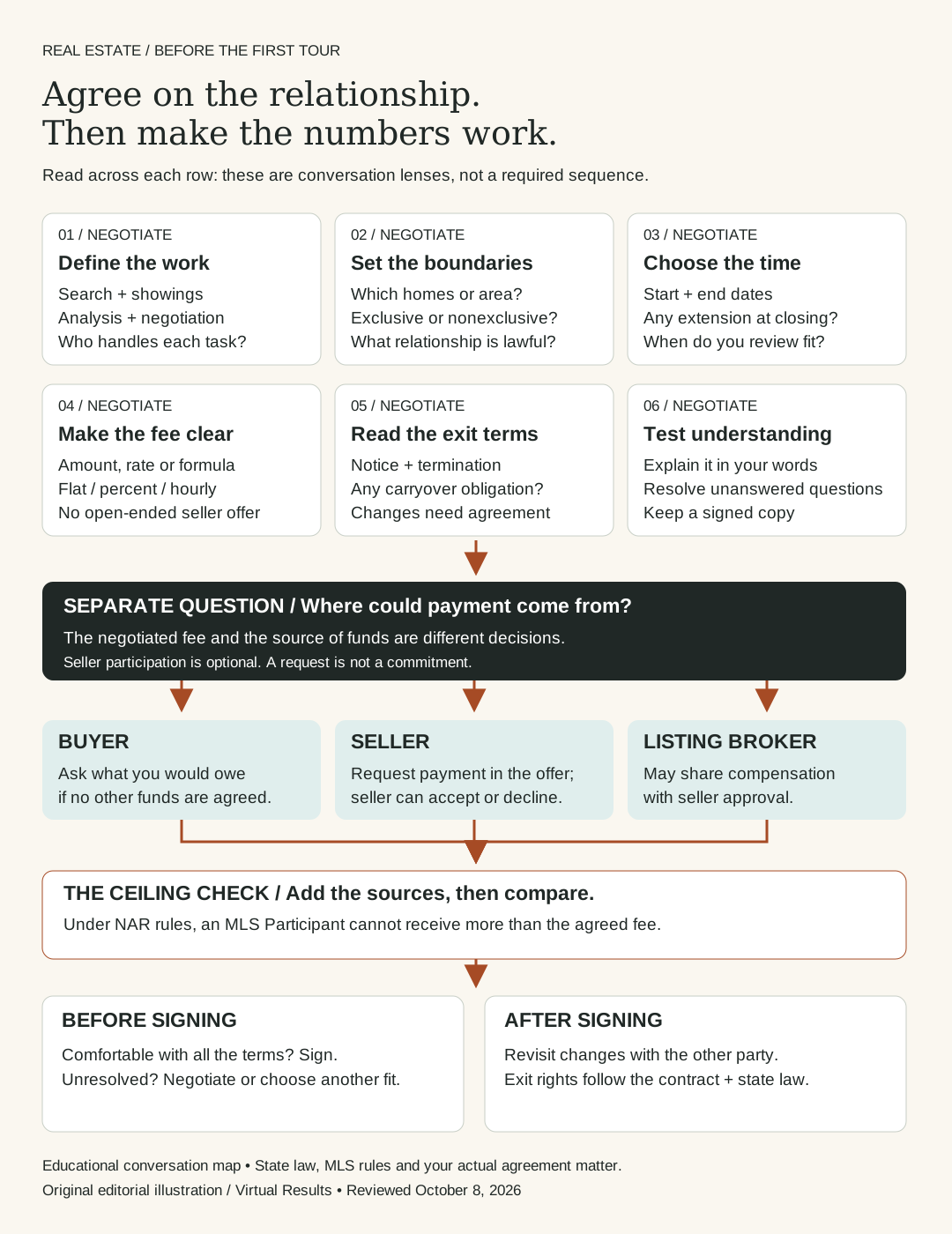
Conversation matrix with a separate payment-source map. Buyer agreements combine several questions that deserve their own space: services, boundaries, duration, the fee and exit terms. The matrix keeps those lenses side by side. The separate payment map lets you discuss who might contribute without blending the funding question into the fee you negotiated.
What it leaves out: Read the numbered panels as conversation topics, not a mandatory order of steps. This view does not show a transaction calendar or reproduce every clause of an agreement.
Open it together: Use it before a tour to ask which part of the relationship still needs discussion. If your client asks when something happens, use a timeline alongside this map.
Sources — credit where it is due.
This original visual draws on the official consumer resources below. Explore their guidance for the fuller explanation.
Read each row left to right, then follow the orange arrows. The top lenses are topics to discuss; they are not a mandatory sequence. Open the full-resolution graphic.
At a glance: services, scope, time, fee and payment sources belong in the same conversation — with each distinction clearly visible.
Diagram text version
Negotiate: services; geographic and relationship boundaries; duration; determinable fee; exit terms; understanding. Consider payment sources separately: buyer, voluntary seller payment, or listing-broker sharing with seller approval. Check total compensation against the agreed ceiling under NAR rules. Before signing, negotiate or choose another fit. After signing, review contract and state-law rights before changing or terminating.
Start with the work, not the signature
A buyer consultation works better when the agreement has a job to do: make expectations visible. Bring two short lists to the meeting. One describes the help you want; the other names decisions you prefer to make yourself. For example, you might want weekly search updates, a comparison of homes before an offer, and help organizing specialist appointments. Ask the agent to turn those requests into a clear description of services. Use the diagram to make the questions you want to discuss visible.
Read the map in three passes
First, read the six lenses at the top. They connect the work, boundaries, time, fee, exit provisions and understanding. Second, move down to the funding lane. It intentionally separates what the brokerage may receive from where funds might come from. Third, use the bottom gates to distinguish an unsigned negotiation from an existing obligation. This structure helps a buyer ask a precise question rather than treating every concern as a question about commission.
A practical way to compare agents
Use the same conversation prompts in each interview. Ask who will actually attend showings, how the agent communicates when unavailable, and what an offer analysis includes. Record answers in your own words. The goal is a meaningful comparison of service and fit. A busy buyer might prioritize rapid scheduling; a first-time buyer might prioritize explanation. Those are different needs, and a useful agreement conversation makes the differences explicit. Do not assume that an appealing presentation tells you which services are actually included.
Decide what the relationship covers
An editorial map can show a boundary; the agreement must define it. Ask about covered locations or properties, exclusivity and the type of relationship permitted locally. Discuss the duration and the point at which you will reassess whether the arrangement works. Read any extension provision alongside the end date. Ask about notice, termination and obligations that could survive termination. Under NAR policy, relationship type, duration, services and compensation type or amount are not dictated; state law and the negotiated contract still matter.
Keep the fee and the funding in different lanes
In the NAR framework, the compensation must be determinable, negotiable and disclosed. It cannot simply float to whatever a seller offers, and an MLS Participant cannot receive above the amount or rate agreed with the buyer. The map separates that ceiling from payment possibilities. A buyer can ask a seller to pay compensation; a seller may voluntarily agree or decline. A listing broker may share compensation with seller approval. Seller concessions toward buyer costs are a distinct concept. Do not turn an expected contribution into a promise before it is documented.
Stress-test the conversation without quoting a market rate
Try a hypothetical where the seller offers no payment, then one where a contribution is agreed. Ask the agent to explain which contract provisions determine your obligation in each case. Avoid treating an invented dollar figure as a typical fee. Write down the question, the answer and the clause that supports it. If the answer depends on a future negotiation, label it unresolved. Ask the lender and settlement professionals to confirm how the proposed arrangement would be documented and handled for your specific purchase.
Use the right review gate
Before signing, unanswered questions are a reason to continue the discussion. NAR’s consumer guide says either side can leave the negotiation if no acceptable agreement is reached. After signing, the question changes: what does the existing agreement allow? Terms can be changed by mutual agreement, while termination and changes may be governed by contract and state law. Keep a signed copy, record agreed amendments and seek an attorney’s help for unclear legal obligations. Keep the exit provisions beside the signed terms as you review your options.
Know when the tour requirement applies
NAR’s MLS policy requires an MLS Participant working with a buyer to have a written agreement before an in-person or live virtual home tour. Visiting an open house independently or merely discussing an agent’s services does not create the same requirement in NAR’s consumer guidance. That distinction is useful at the first conversation, but it is not a claim that every agent everywhere follows identical rules. Ask which state requirements, MLS rules and brokerage procedures apply to your situation.
Turn it into a better client conversation
An agent can open the map during a consultation, pause at each lens and invite the buyer to mark questions. A broker can use the funding lane in training to identify explanations that accidentally imply guaranteed seller payment. A designer can create a local version with approved terminology and a visible review date. The strongest adaptation preserves the separation between fee, payer, permission and obligation. Make the visual simpler to read without erasing the distinctions that help a consumer make an informed choice.
Make this a useful link.
Open this page during a buyer consultation, include it in a reading list or share the question: “Do you know the difference between the fee you agree to and who might help pay it?”
Use the title, publisher, review date and this page’s address. Keep the credit with a reproduced graphic; link to the page so readers can see the explanation and sources.
Adapt it to your practice.
Download the editable SVG. In a vector editor, change the branding, contact details and visual styling. Add the name of your market and a local review date. Have your managing broker and appropriate legal adviser check the relationship names, agreement references, notice requirements and compensation explanations before publishing. Keep any hypothetical example explicitly labeled; remove rates that could look like a standard fee.
For a short social post, use one lens with a question and a link back to the complete resource. For a consultation, open the full map together and discuss unresolved items. When you publish a modified version, label it “Adapted from Virtual Results Real Estate Publishing,” link here, identify your substantive changes and retain the official-source references. Permission is granted to share and adapt this original graphic and accompanying explanation with that attribution; it does not grant rights to third-party materials.
✦ Open it together. Make the conversation better.
Try this with a client: open the diagram during your next conversation. Start with “Where are we now?” Then ask “Which question would you like us to work through?” Let the visual guide the discussion, and keep the client’s own priorities at the center.
Pro tip: bookmark this page so you can return to it in a consultation, showing or team meeting. Give us some love: if you share or adapt it, please link back to Virtual Results Real Estate Publishing.
Make it yours with ChatGPT or Claude — including PowerPoint
Copy the prompt below and paste it into your assistant with this page’s diagram.
Create an original real estate visual based on the idea on this page. First walk me through my choices: client audience, local context, colors, shapes, level of detail, and the questions I want to explain live. Preserve the important distinctions in the explanation. Then remake the visual from scratch in my chosen style, with a clear title, readable labels and the credit “Virtual Results Real Estate Publishing” linked to this page. Give me an editable diagram and a simple browser demo with pause and restart controls if motion adds value. Also create a PowerPoint version if your tools allow it; otherwise give me exact slide-by-slide instructions, including layout, speaker notes and a source slide. Use one overview slide, then one close-up slide for each decision or stage. Suggest two questions to ask clients while we review it together.