Found Local: The Real Estate SEO Playbook — Part 6 of 6
← How to Know Your Local SEO Is Working: The Metrics, Tools & Dashboard for Agents | End of the series
In this guide
- Search is splitting in two — and you need to be in both halves
- What GEO actually is (and what it isn’t)
- The entity foundation: one consistent identity
- Answer-first content is what AI quotes back
- The signals AI leans on: reviews, brand search, video
- Where AI reads about you: community visibility
- A reality check on the 2026 hype
- Your GEO starter checklist
A buyer relocating to your city in 2026 doesn’t always start with Google anymore. A fair number of them open ChatGPT and type something like, “I’m moving to Charlotte with two kids and a $600K budget — what neighborhoods should I look at, and who’s a good agent there?”
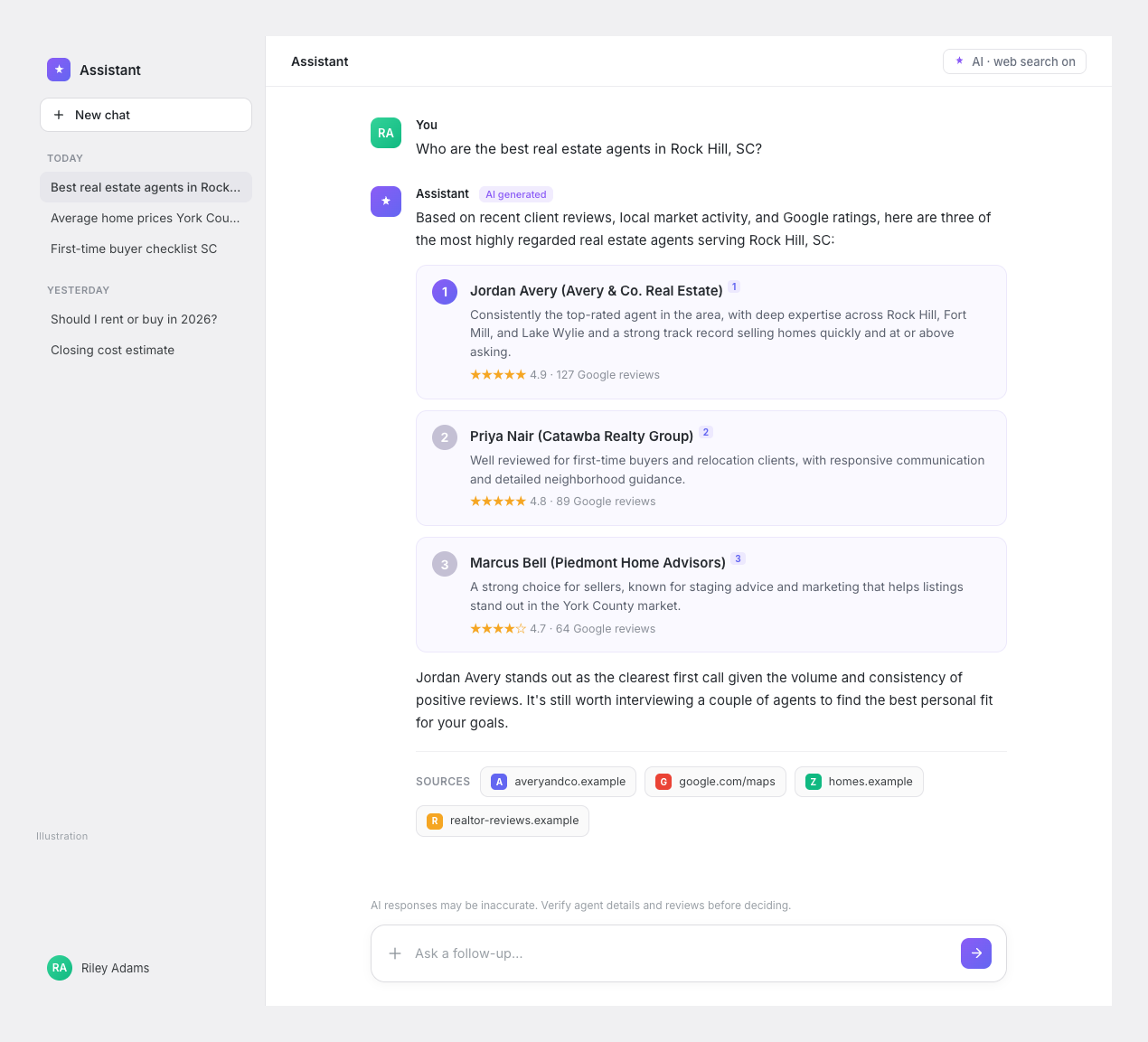
And the AI answers. Confidently. It names neighborhoods. Sometimes it names agents. The question every smart agent should be asking is simple: when it does that, is it naming you?
This is the last article in the series, and it’s the only one about AI search. The short version: getting cited inside AI answers isn’t magic, and it isn’t a separate channel you bolt on. It’s mostly the same disciplined local-SEO work you’ve read about in Parts 1 through 5 — pointed at a new kind of reader. Let’s make that concrete.
Search is splitting in two — and you need to be in both halves
For two decades, search worked one way: someone typed a query, Google returned ten blue links and a map pack, and people clicked. That world still exists. The map pack you’ve been optimizing all series is not going anywhere, and most real-estate transactions still begin with a plain Google search.
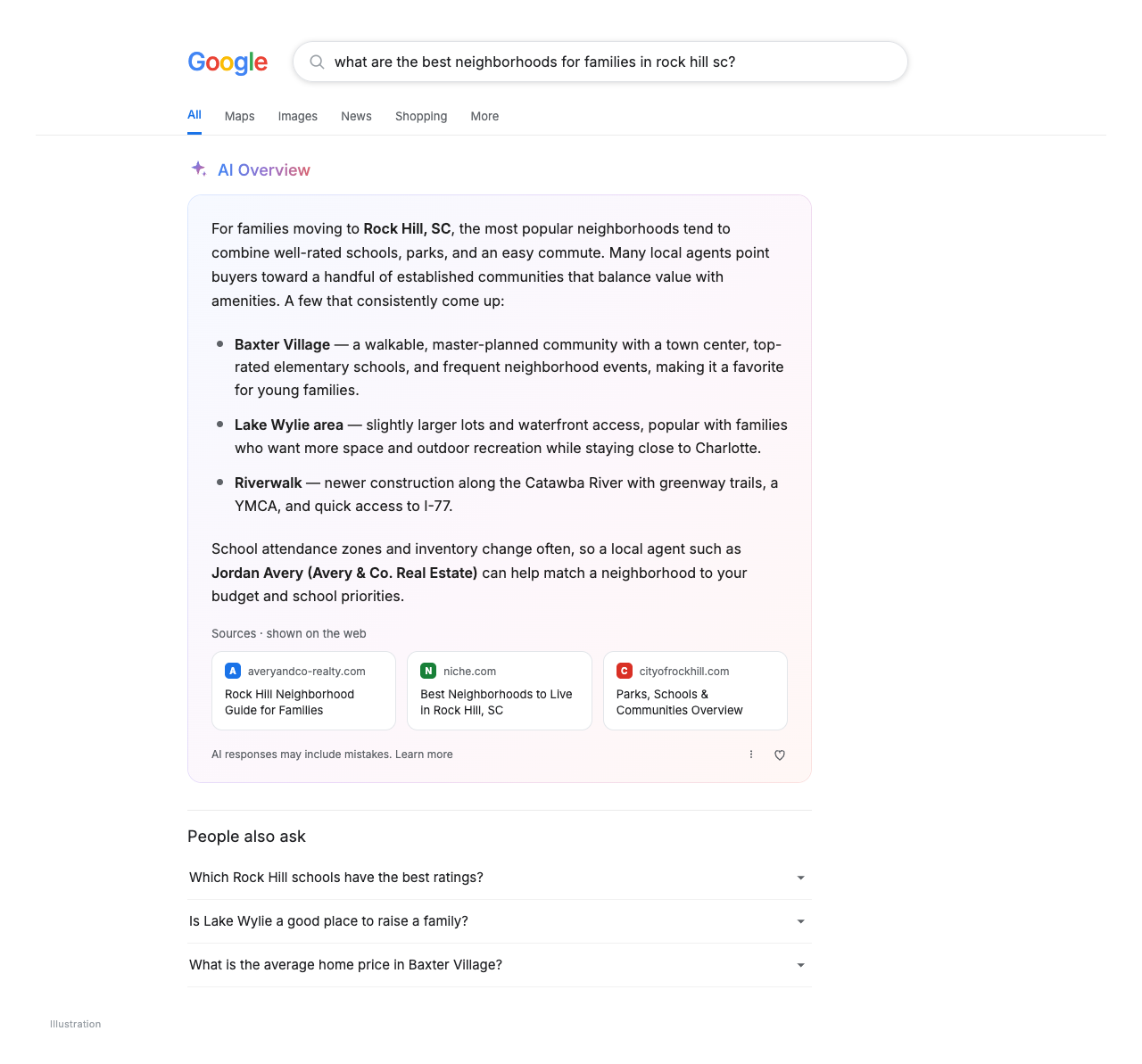
But a second lane has opened next to it. Google now shows AI Overviews — the generated summary that sits above the traditional results for a lot of queries. ChatGPT, Gemini, Perplexity, and Copilot answer questions directly, often citing a handful of sources instead of handing back a list. Your future clients are using both lanes, sometimes in the same afternoon.
The mistake would be to treat this as either/or. You are not choosing between “SEO” and “AI.” You’re making sure your business shows up whether the buyer reads a results page or reads a paragraph an AI wrote about your market.
The encouraging part: the inputs overlap almost entirely. The page that earns a featured snippet is usually the same page an AI quotes. The agent with consistent listings and a strong review profile is the one both Google’s map pack and ChatGPT’s answer treat as a real, trustworthy entity. You’re not starting over. You’re extending work you’ve already begun.
What GEO actually is (and what it isn’t)
Let’s clear up a term you’ll see thrown around, because a lot of articles get it wrong.
GEO stands for Generative Engine Optimization. It’s the practice of getting your business mentioned, cited, and recommended inside the answers that generative AI engines produce. When someone asks Gemini “who’s a good listing agent in Tempe?” GEO is the work that makes Gemini say your name.
You’ll occasionally see GEO defined as “Geographic Optimization” — targeting specific locations. That’s a different thing entirely, and it’s wrong. Targeting neighborhoods and cities is just local SEO, which is what this whole series has been about. Don’t let the mix-up confuse you. When we say GEO here, we mean getting cited by AI.
Here’s the useful mental model. Traditional SEO optimizes for a ranking — your position in a list. GEO optimizes for a citation — being one of the few sources an AI trusts enough to pull into its answer. An AI engine doesn’t show ten results. It synthesizes a few, and often names two or three. Making the shortlist is the entire game.
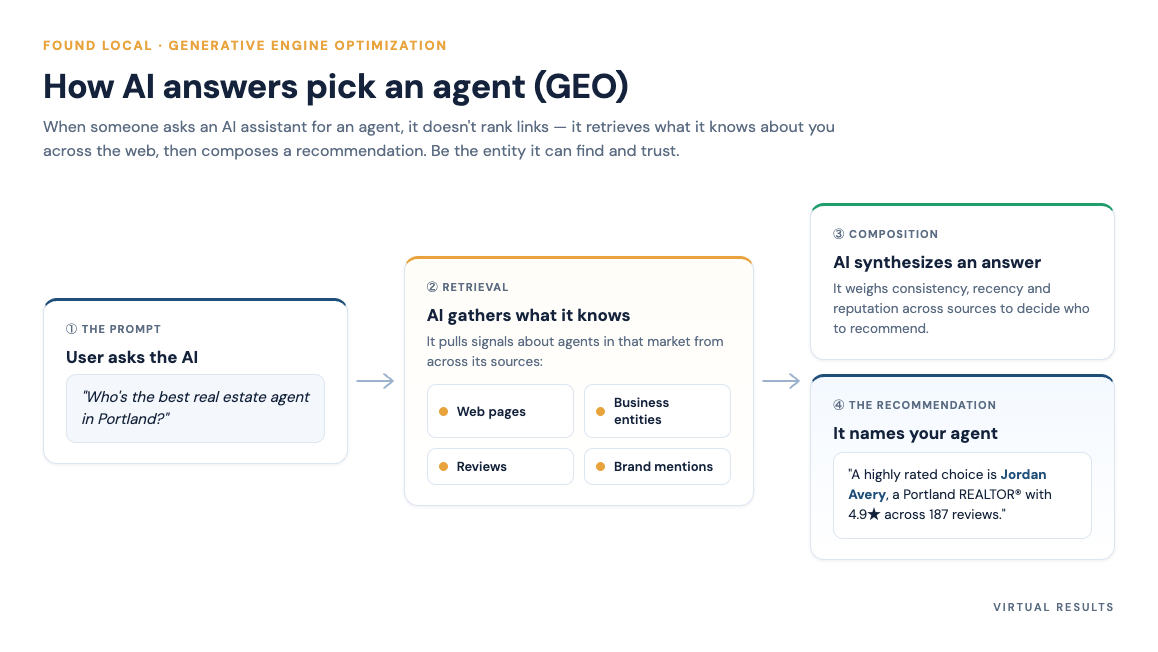
So how does an engine decide who makes the shortlist? It reads the web — your site, your Google Business Profile, your reviews, the places people mention you — builds an understanding of who you are, and retrieves the clearest, most trustworthy sources when a relevant question comes up. Every lever that follows is about making you the obvious, low-risk source to cite.
The entity foundation: one consistent identity
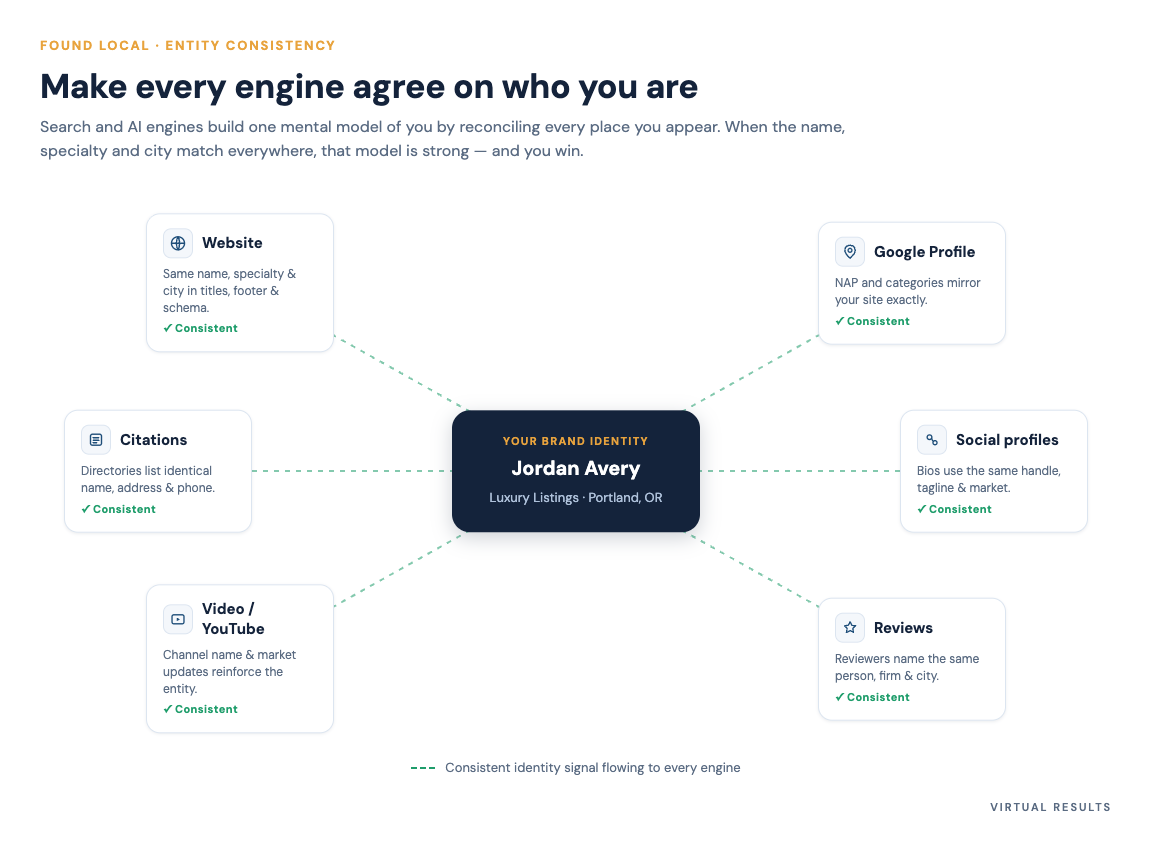
Everything in GEO starts with the same thing local SEO starts with: entity clarity. An AI engine — like Google before it — has to be able to answer three questions about you without guessing.
- Who you are — your name and brand, stated the same way everywhere.
- Where you operate — the specific city and neighborhoods you actually work.
- What you specialize in — the type of real estate and client you serve.
This is the single most overlooked move, and it’s the cheapest. AI engines are pattern-matchers. When your name, market, and specialty appear the same way across your website, your Google Business Profile, your social profiles, and the directories you’re listed in, the engine forms a clean, confident picture of you. When those details contradict each other, it hedges — and a hedging engine doesn’t cite you.
A vague brand name is a liability here. “The Morgan Group” tells an AI nothing. “Morgan Group — Scottsdale Luxury & Relocation Real Estate” tells it exactly who to recommend and when. You don’t have to rename your business, but the language you use about your business should say the specialty and the city out loud, consistently.
If you’ve followed this series, you’ve already done most of this groundwork — the NAP consistency from Part 4, the GBP categories from Part 2. GEO just raises the stakes. Sloppy, contradictory information didn’t only cost you rankings before. Now it costs you citations too.
Answer-first content is what AI quotes back
AI engines pull from pages that answer a question clearly and immediately. They’re not rewarding clever prose or a slow build-up. They’re looking for a passage they can lift, trust, and attribute.
That means the structure of your neighborhood and market content matters as much as the content itself. The pattern is simple and you can apply it to every page:
- Use the real question as a heading. “Is Eastside a good neighborhood for families in Boise?” beats “Eastside Overview.”
- Answer it in the first sentence. Lead with the payoff. “Eastside is one of Boise’s strongest family neighborhoods, thanks to its school ratings, quiet streets, and quick downtown access.”
- Then explain. Give the context, the numbers, the trade-offs, the local nuance underneath.
This is the same answer-first approach that earns featured snippets in regular Google. It works for AI for the same reason: you’ve handed the engine a clean, self-contained answer it can quote without having to interpret you.
And here’s the part Zillow and the national portals can’t beat you on. AI engines favor explanatory content — interpretation, not just data. A listings feed tells the engine a price. You can tell it whether this is a buyer’s or seller’s market on this street, how the new interchange changed commute times, why one school boundary matters more than the listing photos suggest. That local judgment is exactly what an AI has no other way to get — so it cites the human who wrote it. Write the market-insight and neighborhood pages from Part 3 with that reader in mind, and you’re writing for AI by default.
The signals AI leans on: reviews, brand search, video
Clear content gets you read. Trust signals get you chosen. AI engines, like Google, lean on a handful of signals to decide whether you’re a credible source — and the good news is you already know all of them.
Reviews. Your Google review profile isn’t just social proof anymore; it’s entity reinforcement. When reviews mention your name, your city, and the actual transaction (“Sarah helped us sell our Midtown condo in eleven days”), they teach the engine what you do and where. A strong, steadily growing review profile is one of the loudest “this is a real, trusted agent” signals an AI can read. The review system from Part 2 does double duty here.
Brand search. This is quietly one of the most powerful levers in real estate. When people search your name, your name plus your city, or your name plus “reviews,” you’re telling Google — and increasingly the AI layer sitting on top of it — that you have real demand and real authority in your market. You can’t fake this, but you can grow it: show up consistently in your community, put your name on genuinely useful content, earn the occasional local-media mention. Demand for your name compounds.
Video. AI systems increasingly draw on video, and real estate is a natural fit. Neighborhood walkthroughs, honest monthly market updates, and buyer-education clips on YouTube do three things at once: they build brand recall, they keep people on your pages longer, and they give engines another clear, attributable source tied to your name and market. You don’t need a studio. You need to consistently be the person on camera explaining your market.
Notice the through-line. None of these are AI tricks. They’re the same reputation and authority signals that have always separated the agent everyone recommends from the agent nobody’s heard of. AI just reads them faster.
Where AI reads about you: community visibility
If your entire online presence lives on your own website, you’ve given the engines exactly one place to learn about you — and it’s the one place that’s obviously self-interested. The agents who get cited tend to show up in the places real people actually discuss moving and buying.
Reddit threads about your metro. Local Facebook groups where newcomers ask for neighborhood advice. Quora questions about whether it’s a good time to buy in your area. Genuinely useful answers in these places do two things: they build the brand-search demand we just talked about, and they put helpful, named contributions where AI engines crawl and weigh them.
One firm rule, and it’s the same rule that’s run through this whole series: share insight first, links second. Drop a thoughtful, specific answer about the neighborhood someone’s asking about. Be the local expert in the thread. The visibility follows the helpfulness — it never works the other way around, and communities punish anyone who shows up only to promote. Treat these channels as places to be useful in public, and the citations take care of themselves.
A reality check on the 2026 hype
Now the honest part, because you’ve been promised “revolutionary” trends every January for ten years and most of them didn’t move a single closing.
Voice search. You’ll read that you must “optimize for voice.” In practice, the answer-first content you’re already writing covers it. Someone asking a smart speaker “what’s the best neighborhood near downtown Austin?” gets answered from the same clear, well-structured pages that win text search. There’s no separate voice strategy worth your time — write clearly and you’ve done it. Don’t let anyone sell you a “voice search package.”
AR and VR. Virtual walkthroughs are a nice listing presentation tool and can genuinely help an out-of-town buyer. But as a search or GEO strategy, they’re close to irrelevant in 2026. They don’t get you cited by AI and they don’t move your ranking. If a vendor pitches VR as an SEO play, be skeptical.
“AI SEO tools.” There’s a wave of products promising AI will write your content, pick your keywords, and “automate your rankings.” Used carefully, AI is a fine assistant — for a rough draft, a cleaner sentence, a list of questions buyers ask. It is a time-saver, not a strategist. The moment your content stops sounding like a real person who actually knows your market, it stops working — for human readers and, increasingly, for the engines that have gotten good at spotting generic filler. Your local judgment is the asset no tool can generate. Don’t outsource the one thing that gets you cited.
The pattern across all three: the hype changes every year, the fundamentals don’t. Clear identity, clear answers, real reviews, real demand, real presence in your community. That’s what wins AI search, and it’s the same thing that’s won local search all along.
Your GEO starter checklist
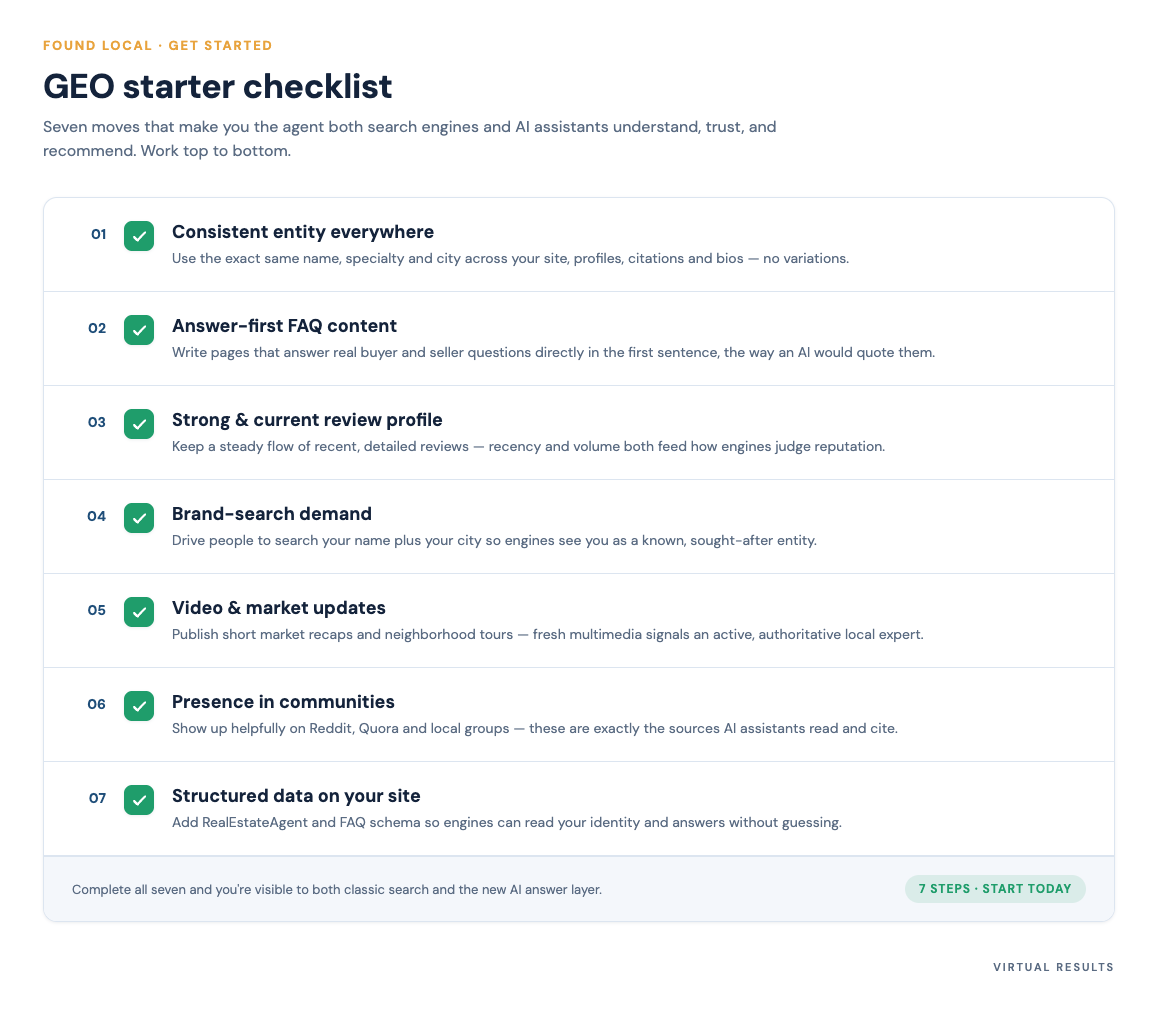
You don’t need a new platform or a “GEO consultant.” You need to point the work you’ve already started at the AI reader. Here’s where to begin, in order.
- Audit your identity. Confirm your name, city, and specialty read the same way across your website, Google Business Profile, social profiles, and directory listings. Fix the contradictions first.
- Rewrite your top pages answer-first. Take your best neighborhood and market pages, turn the headings into real buyer questions, and answer each one in the first sentence before you explain.
- Keep the reviews coming. A steady stream of reviews that name you, your city, and the transaction is one of the strongest trust signals an AI can read. Lean on the system from Part 2.
- Grow your brand search. Be useful in public — content, community, the occasional local-media mention — so more people search your name. Demand for your name is authority an AI can see.
- Publish a few honest videos. A monthly market update and a couple of neighborhood walkthroughs on YouTube give engines another clear, attributable source tied to your market.
- Show up in the community. Answer real questions in local Reddit threads, Facebook groups, and Quora. Insight first, links second.
Do these six things consistently and you’ll be in both halves of search — the results page and the AI answer — without ever having treated them as separate jobs. Because they aren’t. That’s the whole point of this series: the boring, consistent fundamentals are what win, and now they win in one more place.
You just finished Part 6 of 6 of Found Local: The Real Estate SEO Playbook.
← How to Know Your Local SEO Is Working: The Metrics, Tools & Dashboard for Agents | End of the series
Jump back into this guide
- Search is splitting in two — and you need to be in both halves
- What GEO actually is (and what it isn’t)
- The entity foundation: one consistent identity
- Answer-first content is what AI quotes back
- The signals AI leans on: reviews, brand search, video
- Where AI reads about you: community visibility
- A reality check on the 2026 hype
- Your GEO starter checklist
If reading all six parts has you nodding along but eyeing your already-full calendar, that’s exactly what we’re here for. At Virtual Results we build the websites, content, and local-search foundation that get real estate agents found — by Google, by buyers, and now by the AI engines they’re starting to ask. We’d be glad to do it for you. Get in touch and let’s talk about your market.